

359
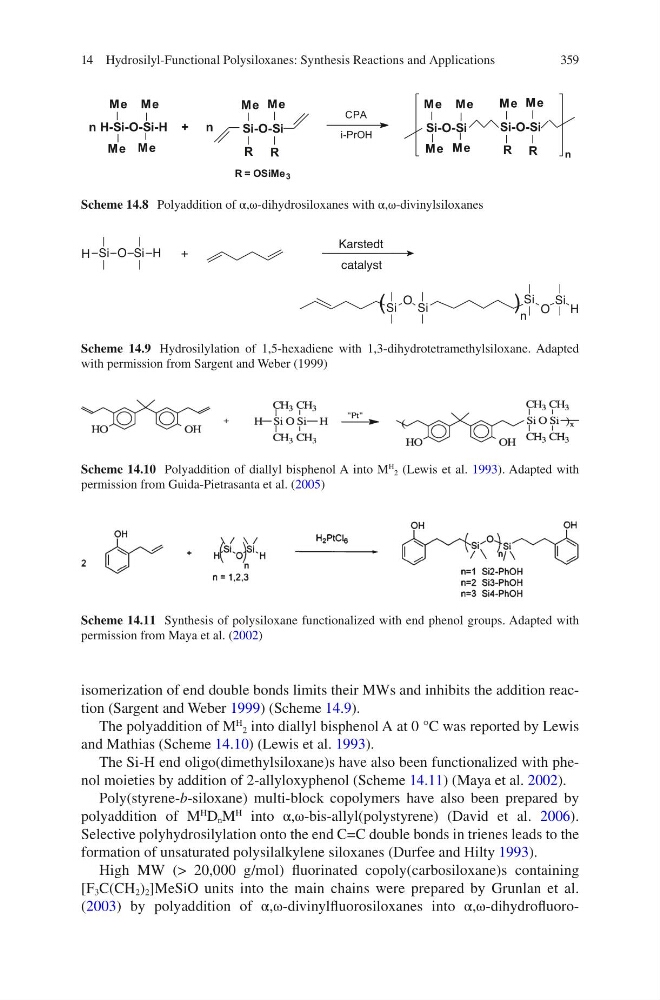
isomerization of end double bonds limits their MWs and inhibits the addition reaction (Sargent and Weber 1999) (Scheme 14.9).
The polyaddition of M
H 2 into diallyl bisphenol A at 0 °C was reported by Lewis
and Mathias (Scheme 14.10) (Lewis et al. 1993).
The Si-H end oligo(dimethylsiloxane)s have also been functionalized with phenol moieties by addition of 2-allyloxyphenol (Scheme 14.11) (Maya et al. 2002).
Poly(styrene-b-siloxane) multi-block copolymers have also been prepared by
polyaddition of M
H
D n M
H
into α,ω-bis-allyl(polystyrene) (David et al. 2006).
Selective polyhydrosilylation onto the end C=C double bonds in trienes leads to the
formation of unsaturated polysilalkylene siloxanes (Durfee and Hilty 1993).
High MW (> 20,000 g/mol) fluorinated copoly(carbosiloxane)s containing
[F 3 C(CH 2 ) 2 ]MeSiO units into the main chains were prepared by Grunlan et al.
(2003) by polyaddition of α,ω-divinylfluorosiloxanes into α,ω-dihydrofluoron H-Si-O-Si-H + n
Me Me
Me Me
Si-O-Si
Me
Me
R R
CPA
i-PrOH
Me
Me
Me
Me
Si-O-Si
R = OSiMe 3
R
R
Me Me
Si-O-Si
n
Scheme 14.8 Polyaddition of α,ω-dihydrosiloxanes with α,ω-divinylsiloxanes
H Si
Si
O
H
+
Karstedt
catalyst
Si
Si
(
) Si Si
O
O
H
n
Scheme 14.9 Hydrosilylation of 1,5-hexadiene with 1,3-dihydrotetramethylsiloxane. Adapted
with permission from Sargent and Weber (1999)
Scheme 14.10 Polyaddition of diallyl bisphenol A into M
H 2 (Lewis et al. 1993). Adapted with
permission from Guida-Pietrasanta et al. (2005)
Scheme 14.11 Synthesis of polysiloxane functionalized with end phenol groups. Adapted with
permission from Maya et al. (2002)
14 Hydrosilyl-Functional Polysiloxanes: Synthesis Reactions and Applications