

358
films was tailored by changing a mole ratio of D
H
and T
H
units in monomers: from
50/50 to 95/5 (mol.%). Similarly, homogeneous thin films of the elastomeric PMHS
network were formed using a D
H
/T
H
ratio: 85/5–99/1 (mol. %). A mixture of the
monomers was polymerized in the presence of 0.05% TFA in ethanol (using molar
ratio: [EtOH]/[Si] = 1 and hydrolysis ratio: h = [H 2 O]/[SiOEt] = 0.5). The layers of
the submicrometer thickness were cured at 100 °C. Thin sol-gel films of PMHS soft
networks containing less than 5% of T
H
units were also grafted onto silica, followed
by functionalization through hydrosilylation of 1-alkenes (CH 2 = CH(CH 2 ) n-2 CH 3
(n = 5, 11, 17)) with Si-H groups, which led to the polysiloxane network with
n-alkyl pendant chains. The surface-anchored films were chemically stable and
covalently bonded to the silica surface. PMHS gel powders were also hydrosilylated
with 1-alkenes. The crystallization of the long n-octadecyl and n-dodecyl chains has
also been observed in the modified polysiloxane coatings (Thami et al. 2008).
The copolymers of silicones with organic polymers (‘hybrid silicones’) have also
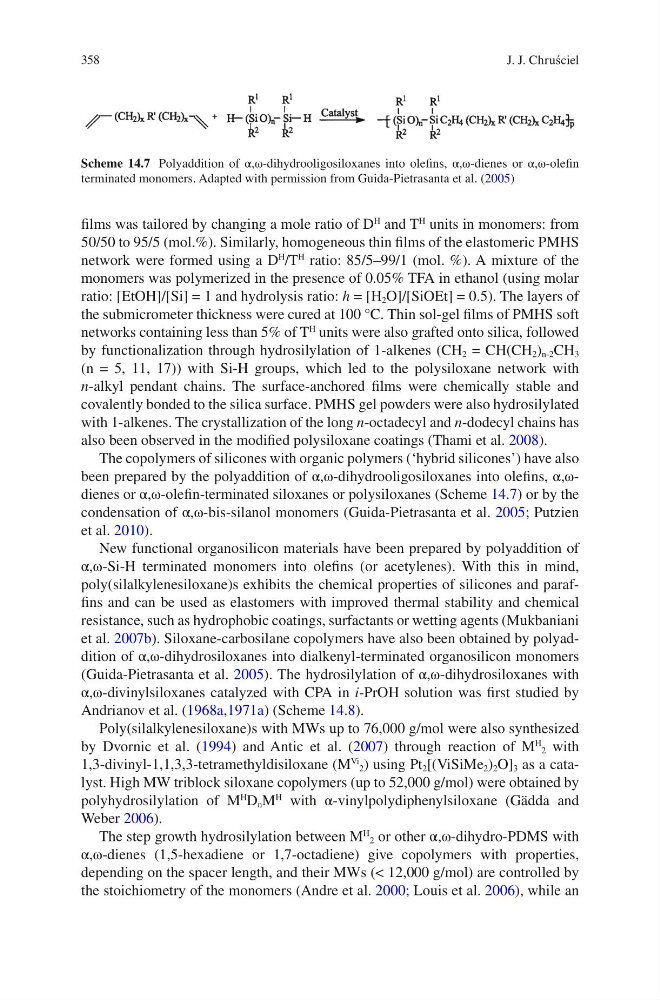
been prepared by the polyaddition of α,ω-dihydrooligosiloxanes into olefins, α,ωdienes or α,ω-olefin-terminated siloxanes or polysiloxanes (Scheme 14.7) or by the
condensation of α,ω-bis-silanol monomers (Guida-Pietrasanta et al. 2005; Putzien
et al. 2010).
New functional organosilicon materials have been prepared by polyaddition of
α,ω- Si- H terminated monomers into olefins (or acetylenes). With this in mind,
poly(silalkylenesiloxane)s exhibits the chemical properties of silicones and paraffins and can be used as elastomers with improved thermal stability and chemical
resistance, such as hydrophobic coatings, surfactants or wetting agents (Mukbaniani
et al. 2007b). Siloxane-carbosilane copolymers have also been obtained by polyaddition of α,ω-dihydrosiloxanes into dialkenyl-terminated organosilicon monomers
(Guida- Pietrasanta et al. 2005). The hydrosilylation of α,ω-dihydrosiloxanes with
α,ω- divinylsiloxanes catalyzed with CPA in i-PrOH solution was first studied by
Andrianov et al. (1968a,1971a) (Scheme 14.8).
Poly(silalkylenesiloxane)s with MWs up to 76,000 g/mol were also synthesized
by Dvornic et al. (1994) and Antic et al. (2007) through reaction of M
H 2 with
1,3-divinyl-1,1,3,3-tetramethyldisiloxane (M
Vi
2 ) using Pt 2 [(ViSiMe 2 ) 2 O] 3 as a catalyst. High MW triblock siloxane copolymers (up to 52,000 g/mol) were obtained by
polyhydrosilylation of M
H
D n M
H
with α-vinylpolydiphenylsiloxane (Gädda and
Weber 2006).
The step growth hydrosilylation between M
H 2 or other α,ω-dihydro-PDMS with
α,ω-dienes (1,5-hexadiene or 1,7-octadiene) give copolymers with properties,
depending on the spacer length, and their MWs (< 12,000 g/mol) are controlled by
the stoichiometry of the monomers (Andre et al. 2000; Louis et al. 2006), while an
Scheme 14.7 Polyaddition of α,ω-dihydrooligosiloxanes into olefins, α,ω-dienes or α,ω-olefin
terminated monomers. Adapted with permission from Guida-Pietrasanta et al. (2005)
J. J. Chruściel