

349
14.5 PHS and PMHS Reactions
The energy of the Si-H bond is in the range from ~318 to ~419 kJ/mol, and depends
on the chemical structure of silicon compounds (Eaborn 1960; Bażant et al. 1965;
Brook 2000), and is less than the energy of the C-H bond (~413–420 kJ/mol)
(Colvin 1981; Walsh 1981; Marciniec et al. 1992; White 1995). A bigger ionic
(atomic) radius of silicon [r Si = 1.06 Å (1.17 Å)] than the carbon atom [r C = 0,66 Å
(0.77 Å)] and a low size of hydrogen atom, causing a steric hindrance in the silicon
center, which is lower than in the C atom. A length of the Si-H bond (1.48 Å) is
greater than in the case of C-H bond (1.09 Å). The Si atom is not only more positive
(1.8 according to a Pauling’s scale) than C atom (2.5), but also more positive than H
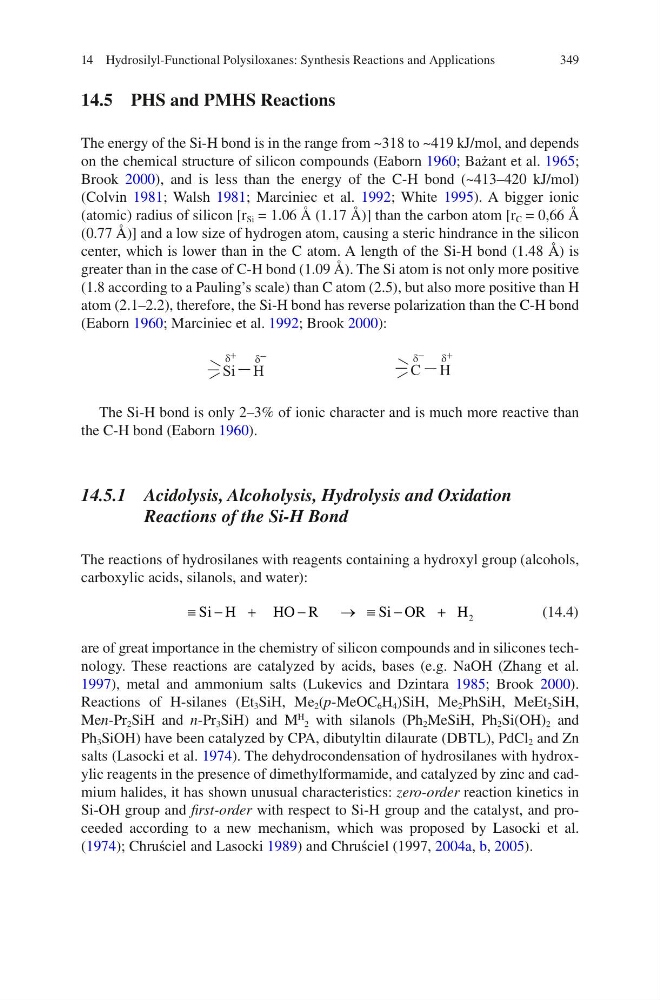
atom (2.1–2.2), therefore, the Si-H bond has reverse polarization than the C-H bond
(Eaborn 1960; Marciniec et al. 1992; Brook 2000):
H
C
δ +
δ −
H
Si
δ +
δ −
The Si-H bond is only 2–3% of ionic character and is much more reactive than
the C-H bond (Eaborn 1960).
14.5.1 Acidolysis, Alcoholysis, Hydrolysis and Oxidation
Reactions of the Si-H Bond
The reactions of hydrosilanes with reagents containing a hydroxyl group (alcohols,
carboxylic acids, silanols, and water):
≡ −
−
≡ −
Si H
HO R
Si OR
H
+
→
+
2
(14.4)
are of great importance in the chemistry of silicon compounds and in silicones technology. These reactions are catalyzed by acids, bases (e.g. NaOH (Zhang et al.
1997), metal and ammonium salts (Lukevics and Dzintara 1985; Brook 2000).
Reactions of H-silanes (Et 3 SiH, Me 2 (p-MeOC 6 H 4 )SiH, Me 2 PhSiH, MeEt 2 SiH,
Men-Pr 2 SiH and n-Pr 3 SiH) and M
H 2 with silanols (Ph 2 MeSiH, Ph 2 Si(OH) 2 and
Ph 3 SiOH) have been catalyzed by CPA, dibutyltin dilaurate (DBTL), PdCl 2 and Zn
salts (Lasocki et al. 1974). The dehydrocondensation of hydrosilanes with hydroxylic reagents in the presence of dimethylformamide, and catalyzed by zinc and cadmium halides, it has shown unusual characteristics: zero-order reaction kinetics in
Si-OH group and first-order with respect to Si-H group and the catalyst, and proceeded according to a new mechanism, which was proposed by Lasocki et al.
(1974); Chruściel and Lasocki 1989) and Chruściel (1997, 2004a, b, 2005).
14 Hydrosilyl-Functional Polysiloxanes: Synthesis Reactions and Applications