

348
B(OH) 3 + 3 Me 2 SiCl 2
Et 2 O
Et 2 O
reflux
B(OSiMe 2 Cl) 3 + 3 HCl
"precursor"
x B(OSiMe 2 Cl) + m Me
+ n MeHSiCl 2 + y Me 3 SiCl
H 2 O/Et 2 O
0 °C
POLY(METHYLHYDROBOROSILOXANES)
x B(OSiMe 2 Cl) 3
2 SiCl 2
2
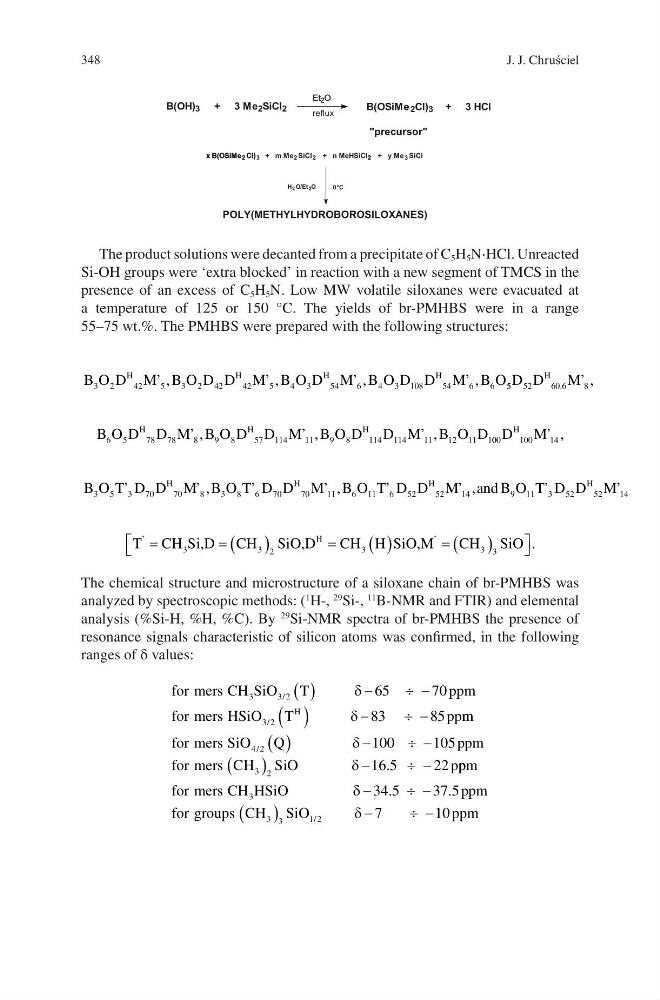
The product solutions were decanted from a precipitate of C 5 H 5 N⋅HCl. Unreacted
Si-OH groups were ‘extra blocked’ in reaction with a new segment of TMCS in the
presence of an excess of C 5 H 5 N. Low MW volatile siloxanes were evacuated at
a temperature of 125 or 150 °C. The yields of br-PMHBS were in a range
55–75 wt.%. The PMHBS were prepared with the following structures:
B O D M B O D D M B O D M B O D D M B O
H
H
H
H
3 2
42
5
3 2 42
4 2
5
4 3
54
6
4 3 108
54
6
6
’ ,
’ ,
’ ,
’ ,
5 5 52
6 0 6
8
D D
M ,
H
.
’
B O D D M B O D D M B O D D M B O D
H
H
H
6 5
78 78
8
9 8
5 7 114
11
9 8
114 114
11
12 11 1
’ ,
’ ,
’ ,
0 00
100
14
D M ,
H
’
B O T D D M B O T D D M B O T D D M a
H
H
H
3 5
3
70
7 0
8
3 8
6
70
7 0
1 1
6 11
6
52
5 2
1 4
’
’,
’
’ ,
’
’ , n nd B O T D D M
H
9 11
3
52
52
14
’
’
T CH Si,D CH SiO,D
CH H SiO,M
CH SiO .
H
’
’
=
=(
)
=
( )
= ( )
3
3 2
3
3 3
The chemical structure and microstructure of a siloxane chain of br-PMHBS was
analyzed by spectroscopic methods: (
1
H-,
29
Si-,
11
B-NMR and FTIR) and elemental
analysis (%Si-H, %H, %C). By
29
Si-NMR spectra of br-PMHBS the presence of
resonance signals characteristic of silicon atoms was confirmed, in the following
ranges of δ values:
for mers CH SiO
T
ppm
for mers HSiO
T
pp
H
3
32
3 2
65
70
83
85
/
/
( )
( )
δ −
÷ −
δ −
÷ −
m m
for mers SiO
Q
ppm
for mers CH SiO
p
4 2
3 2
100
105
16 5
22
/
.
( )
( )
δ −
÷ −
δ −
÷ −
p pm
for mers CH HSiO
ppm
for groups CH SiO
3
3 3
1 2
34 5
37 5
7
δ −
÷ −
δ −
÷ −
.
.
/
( )
1 10 ppm
J. J. Chruściel