

259
analyzed by Ohm et al. (2012) in terms of specific aspects, compared to organic
networks.
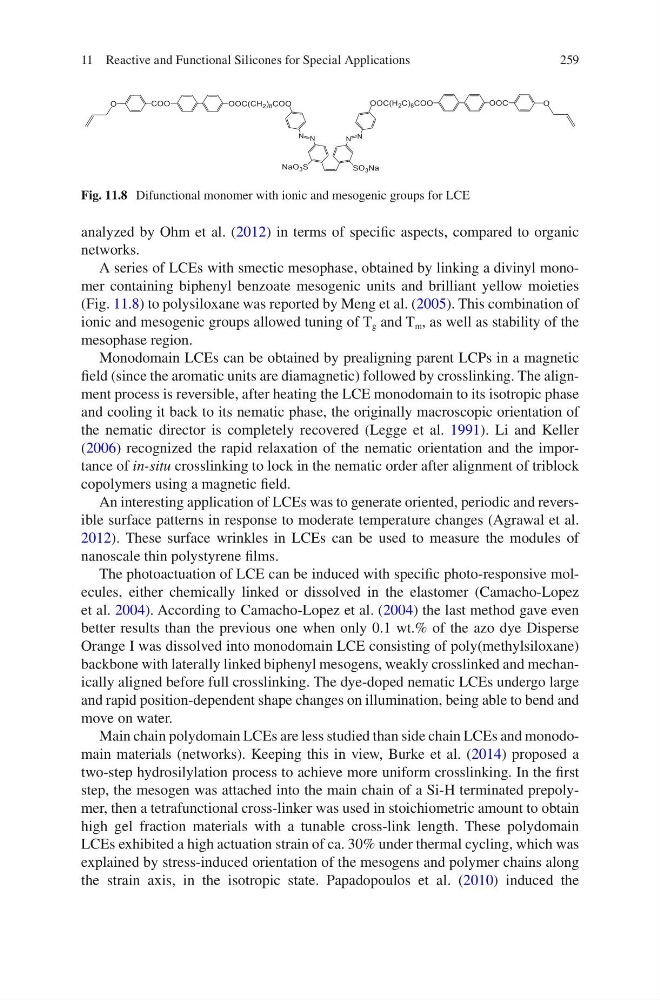
A series of LCEs with smectic mesophase, obtained by linking a divinyl monomer containing biphenyl benzoate mesogenic units and brilliant yellow moieties
(Fig. 11.8) to polysiloxane was reported by Meng et al. (2005). This combination of
ionic and mesogenic groups allowed tuning of T g and T m , as well as stability of the
mesophase region.
Monodomain LCEs can be obtained by prealigning parent LCPs in a magnetic
field (since the aromatic units are diamagnetic) followed by crosslinking. The alignment process is reversible, after heating the LCE monodomain to its isotropic phase
and cooling it back to its nematic phase, the originally macroscopic orientation of
the nematic director is completely recovered (Legge et al. 1991). Li and Keller
(2006) recognized the rapid relaxation of the nematic orientation and the importance of in-situ crosslinking to lock in the nematic order after alignment of triblock
copolymers using a magnetic field.
An interesting application of LCEs was to generate oriented, periodic and reversible surface patterns in response to moderate temperature changes (Agrawal et al.
2012). These surface wrinkles in LCEs can be used to measure the modules of
nanoscale thin polystyrene films.
The photoactuation of LCE can be induced with specific photo-responsive molecules, either chemically linked or dissolved in the elastomer (Camacho-Lopez
et al. 2004). According to Camacho-Lopez et al. (2004) the last method gave even
better results than the previous one when only 0.1 wt.% of the azo dye Disperse
Orange I was dissolved into monodomain LCE consisting of poly(methylsiloxane)
backbone with laterally linked biphenyl mesogens, weakly crosslinked and mechanically aligned before full crosslinking. The dye-doped nematic LCEs undergo large
and rapid position-dependent shape changes on illumination, being able to bend and
move on water.
Main chain polydomain LCEs are less studied than side chain LCEs and monodomain materials (networks). Keeping this in view, Burke et al. (2014) proposed a
two-step hydrosilylation process to achieve more uniform crosslinking. In the first
step, the mesogen was attached into the main chain of a Si-H terminated prepolymer, then a tetrafunctional cross-linker was used in stoichiometric amount to obtain
high gel fraction materials with a tunable cross-link length. These polydomain
LCEs exhibited a high actuation strain of ca. 30% under thermal cycling, which was
explained by stress-induced orientation of the mesogens and polymer chains along
the strain axis, in the isotropic state. Papadopoulos et al. (2010) induced the
Fig. 11.8 Difunctional monomer with ionic and mesogenic groups for LCE
11 Reactive and Functional Silicones for Special Applications
analyzed by Ohm et al. (2012) in terms of specific aspects, compared to organic
networks.
A series of LCEs with smectic mesophase, obtained by linking a divinyl monomer containing biphenyl benzoate mesogenic units and brilliant yellow moieties
(Fig. 11.8) to polysiloxane was reported by Meng et al. (2005). This combination of
ionic and mesogenic groups allowed tuning of T g and T m , as well as stability of the
mesophase region.
Monodomain LCEs can be obtained by prealigning parent LCPs in a magnetic
field (since the aromatic units are diamagnetic) followed by crosslinking. The alignment process is reversible, after heating the LCE monodomain to its isotropic phase
and cooling it back to its nematic phase, the originally macroscopic orientation of
the nematic director is completely recovered (Legge et al. 1991). Li and Keller
(2006) recognized the rapid relaxation of the nematic orientation and the importance of in-situ crosslinking to lock in the nematic order after alignment of triblock
copolymers using a magnetic field.
An interesting application of LCEs was to generate oriented, periodic and reversible surface patterns in response to moderate temperature changes (Agrawal et al.
2012). These surface wrinkles in LCEs can be used to measure the modules of
nanoscale thin polystyrene films.
The photoactuation of LCE can be induced with specific photo-responsive molecules, either chemically linked or dissolved in the elastomer (Camacho-Lopez
et al. 2004). According to Camacho-Lopez et al. (2004) the last method gave even
better results than the previous one when only 0.1 wt.% of the azo dye Disperse
Orange I was dissolved into monodomain LCE consisting of poly(methylsiloxane)
backbone with laterally linked biphenyl mesogens, weakly crosslinked and mechanically aligned before full crosslinking. The dye-doped nematic LCEs undergo large
and rapid position-dependent shape changes on illumination, being able to bend and
move on water.
Main chain polydomain LCEs are less studied than side chain LCEs and monodomain materials (networks). Keeping this in view, Burke et al. (2014) proposed a
two-step hydrosilylation process to achieve more uniform crosslinking. In the first
step, the mesogen was attached into the main chain of a Si-H terminated prepolymer, then a tetrafunctional cross-linker was used in stoichiometric amount to obtain
high gel fraction materials with a tunable cross-link length. These polydomain
LCEs exhibited a high actuation strain of ca. 30% under thermal cycling, which was
explained by stress-induced orientation of the mesogens and polymer chains along
the strain axis, in the isotropic state. Papadopoulos et al. (2010) induced the
Fig. 11.8 Difunctional monomer with ionic and mesogenic groups for LCE
11 Reactive and Functional Silicones for Special Applications