

258
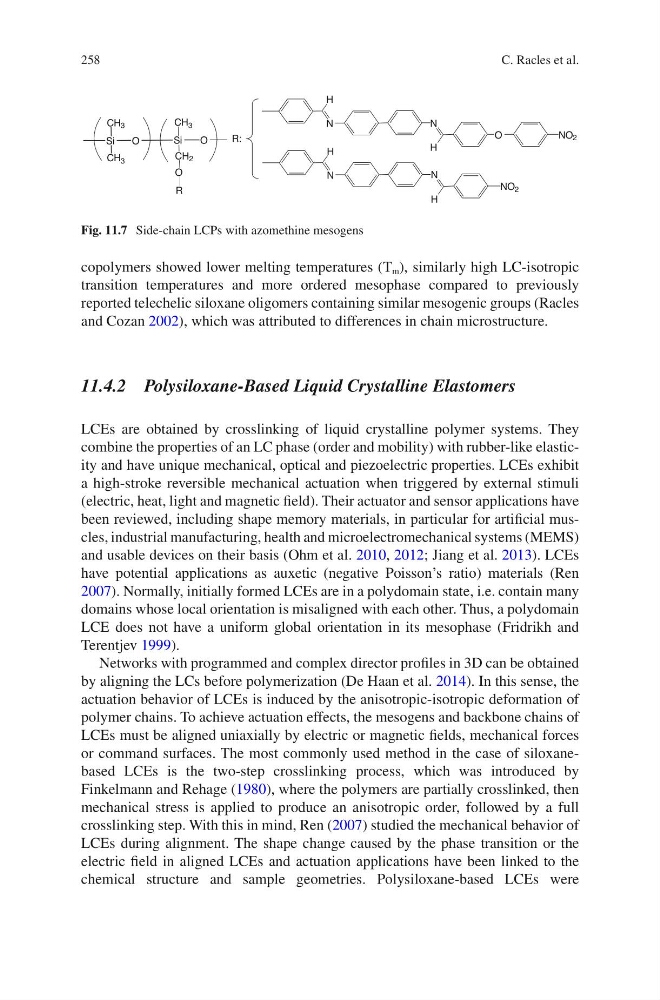
copolymers showed lower melting temperatures (T m ), similarly high LC-isotropic
transition temperatures and more ordered mesophase compared to previously
reported telechelic siloxane oligomers containing similar mesogenic groups (Racles
and Cozan 2002), which was attributed to differences in chain microstructure.
11.4.2 Polysiloxane-Based Liquid Crystalline Elastomers
LCEs are obtained by crosslinking of liquid crystalline polymer systems. They
combine the properties of an LC phase (order and mobility) with rubber-like elasticity and have unique mechanical, optical and piezoelectric properties. LCEs exhibit
a high-stroke reversible mechanical actuation when triggered by external stimuli
(electric, heat, light and magnetic field). Their actuator and sensor applications have
been reviewed, including shape memory materials, in particular for artificial muscles, industrial manufacturing, health and microelectromechanical systems (MEMS)
and usable devices on their basis (Ohm et al. 2010, 2012; Jiang et al. 2013). LCEs
have potential applications as auxetic (negative Poisson’s ratio) materials (Ren
2007). Normally, initially formed LCEs are in a polydomain state, i.e. contain many
domains whose local orientation is misaligned with each other. Thus, a polydomain
LCE does not have a uniform global orientation in its mesophase (Fridrikh and
Terentjev 1999).
Networks with programmed and complex director profiles in 3D can be obtained
by aligning the LCs before polymerization (De Haan et al. 2014). In this sense, the
actuation behavior of LCEs is induced by the anisotropic-isotropic deformation of
polymer chains. To achieve actuation effects, the mesogens and backbone chains of
LCEs must be aligned uniaxially by electric or magnetic fields, mechanical forces
or command surfaces. The most commonly used method in the case of siloxanebased LCEs is the two-step crosslinking process, which was introduced by
Finkelmann and Rehage (1980), where the polymers are partially crosslinked, then
mechanical stress is applied to produce an anisotropic order, followed by a full
crosslinking step. With this in mind, Ren (2007) studied the mechanical behavior of
LCEs during alignment. The shape change caused by the phase transition or the
electric field in aligned LCEs and actuation applications have been linked to the
chemical structure and sample geometries. Polysiloxane-based LCEs were
Si
CH 3
O
Si
CH 3
O
CH 3
CH 2
O
R
N
H
N
H
O
N
H
N
H
NO 2
NO 2
R:
Fig. 11.7 Side-chain LCPs with azomethine mesogens
C. Racles et al.
copolymers showed lower melting temperatures (T m ), similarly high LC-isotropic
transition temperatures and more ordered mesophase compared to previously
reported telechelic siloxane oligomers containing similar mesogenic groups (Racles
and Cozan 2002), which was attributed to differences in chain microstructure.
11.4.2 Polysiloxane-Based Liquid Crystalline Elastomers
LCEs are obtained by crosslinking of liquid crystalline polymer systems. They
combine the properties of an LC phase (order and mobility) with rubber-like elasticity and have unique mechanical, optical and piezoelectric properties. LCEs exhibit
a high-stroke reversible mechanical actuation when triggered by external stimuli
(electric, heat, light and magnetic field). Their actuator and sensor applications have
been reviewed, including shape memory materials, in particular for artificial muscles, industrial manufacturing, health and microelectromechanical systems (MEMS)
and usable devices on their basis (Ohm et al. 2010, 2012; Jiang et al. 2013). LCEs
have potential applications as auxetic (negative Poisson’s ratio) materials (Ren
2007). Normally, initially formed LCEs are in a polydomain state, i.e. contain many
domains whose local orientation is misaligned with each other. Thus, a polydomain
LCE does not have a uniform global orientation in its mesophase (Fridrikh and
Terentjev 1999).
Networks with programmed and complex director profiles in 3D can be obtained
by aligning the LCs before polymerization (De Haan et al. 2014). In this sense, the
actuation behavior of LCEs is induced by the anisotropic-isotropic deformation of
polymer chains. To achieve actuation effects, the mesogens and backbone chains of
LCEs must be aligned uniaxially by electric or magnetic fields, mechanical forces
or command surfaces. The most commonly used method in the case of siloxanebased LCEs is the two-step crosslinking process, which was introduced by
Finkelmann and Rehage (1980), where the polymers are partially crosslinked, then
mechanical stress is applied to produce an anisotropic order, followed by a full
crosslinking step. With this in mind, Ren (2007) studied the mechanical behavior of
LCEs during alignment. The shape change caused by the phase transition or the
electric field in aligned LCEs and actuation applications have been linked to the
chemical structure and sample geometries. Polysiloxane-based LCEs were
Si
CH 3
O
Si
CH 3
O
CH 3
CH 2
O
R
N
H
N
H
O
N
H
N
H
NO 2
NO 2
R:
Fig. 11.7 Side-chain LCPs with azomethine mesogens
C. Racles et al.