

248
smart category. When a dielectric elastomer film is between two electrodes to which
an electric field is applied, the Coulomb forces that are developed compress the
elastomer in the section causing its lateral expansion due to its incompressibility
(Carpi et al. 2011). This response known as actuation is directly proportional to the
dielectric permittivity of the material and inversely proportional to the Young’s
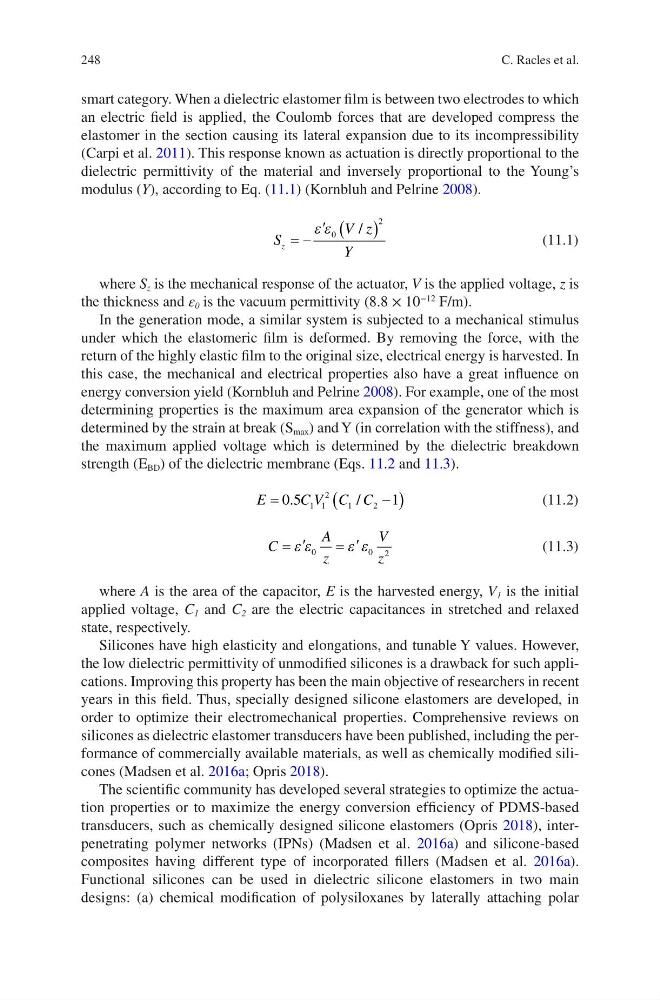
modulus (Y), according to Eq. (11.1) (Kornbluh and Pelrine 2008).
S
V z
Y
z = −
( )
′
ε ε 0
2
/
(11.1)
where S z is the mechanical response of the actuator, V is the applied voltage, z is
the thickness and ε 0 is the vacuum permittivity (8.8 × 10
−12
F/m).
In the generation mode, a similar system is subjected to a mechanical stimulus
under which the elastomeric film is deformed. By removing the force, with the
return of the highly elastic film to the original size, electrical energy is harvested. In
this case, the mechanical and electrical properties also have a great influence on
energy conversion yield (Kornbluh and Pelrine 2008). For example, one of the most
determining properties is the maximum area expansion of the generator which is
determined by the strain at break (S max ) and Y (in correlation with the stiffness), and
the maximum applied voltage which is determined by the dielectric breakdown
strength (E BD ) of the dielectric membrane (Eqs. 11.2 and 11.3).
E
CV C C
=
−
(
)
0 5
1
1 1
2
1
2
.
/
(11.2)
C
A
z
V
z
=
=
′
′
ε ε
ε ε
0
0 2
(11.3)
where A is the area of the capacitor, E is the harvested energy, V 1 is the initial
applied voltage, C 1 and C 2 are the electric capacitances in stretched and relaxed
state, respectively.
Silicones have high elasticity and elongations, and tunable Y values. However,
the low dielectric permittivity of unmodified silicones is a drawback for such applications. Improving this property has been the main objective of researchers in recent
years in this field. Thus, specially designed silicone elastomers are developed, in
order to optimize their electromechanical properties. Comprehensive reviews on
silicones as dielectric elastomer transducers have been published, including the performance of commercially available materials, as well as chemically modified silicones (Madsen et al. 2016a; Opris 2018).
The scientific community has developed several strategies to optimize the actuation properties or to maximize the energy conversion efficiency of PDMS-based
transducers, such as chemically designed silicone elastomers (Opris 2018), interpenetrating polymer networks (IPNs) (Madsen et al. 2016a) and silicone-based
composites having different type of incorporated fillers (Madsen et al. 2016a).
Functional silicones can be used in dielectric silicone elastomers in two main
designs: (a) chemical modification of polysiloxanes by laterally attaching polar
C. Racles et al.
smart category. When a dielectric elastomer film is between two electrodes to which
an electric field is applied, the Coulomb forces that are developed compress the
elastomer in the section causing its lateral expansion due to its incompressibility
(Carpi et al. 2011). This response known as actuation is directly proportional to the
dielectric permittivity of the material and inversely proportional to the Young’s
modulus (Y), according to Eq. (11.1) (Kornbluh and Pelrine 2008).
S
V z
Y
z = −
( )
′
ε ε 0
2
/
(11.1)
where S z is the mechanical response of the actuator, V is the applied voltage, z is
the thickness and ε 0 is the vacuum permittivity (8.8 × 10
−12
F/m).
In the generation mode, a similar system is subjected to a mechanical stimulus
under which the elastomeric film is deformed. By removing the force, with the
return of the highly elastic film to the original size, electrical energy is harvested. In
this case, the mechanical and electrical properties also have a great influence on
energy conversion yield (Kornbluh and Pelrine 2008). For example, one of the most
determining properties is the maximum area expansion of the generator which is
determined by the strain at break (S max ) and Y (in correlation with the stiffness), and
the maximum applied voltage which is determined by the dielectric breakdown
strength (E BD ) of the dielectric membrane (Eqs. 11.2 and 11.3).
E
CV C C
=
−
(
)
0 5
1
1 1
2
1
2
.
/
(11.2)
C
A
z
V
z
=
=
′
′
ε ε
ε ε
0
0 2
(11.3)
where A is the area of the capacitor, E is the harvested energy, V 1 is the initial
applied voltage, C 1 and C 2 are the electric capacitances in stretched and relaxed
state, respectively.
Silicones have high elasticity and elongations, and tunable Y values. However,
the low dielectric permittivity of unmodified silicones is a drawback for such applications. Improving this property has been the main objective of researchers in recent
years in this field. Thus, specially designed silicone elastomers are developed, in
order to optimize their electromechanical properties. Comprehensive reviews on
silicones as dielectric elastomer transducers have been published, including the performance of commercially available materials, as well as chemically modified silicones (Madsen et al. 2016a; Opris 2018).
The scientific community has developed several strategies to optimize the actuation properties or to maximize the energy conversion efficiency of PDMS-based
transducers, such as chemically designed silicone elastomers (Opris 2018), interpenetrating polymer networks (IPNs) (Madsen et al. 2016a) and silicone-based
composites having different type of incorporated fillers (Madsen et al. 2016a).
Functional silicones can be used in dielectric silicone elastomers in two main
designs: (a) chemical modification of polysiloxanes by laterally attaching polar
C. Racles et al.