

247
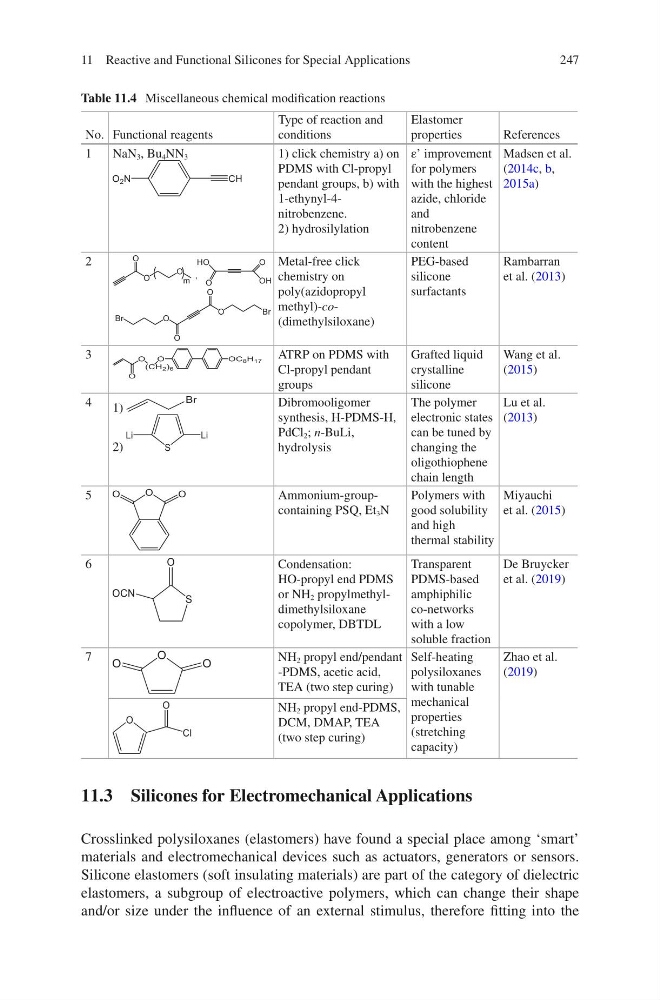
Table 11.4 Miscellaneous chemical modification reactions
No. Functional reagents
Type of reaction and
conditions
Elastomer
properties
References
1
NaN 3 , Bu 4 NN 3
1) click chemistry a) on
PDMS with Cl-propyl
pendant groups, b) with
1-ethynyl-4nitrobenzene.
2) hydrosilylation
ε’ improvement
for polymers
with the highest
azide, chloride
and
nitrobenzene
content
Madsen et al.
(2014c, b,
2015a)
2
Metal-free click
chemistry on
poly(azidopropyl
methyl)-co(dimethylsiloxane)
PEG-based
silicone
surfactants
Rambarran
et al. (2013)
3
ATRP on PDMS with
Cl-propyl pendant
groups
Grafted liquid
crystalline
silicone
Wang et al.
(2015)
4
1)
2)
Dibromooligomer
synthesis, H-PDMS-H,
PdCl 2 ; n-BuLi,
hydrolysis
The polymer
electronic states
can be tuned by
changing the
oligothiophene
chain length
Lu et al.
(2013)
5
Ammonium-groupcontaining PSQ, Et 3 N
Polymers with
good solubility
and high
thermal stability
Miyauchi
et al. (2015)
6
Condensation:
HO-propyl end PDMS
or NH 2 propylmethyldimethylsiloxane
copolymer, DBTDL
Transparent
PDMS-based
amphiphilic
co-networks
with a low
soluble fraction
De Bruycker
et al. (2019)
7
NH 2 propyl end/pendant
-PDMS, acetic acid,
TEA (two step curing)
Self-heating
polysiloxanes
with tunable
mechanical
properties
(stretching
capacity)
Zhao et al.
(2019)
NH 2 propyl end-PDMS,
DCM, DMAP, TEA
(two step curing)
11.3 Silicones for Electromechanical Applications
Crosslinked polysiloxanes (elastomers) have found a special place among ‘smart’
materials and electromechanical devices such as actuators, generators or sensors.
Silicone elastomers (soft insulating materials) are part of the category of dielectric
elastomers, a subgroup of electroactive polymers, which can change their shape
and/or size under the influence of an external stimulus, therefore fitting into the
11 Reactive and Functional Silicones for Special Applications
Table 11.4 Miscellaneous chemical modification reactions
No. Functional reagents
Type of reaction and
conditions
Elastomer
properties
References
1
NaN 3 , Bu 4 NN 3
1) click chemistry a) on
PDMS with Cl-propyl
pendant groups, b) with
1-ethynyl-4nitrobenzene.
2) hydrosilylation
ε’ improvement
for polymers
with the highest
azide, chloride
and
nitrobenzene
content
Madsen et al.
(2014c, b,
2015a)
2
Metal-free click
chemistry on
poly(azidopropyl
methyl)-co(dimethylsiloxane)
PEG-based
silicone
surfactants
Rambarran
et al. (2013)
3
ATRP on PDMS with
Cl-propyl pendant
groups
Grafted liquid
crystalline
silicone
Wang et al.
(2015)
4
1)
2)
Dibromooligomer
synthesis, H-PDMS-H,
PdCl 2 ; n-BuLi,
hydrolysis
The polymer
electronic states
can be tuned by
changing the
oligothiophene
chain length
Lu et al.
(2013)
5
Ammonium-groupcontaining PSQ, Et 3 N
Polymers with
good solubility
and high
thermal stability
Miyauchi
et al. (2015)
6
Condensation:
HO-propyl end PDMS
or NH 2 propylmethyldimethylsiloxane
copolymer, DBTDL
Transparent
PDMS-based
amphiphilic
co-networks
with a low
soluble fraction
De Bruycker
et al. (2019)
7
NH 2 propyl end/pendant
-PDMS, acetic acid,
TEA (two step curing)
Self-heating
polysiloxanes
with tunable
mechanical
properties
(stretching
capacity)
Zhao et al.
(2019)
NH 2 propyl end-PDMS,
DCM, DMAP, TEA
(two step curing)
11.3 Silicones for Electromechanical Applications
Crosslinked polysiloxanes (elastomers) have found a special place among ‘smart’
materials and electromechanical devices such as actuators, generators or sensors.
Silicone elastomers (soft insulating materials) are part of the category of dielectric
elastomers, a subgroup of electroactive polymers, which can change their shape
and/or size under the influence of an external stimulus, therefore fitting into the
11 Reactive and Functional Silicones for Special Applications