

225
the interactions, each phase correspond to a biological response of an intensity
which correlates directly with the degree of biocompatibility of the material in
question:
(i) Initial physical, chemical and biochemical reaction between the surface of the
biomaterial and the biological system;
(ii) Modification by the biological environment of certain physicochemical properties of the surface of the material;
(iii) Development of a local biological response in the immediate vicinity of the
biomaterial and
(iv) Dissemination of this local response throughout the body.
10.5.2 Biocompatibility of Silicones
The biocompatibility of silicones is a direct consequence of the molecular structure
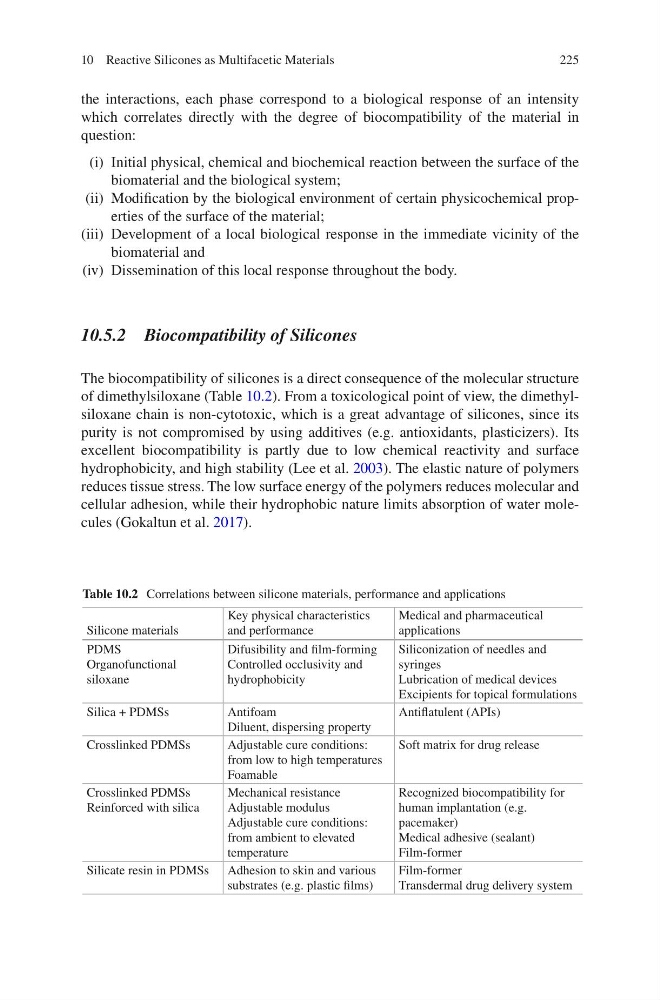
of dimethylsiloxane (Table 10.2). From a toxicological point of view, the dimethylsiloxane chain is non-cytotoxic, which is a great advantage of silicones, since its
purity is not compromised by using additives (e.g. antioxidants, plasticizers). Its
excellent biocompatibility is partly due to low chemical reactivity and surface
hydrophobicity, and high stability (Lee et al. 2003). The elastic nature of polymers
reduces tissue stress. The low surface energy of the polymers reduces molecular and
cellular adhesion, while their hydrophobic nature limits absorption of water molecules (Gokaltun et al. 2017).
Table 10.2 Correlations between silicone materials, performance and applications
Silicone materials
Key physical characteristics
and performance
Medical and pharmaceutical
applications
PDMS
Organofunctional
siloxane
Difusibility and film-forming
Controlled occlusivity and
hydrophobicity
Siliconization of needles and
syringes
Lubrication of medical devices
Excipients for topical formulations
Silica + PDMSs
Antifoam
Diluent, dispersing property
Antiflatulent (APIs)
Crosslinked PDMSs
Adjustable cure conditions:
from low to high temperatures
Foamable
Soft matrix for drug release
Crosslinked PDMSs
Reinforced with silica
Mechanical resistance
Adjustable modulus
Adjustable cure conditions:
from ambient to elevated
temperature
Recognized biocompatibility for
human implantation (e.g.
pacemaker)
Medical adhesive (sealant)
Film-former
Silicate resin in PDMSs Adhesion to skin and various
substrates (e.g. plastic films)
Film-former
Transdermal drug delivery system
10 Reactive Silicones as Multifacetic Materials
the interactions, each phase correspond to a biological response of an intensity
which correlates directly with the degree of biocompatibility of the material in
question:
(i) Initial physical, chemical and biochemical reaction between the surface of the
biomaterial and the biological system;
(ii) Modification by the biological environment of certain physicochemical properties of the surface of the material;
(iii) Development of a local biological response in the immediate vicinity of the
biomaterial and
(iv) Dissemination of this local response throughout the body.
10.5.2 Biocompatibility of Silicones
The biocompatibility of silicones is a direct consequence of the molecular structure
of dimethylsiloxane (Table 10.2). From a toxicological point of view, the dimethylsiloxane chain is non-cytotoxic, which is a great advantage of silicones, since its
purity is not compromised by using additives (e.g. antioxidants, plasticizers). Its
excellent biocompatibility is partly due to low chemical reactivity and surface
hydrophobicity, and high stability (Lee et al. 2003). The elastic nature of polymers
reduces tissue stress. The low surface energy of the polymers reduces molecular and
cellular adhesion, while their hydrophobic nature limits absorption of water molecules (Gokaltun et al. 2017).
Table 10.2 Correlations between silicone materials, performance and applications
Silicone materials
Key physical characteristics
and performance
Medical and pharmaceutical
applications
PDMS
Organofunctional
siloxane
Difusibility and film-forming
Controlled occlusivity and
hydrophobicity
Siliconization of needles and
syringes
Lubrication of medical devices
Excipients for topical formulations
Silica + PDMSs
Antifoam
Diluent, dispersing property
Antiflatulent (APIs)
Crosslinked PDMSs
Adjustable cure conditions:
from low to high temperatures
Foamable
Soft matrix for drug release
Crosslinked PDMSs
Reinforced with silica
Mechanical resistance
Adjustable modulus
Adjustable cure conditions:
from ambient to elevated
temperature
Recognized biocompatibility for
human implantation (e.g.
pacemaker)
Medical adhesive (sealant)
Film-former
Silicate resin in PDMSs Adhesion to skin and various
substrates (e.g. plastic films)
Film-former
Transdermal drug delivery system
10 Reactive Silicones as Multifacetic Materials