

224
nanocomposite was successfully prepared by functionalizing MWCNTs with silane
compound (Kim et al. 2008). This allowed a homogeneous dispersion of functionalized MWCNTs in the silicone matrix. The silicone rubber/functionalized MWCNTs
(1 wt.%) composites showed that the tensile strength and modulus of the composites improved dramatically by about 50 and 28%, respectively, compared to silicone
rubber (Kim et al. 2008).
10.4.13 Super Ball Show
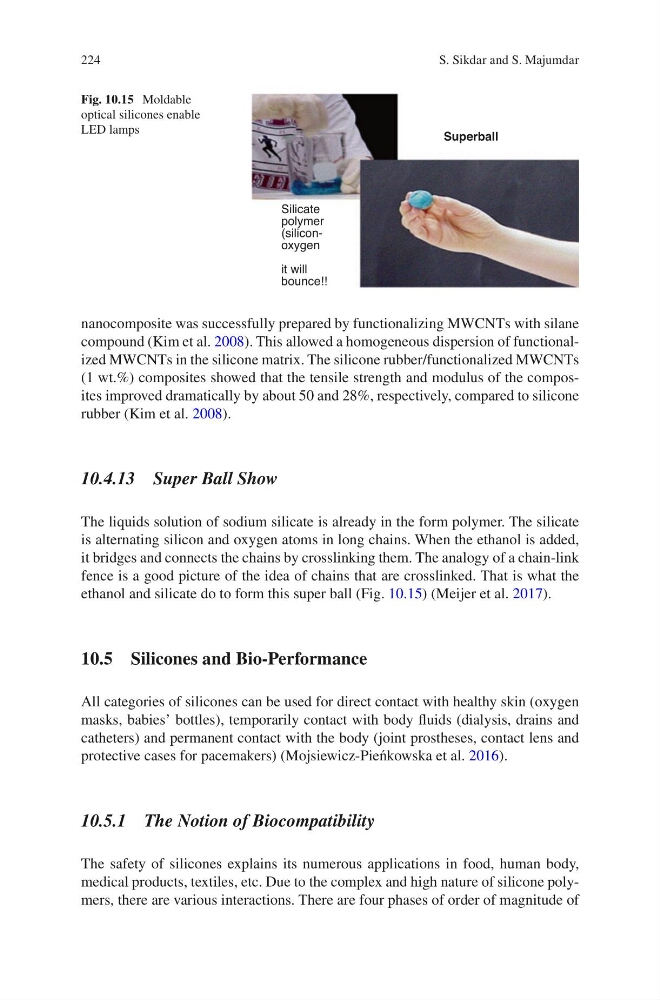
The liquids solution of sodium silicate is already in the form polymer. The silicate
is alternating silicon and oxygen atoms in long chains. When the ethanol is added,
it bridges and connects the chains by crosslinking them. The analogy of a chain-link
fence is a good picture of the idea of chains that are crosslinked. That is what the
ethanol and silicate do to form this super ball (Fig. 10.15) (Meijer et al. 2017).
10.5 Silicones and Bio-Performance
All categories of silicones can be used for direct contact with healthy skin (oxygen
masks, babies’ bottles), temporarily contact with body fluids (dialysis, drains and
catheters) and permanent contact with the body (joint prostheses, contact lens and
protective cases for pacemakers) (Mojsiewicz-Pieńkowska et al. 2016).
10.5.1 The Notion of Biocompatibility
The safety of silicones explains its numerous applications in food, human body,
medical products, textiles, etc. Due to the complex and high nature of silicone polymers, there are various interactions. There are four phases of order of magnitude of
Superball
Silicate
polymer
(siliconoxygen
it will
bounce!!
Fig. 10.15 Moldable
optical silicones enable
LED lamps
S. Sikdar and S. Majumdar
nanocomposite was successfully prepared by functionalizing MWCNTs with silane
compound (Kim et al. 2008). This allowed a homogeneous dispersion of functionalized MWCNTs in the silicone matrix. The silicone rubber/functionalized MWCNTs
(1 wt.%) composites showed that the tensile strength and modulus of the composites improved dramatically by about 50 and 28%, respectively, compared to silicone
rubber (Kim et al. 2008).
10.4.13 Super Ball Show
The liquids solution of sodium silicate is already in the form polymer. The silicate
is alternating silicon and oxygen atoms in long chains. When the ethanol is added,
it bridges and connects the chains by crosslinking them. The analogy of a chain-link
fence is a good picture of the idea of chains that are crosslinked. That is what the
ethanol and silicate do to form this super ball (Fig. 10.15) (Meijer et al. 2017).
10.5 Silicones and Bio-Performance
All categories of silicones can be used for direct contact with healthy skin (oxygen
masks, babies’ bottles), temporarily contact with body fluids (dialysis, drains and
catheters) and permanent contact with the body (joint prostheses, contact lens and
protective cases for pacemakers) (Mojsiewicz-Pieńkowska et al. 2016).
10.5.1 The Notion of Biocompatibility
The safety of silicones explains its numerous applications in food, human body,
medical products, textiles, etc. Due to the complex and high nature of silicone polymers, there are various interactions. There are four phases of order of magnitude of
Superball
Silicate
polymer
(siliconoxygen
it will
bounce!!
Fig. 10.15 Moldable
optical silicones enable
LED lamps
S. Sikdar and S. Majumdar