

160
reactivity toward carboxylic acid is less attractive (Malik et al. 2000). On the other
hand, TMP has three primary hydroxyl groups with the same reactivity which is
attractive for industrial applications (Malik et al. 2000).
8.1.1.2.2 Dicarboxylic Acid or Anhydride
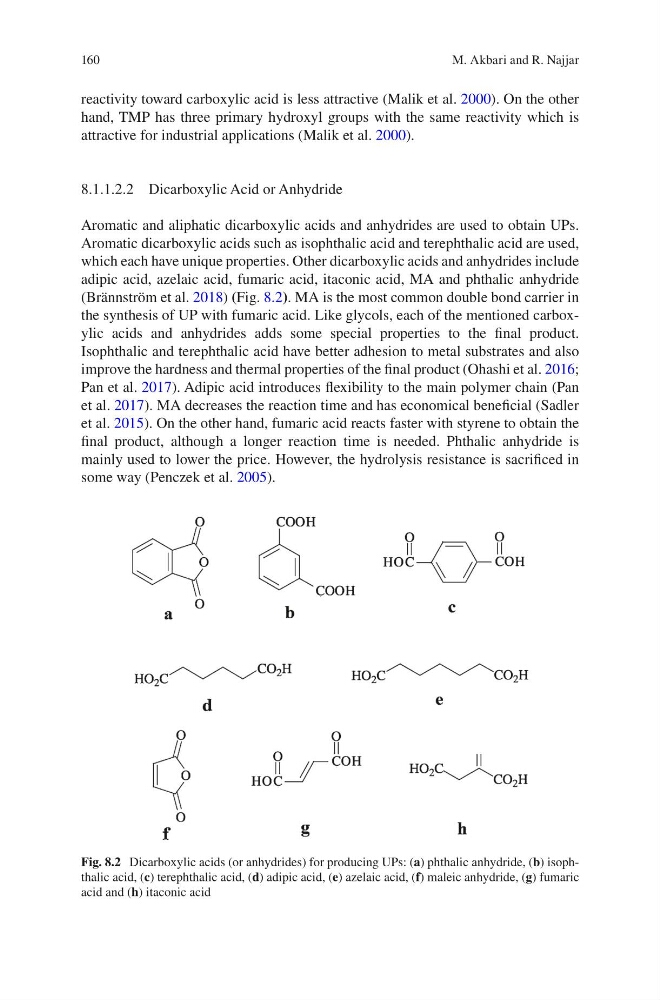
Aromatic and aliphatic dicarboxylic acids and anhydrides are used to obtain UPs.
Aromatic dicarboxylic acids such as isophthalic acid and terephthalic acid are used,
which each have unique properties. Other dicarboxylic acids and anhydrides include
adipic acid, azelaic acid, fumaric acid, itaconic acid, MA and phthalic anhydride
(Brännström et al. 2018) (Fig. 8.2). MA is the most common double bond carrier in
the synthesis of UP with fumaric acid. Like glycols, each of the mentioned carboxylic acids and anhydrides adds some special properties to the final product.
Isophthalic and terephthalic acid have better adhesion to metal substrates and also
improve the hardness and thermal properties of the final product (Ohashi et al. 2016;
Pan et al. 2017). Adipic acid introduces flexibility to the main polymer chain (Pan
et al. 2017). MA decreases the reaction time and has economical beneficial (Sadler
et al. 2015). On the other hand, fumaric acid reacts faster with styrene to obtain the
final product, although a longer reaction time is needed. Phthalic anhydride is
mainly used to lower the price. However, the hydrolysis resistance is sacrificed in
some way (Penczek et al. 2005).
Fig. 8.2 Dicarboxylic acids (or anhydrides) for producing UPs: (a) phthalic anhydride, (b) isophthalic acid, (c) terephthalic acid, (d) adipic acid, (e) azelaic acid, (f) maleic anhydride, (g) fumaric
acid and (h) itaconic acid
M. Akbari and R. Najjar
reactivity toward carboxylic acid is less attractive (Malik et al. 2000). On the other
hand, TMP has three primary hydroxyl groups with the same reactivity which is
attractive for industrial applications (Malik et al. 2000).
8.1.1.2.2 Dicarboxylic Acid or Anhydride
Aromatic and aliphatic dicarboxylic acids and anhydrides are used to obtain UPs.
Aromatic dicarboxylic acids such as isophthalic acid and terephthalic acid are used,
which each have unique properties. Other dicarboxylic acids and anhydrides include
adipic acid, azelaic acid, fumaric acid, itaconic acid, MA and phthalic anhydride
(Brännström et al. 2018) (Fig. 8.2). MA is the most common double bond carrier in
the synthesis of UP with fumaric acid. Like glycols, each of the mentioned carboxylic acids and anhydrides adds some special properties to the final product.
Isophthalic and terephthalic acid have better adhesion to metal substrates and also
improve the hardness and thermal properties of the final product (Ohashi et al. 2016;
Pan et al. 2017). Adipic acid introduces flexibility to the main polymer chain (Pan
et al. 2017). MA decreases the reaction time and has economical beneficial (Sadler
et al. 2015). On the other hand, fumaric acid reacts faster with styrene to obtain the
final product, although a longer reaction time is needed. Phthalic anhydride is
mainly used to lower the price. However, the hydrolysis resistance is sacrificed in
some way (Penczek et al. 2005).
Fig. 8.2 Dicarboxylic acids (or anhydrides) for producing UPs: (a) phthalic anhydride, (b) isophthalic acid, (c) terephthalic acid, (d) adipic acid, (e) azelaic acid, (f) maleic anhydride, (g) fumaric
acid and (h) itaconic acid
M. Akbari and R. Najjar