

159
8.1.1.2.1 Glycols
Too many types of monomers are applicable for producing UPs, but from an industrial point of view, some are usable. Glycols and anhydrides or dicarboxylic acids
are used to synthesize UPs. Almost always the double bond is in the dicarboxylic
acids or anhydrides and glycols have no double bond. Glycols such as 1,2- propylene
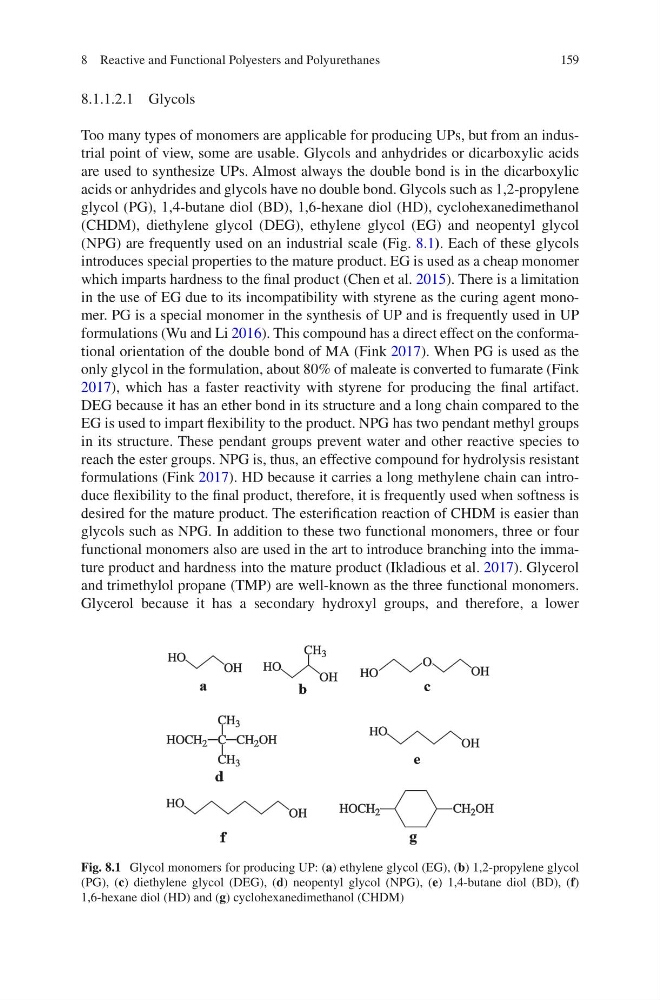
glycol (PG), 1,4-butane diol (BD), 1,6-hexane diol (HD), cyclohexanedimethanol
(CHDM), diethylene glycol (DEG), ethylene glycol (EG) and neopentyl glycol
(NPG) are frequently used on an industrial scale (Fig. 8.1). Each of these glycols
introduces special properties to the mature product. EG is used as a cheap monomer
which imparts hardness to the final product (Chen et al. 2015). There is a limitation
in the use of EG due to its incompatibility with styrene as the curing agent monomer. PG is a special monomer in the synthesis of UP and is frequently used in UP
formulations (Wu and Li 2016). This compound has a direct effect on the conformational orientation of the double bond of MA (Fink 2017). When PG is used as the
only glycol in the formulation, about 80% of maleate is converted to fumarate (Fink
2017), which has a faster reactivity with styrene for producing the final artifact.
DEG because it has an ether bond in its structure and a long chain compared to the
EG is used to impart flexibility to the product. NPG has two pendant methyl groups
in its structure. These pendant groups prevent water and other reactive species to
reach the ester groups. NPG is, thus, an effective compound for hydrolysis resistant
formulations (Fink 2017). HD because it carries a long methylene chain can introduce flexibility to the final product, therefore, it is frequently used when softness is
desired for the mature product. The esterification reaction of CHDM is easier than
glycols such as NPG. In addition to these two functional monomers, three or four
functional monomers also are used in the art to introduce branching into the immature product and hardness into the mature product (Ikladious et al. 2017). Glycerol
and trimethylol propane (TMP) are well-known as the three functional monomers.
Glycerol because it has a secondary hydroxyl groups, and therefore, a lower
Fig. 8.1 Glycol monomers for producing UP: (a) ethylene glycol (EG), (b) 1,2-propylene glycol
(PG), (c) diethylene glycol (DEG), (d) neopentyl glycol (NPG), (e) 1,4-butane diol (BD), (f)
1,6-hexane diol (HD) and (g) cyclohexanedimethanol (CHDM)
8 Reactive and Functional Polyesters and Polyurethanes
8.1.1.2.1 Glycols
Too many types of monomers are applicable for producing UPs, but from an industrial point of view, some are usable. Glycols and anhydrides or dicarboxylic acids
are used to synthesize UPs. Almost always the double bond is in the dicarboxylic
acids or anhydrides and glycols have no double bond. Glycols such as 1,2- propylene
glycol (PG), 1,4-butane diol (BD), 1,6-hexane diol (HD), cyclohexanedimethanol
(CHDM), diethylene glycol (DEG), ethylene glycol (EG) and neopentyl glycol
(NPG) are frequently used on an industrial scale (Fig. 8.1). Each of these glycols
introduces special properties to the mature product. EG is used as a cheap monomer
which imparts hardness to the final product (Chen et al. 2015). There is a limitation
in the use of EG due to its incompatibility with styrene as the curing agent monomer. PG is a special monomer in the synthesis of UP and is frequently used in UP
formulations (Wu and Li 2016). This compound has a direct effect on the conformational orientation of the double bond of MA (Fink 2017). When PG is used as the
only glycol in the formulation, about 80% of maleate is converted to fumarate (Fink
2017), which has a faster reactivity with styrene for producing the final artifact.
DEG because it has an ether bond in its structure and a long chain compared to the
EG is used to impart flexibility to the product. NPG has two pendant methyl groups
in its structure. These pendant groups prevent water and other reactive species to
reach the ester groups. NPG is, thus, an effective compound for hydrolysis resistant
formulations (Fink 2017). HD because it carries a long methylene chain can introduce flexibility to the final product, therefore, it is frequently used when softness is
desired for the mature product. The esterification reaction of CHDM is easier than
glycols such as NPG. In addition to these two functional monomers, three or four
functional monomers also are used in the art to introduce branching into the immature product and hardness into the mature product (Ikladious et al. 2017). Glycerol
and trimethylol propane (TMP) are well-known as the three functional monomers.
Glycerol because it has a secondary hydroxyl groups, and therefore, a lower
Fig. 8.1 Glycol monomers for producing UP: (a) ethylene glycol (EG), (b) 1,2-propylene glycol
(PG), (c) diethylene glycol (DEG), (d) neopentyl glycol (NPG), (e) 1,4-butane diol (BD), (f)
1,6-hexane diol (HD) and (g) cyclohexanedimethanol (CHDM)
8 Reactive and Functional Polyesters and Polyurethanes