

117
starch/nanocellulose films, and the improvement of σ max and ε b values with the
incorporation of nanocellulose was more pronounced with respect to the addition of
gum Arabic (Vigneshwaran et al. 2011). Qazanfarzadeh and Kadivar (2016) found
that ε b values of whey protein composite films influenced negatively with the addition of cellulose nanofibers, while the ε b values of whey protein-glycerol composite
films decreased significantly by the incorporation of oat husk cellulose nanofibers
up to 5%, conversely the highest σ max and E value was observed for 5% cellulose
nanofiber- containing composite films (Qazanfarzadeh and Kadivar 2016).
The reduction of WVP and WVTR of nanocomposite films with the incorporation of cellulose nanomaterials reflects the compatibility of the matrix and the filler.
The high aspect ratio and the large surface area of nano-fillers creates a tortuous
pathway, which leads the gas molecules travelling through a longer way into the
composite film, while the water vapor permeance into the film is reduced. This
behavior is also observed in the nanocomposite films containing nanocellulose fillers, though there is a limit to the amount of nano-filler. Beyond a certain limit, the
cellulose nanomaterials can be aggregated, and uneven distribution can act reversely
and raise the WVP. The WVTR of PLA-containing hydrophobic-modified nanocellulose composites melted on paper under two different environmental conditions,
namely 23 °C-50% relative humidity (RH) and 38 °C-90% RH were evaluated by
Song et al. (2014). The WVTR of composites stored at 90% RH were comparably
higher than the films stored at 50% RH, but the lowest WVTR value was
observed for 1% nanocellulose containing film at a coating amount 40 g/m
2
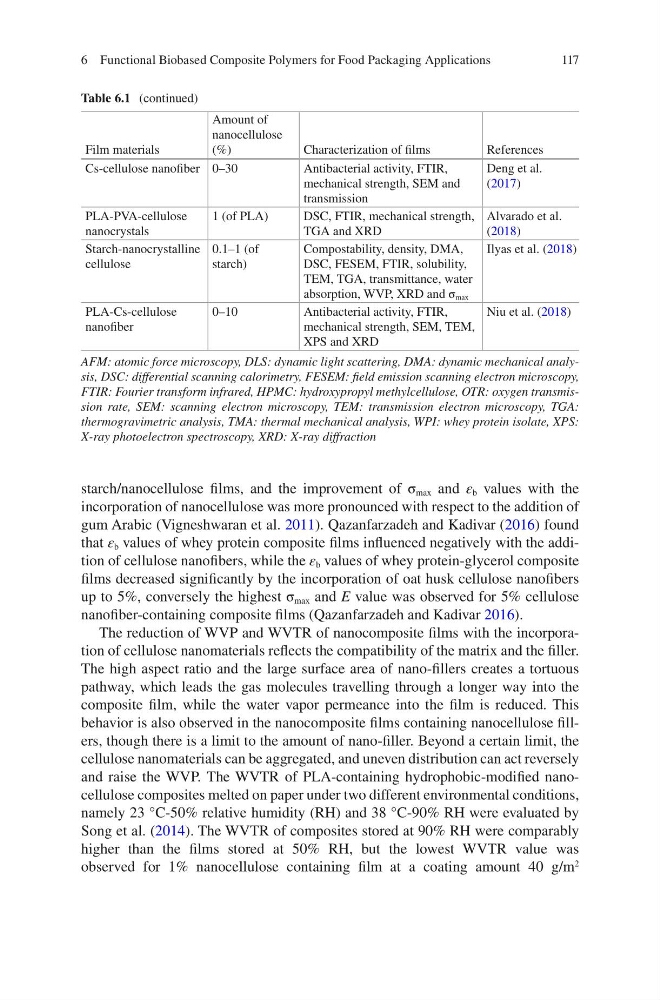
Table 6.1 (continued)
Film materials
Amount of
nanocellulose
(%)
Characterization of films
References
Cs-cellulose nanofiber 0–30
Antibacterial activity, FTIR,
mechanical strength, SEM and
transmission
Deng et al.
(2017)
PLA-PVA-cellulose
nanocrystals
1 (of PLA)
DSC, FTIR, mechanical strength,
TGA and XRD
Alvarado et al.
(2018)
Starch-nanocrystalline
cellulose
0.1–1 (of
starch)
Compostability, density, DMA,
DSC, FESEM, FTIR, solubility,
TEM, TGA, transmittance, water
absorption, WVP, XRD and σ max
Ilyas et al. (2018)
PLA-Cs-cellulose
nanofiber
0–10
Antibacterial activity, FTIR,
mechanical strength, SEM, TEM,
XPS and XRD
Niu et al. (2018)
AFM: atomic force microscopy, DLS: dynamic light scattering, DMA: dynamic mechanical analysis, DSC: differential scanning calorimetry, FESEM: field emission scanning electron microscopy,
FTIR: Fourier transform infrared, HPMC: hydroxypropyl methylcellulose, OTR: oxygen transmission rate, SEM: scanning electron microscopy, TEM: transmission electron microscopy, TGA:
thermogravimetric analysis, TMA: thermal mechanical analysis, WPI: whey protein isolate, XPS:
X-ray photoelectron spectroscopy, XRD: X-ray diffraction
6 Functional Biobased Composite Polymers for Food Packaging Applications
starch/nanocellulose films, and the improvement of σ max and ε b values with the
incorporation of nanocellulose was more pronounced with respect to the addition of
gum Arabic (Vigneshwaran et al. 2011). Qazanfarzadeh and Kadivar (2016) found
that ε b values of whey protein composite films influenced negatively with the addition of cellulose nanofibers, while the ε b values of whey protein-glycerol composite
films decreased significantly by the incorporation of oat husk cellulose nanofibers
up to 5%, conversely the highest σ max and E value was observed for 5% cellulose
nanofiber- containing composite films (Qazanfarzadeh and Kadivar 2016).
The reduction of WVP and WVTR of nanocomposite films with the incorporation of cellulose nanomaterials reflects the compatibility of the matrix and the filler.
The high aspect ratio and the large surface area of nano-fillers creates a tortuous
pathway, which leads the gas molecules travelling through a longer way into the
composite film, while the water vapor permeance into the film is reduced. This
behavior is also observed in the nanocomposite films containing nanocellulose fillers, though there is a limit to the amount of nano-filler. Beyond a certain limit, the
cellulose nanomaterials can be aggregated, and uneven distribution can act reversely
and raise the WVP. The WVTR of PLA-containing hydrophobic-modified nanocellulose composites melted on paper under two different environmental conditions,
namely 23 °C-50% relative humidity (RH) and 38 °C-90% RH were evaluated by
Song et al. (2014). The WVTR of composites stored at 90% RH were comparably
higher than the films stored at 50% RH, but the lowest WVTR value was
observed for 1% nanocellulose containing film at a coating amount 40 g/m
2
Table 6.1 (continued)
Film materials
Amount of
nanocellulose
(%)
Characterization of films
References
Cs-cellulose nanofiber 0–30
Antibacterial activity, FTIR,
mechanical strength, SEM and
transmission
Deng et al.
(2017)
PLA-PVA-cellulose
nanocrystals
1 (of PLA)
DSC, FTIR, mechanical strength,
TGA and XRD
Alvarado et al.
(2018)
Starch-nanocrystalline
cellulose
0.1–1 (of
starch)
Compostability, density, DMA,
DSC, FESEM, FTIR, solubility,
TEM, TGA, transmittance, water
absorption, WVP, XRD and σ max
Ilyas et al. (2018)
PLA-Cs-cellulose
nanofiber
0–10
Antibacterial activity, FTIR,
mechanical strength, SEM, TEM,
XPS and XRD
Niu et al. (2018)
AFM: atomic force microscopy, DLS: dynamic light scattering, DMA: dynamic mechanical analysis, DSC: differential scanning calorimetry, FESEM: field emission scanning electron microscopy,
FTIR: Fourier transform infrared, HPMC: hydroxypropyl methylcellulose, OTR: oxygen transmission rate, SEM: scanning electron microscopy, TEM: transmission electron microscopy, TGA:
thermogravimetric analysis, TMA: thermal mechanical analysis, WPI: whey protein isolate, XPS:
X-ray photoelectron spectroscopy, XRD: X-ray diffraction
6 Functional Biobased Composite Polymers for Food Packaging Applications