

70
with oxygen-containing groups in the side chains and the size of the conjugated
systems reduced the antioxidant activity. In another study, Ponomarenko et al.
(2015b) found that the reactions of o-OCH 3 , α-CH 2 , and aliphatic carbonyl groups
with free radicals were based on a proton-coupled electron transfer mechanism,
while the reactions of the ether bonds in the aliphatic side chains, the carbohydrate
impurities, and the OCH 3 groups in C 9 unit were based on a sequential proton loss
electron transfer (SPLET) mechanism, and the π-conjugated systems were based on
both mechanisms.
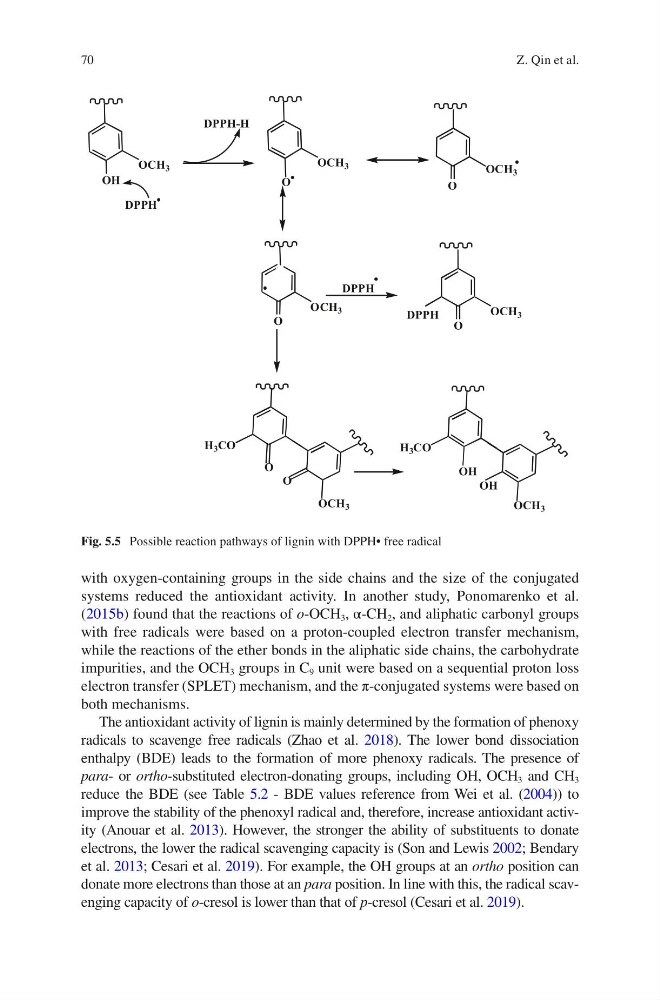
The antioxidant activity of lignin is mainly determined by the formation of phenoxy
radicals to scavenge free radicals (Zhao et al. 2018). The lower bond dissociation
enthalpy (BDE) leads to the formation of more phenoxy radicals. The presence of
para- or ortho-substituted electron-donating groups, including OH, OCH 3 and CH 3
reduce the BDE (see Table 5.2 - BDE values reference from Wei et al. (2004)) to
improve the stability of the phenoxyl radical and, therefore, increase antioxidant activity (Anouar et al. 2013). However, the stronger the ability of substituents to donate
electrons, the lower the radical scavenging capacity is (Son and Lewis 2002; Bendary
et al. 2013; Cesari et al. 2019). For example, the OH groups at an ortho position can
donate more electrons than those at an para position. In line with this, the radical scavenging capacity of o-cresol is lower than that of p-cresol (Cesari et al. 2019).
OH
OCH 3
O
O
OCH 3
H 3 CO
O
OCH 3
OCH 3
OH
OH
DPPH
DPPH
DPPH-H
OCH 3
O
OCH 3
H 3 CO
OCH 3
O
O
DPPH
Fig. 5.5 Possible reaction pathways of lignin with DPPH• free radical
Z. Qin et al.
with oxygen-containing groups in the side chains and the size of the conjugated
systems reduced the antioxidant activity. In another study, Ponomarenko et al.
(2015b) found that the reactions of o-OCH 3 , α-CH 2 , and aliphatic carbonyl groups
with free radicals were based on a proton-coupled electron transfer mechanism,
while the reactions of the ether bonds in the aliphatic side chains, the carbohydrate
impurities, and the OCH 3 groups in C 9 unit were based on a sequential proton loss
electron transfer (SPLET) mechanism, and the π-conjugated systems were based on
both mechanisms.
The antioxidant activity of lignin is mainly determined by the formation of phenoxy
radicals to scavenge free radicals (Zhao et al. 2018). The lower bond dissociation
enthalpy (BDE) leads to the formation of more phenoxy radicals. The presence of
para- or ortho-substituted electron-donating groups, including OH, OCH 3 and CH 3
reduce the BDE (see Table 5.2 - BDE values reference from Wei et al. (2004)) to
improve the stability of the phenoxyl radical and, therefore, increase antioxidant activity (Anouar et al. 2013). However, the stronger the ability of substituents to donate
electrons, the lower the radical scavenging capacity is (Son and Lewis 2002; Bendary
et al. 2013; Cesari et al. 2019). For example, the OH groups at an ortho position can
donate more electrons than those at an para position. In line with this, the radical scavenging capacity of o-cresol is lower than that of p-cresol (Cesari et al. 2019).
OH
OCH 3
O
O
OCH 3
H 3 CO
O
OCH 3
OCH 3
OH
OH
DPPH
DPPH
DPPH-H
OCH 3
O
OCH 3
H 3 CO
OCH 3
O
O
DPPH
Fig. 5.5 Possible reaction pathways of lignin with DPPH• free radical
Z. Qin et al.