

69
coniferous wood species by various methods, and concluded that aliphatic hydroxyl
groups in side chains, non-etherified phenolic hydroxyl groups onto the lignin structure, and high heterogeneity, polydispersity and Mw were the main factors to reduce
the free radical scavenging activity of lignin. In addition, low purity lignin containing many residual carbohydrates has a low antioxidant activity because carbohydrates can generate hydrogen bonds with phenolic hydroxyl groups of lignin, which
interferes with the antioxidant activity of lignin. Pan et al. (2006) evaluated the free
radical scavenging activities of 21 ethanol lignin fractions extracted from hybrid
poplar, and concluded that lignin with less aliphatic hydroxyl groups, more phenolic
hydroxyl groups, lower Mw, and a narrower Mw distribution had a greater antioxidant activity. Similar conclusions were made by Dizhbite et al. (2004), i.e. low Mw
lignins having more aromatic hydroxyl groups and high Mw, showed a higher antioxidant activity.
Morales and Lucas (2010) found that the length of the alkyl side chain in the
phenylpropane units, and in the carboxylic and alcohol groups helped increase the
antioxidant activity. A longer alkyl chain gave lignin a greater radical scavenging
capacity. Ponomarenko et al. (2015a) explored the quantitative and qualitative
structure- activity relationship of lignins. The results revealed that the content of
phenolic hydroxyl groups is the most important factor to determine the antioxidant
activity of lignin. Other factors, such as the content of guaiacyl and syringyl units,
the number of phenylpropane units with CH 2 groups in the side chains at the
α-position, and the amount of methoxyl per phenylpropane unit, also had positive
influences on antioxidant activity. In contrast, the number of phenylpropane units
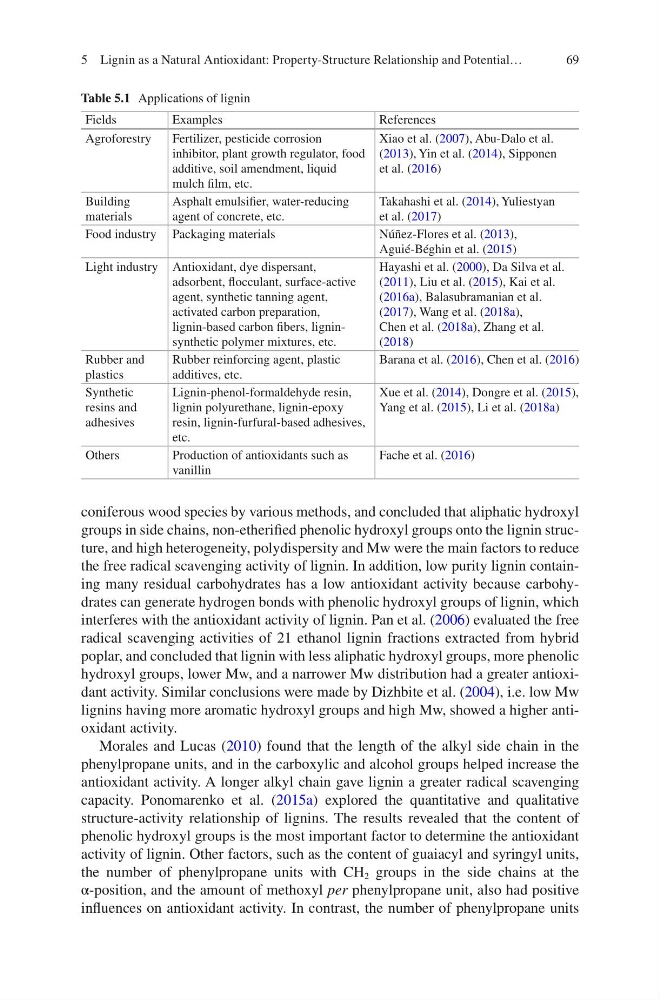
Table 5.1 Applications of lignin
Fields
Examples
References
Agroforestry
Fertilizer, pesticide corrosion
inhibitor, plant growth regulator, food
additive, soil amendment, liquid
mulch film, etc.
Xiao et al. (2007), Abu-Dalo et al.
(2013), Yin et al. (2014), Sipponen
et al. (2016)
Building
materials
Asphalt emulsifier, water-reducing
agent of concrete, etc.
Takahashi et al. (2014), Yuliestyan
et al. (2017)
Food industry Packaging materials
Núñez-Flores et al. (2013),
Aguié- Béghin et al. (2015)
Light industry Antioxidant, dye dispersant,
adsorbent, flocculant, surface-active
agent, synthetic tanning agent,
activated carbon preparation,
lignin-based carbon fibers, ligninsynthetic polymer mixtures, etc.
Hayashi et al. (2000), Da Silva et al.
(2011), Liu et al. (2015), Kai et al.
(2016a), Balasubramanian et al.
(2017), Wang et al. (2018a),
Chen et al. (2018a), Zhang et al.
(2018)
Rubber and
plastics
Rubber reinforcing agent, plastic
additives, etc.
Barana et al. (2016), Chen et al. (2016)
Synthetic
resins and
adhesives
Lignin-phenol-formaldehyde resin,
lignin polyurethane, lignin-epoxy
resin, lignin-furfural-based adhesives,
etc.
Xue et al. (2014), Dongre et al. (2015),
Yang et al. (2015), Li et al. (2018a)
Others
Production of antioxidants such as
vanillin
Fache et al. (2016)
5 Lignin as a Natural Antioxidant: Property-Structure Relationship and Potential…
coniferous wood species by various methods, and concluded that aliphatic hydroxyl
groups in side chains, non-etherified phenolic hydroxyl groups onto the lignin structure, and high heterogeneity, polydispersity and Mw were the main factors to reduce
the free radical scavenging activity of lignin. In addition, low purity lignin containing many residual carbohydrates has a low antioxidant activity because carbohydrates can generate hydrogen bonds with phenolic hydroxyl groups of lignin, which
interferes with the antioxidant activity of lignin. Pan et al. (2006) evaluated the free
radical scavenging activities of 21 ethanol lignin fractions extracted from hybrid
poplar, and concluded that lignin with less aliphatic hydroxyl groups, more phenolic
hydroxyl groups, lower Mw, and a narrower Mw distribution had a greater antioxidant activity. Similar conclusions were made by Dizhbite et al. (2004), i.e. low Mw
lignins having more aromatic hydroxyl groups and high Mw, showed a higher antioxidant activity.
Morales and Lucas (2010) found that the length of the alkyl side chain in the
phenylpropane units, and in the carboxylic and alcohol groups helped increase the
antioxidant activity. A longer alkyl chain gave lignin a greater radical scavenging
capacity. Ponomarenko et al. (2015a) explored the quantitative and qualitative
structure- activity relationship of lignins. The results revealed that the content of
phenolic hydroxyl groups is the most important factor to determine the antioxidant
activity of lignin. Other factors, such as the content of guaiacyl and syringyl units,
the number of phenylpropane units with CH 2 groups in the side chains at the
α-position, and the amount of methoxyl per phenylpropane unit, also had positive
influences on antioxidant activity. In contrast, the number of phenylpropane units
Table 5.1 Applications of lignin
Fields
Examples
References
Agroforestry
Fertilizer, pesticide corrosion
inhibitor, plant growth regulator, food
additive, soil amendment, liquid
mulch film, etc.
Xiao et al. (2007), Abu-Dalo et al.
(2013), Yin et al. (2014), Sipponen
et al. (2016)
Building
materials
Asphalt emulsifier, water-reducing
agent of concrete, etc.
Takahashi et al. (2014), Yuliestyan
et al. (2017)
Food industry Packaging materials
Núñez-Flores et al. (2013),
Aguié- Béghin et al. (2015)
Light industry Antioxidant, dye dispersant,
adsorbent, flocculant, surface-active
agent, synthetic tanning agent,
activated carbon preparation,
lignin-based carbon fibers, ligninsynthetic polymer mixtures, etc.
Hayashi et al. (2000), Da Silva et al.
(2011), Liu et al. (2015), Kai et al.
(2016a), Balasubramanian et al.
(2017), Wang et al. (2018a),
Chen et al. (2018a), Zhang et al.
(2018)
Rubber and
plastics
Rubber reinforcing agent, plastic
additives, etc.
Barana et al. (2016), Chen et al. (2016)
Synthetic
resins and
adhesives
Lignin-phenol-formaldehyde resin,
lignin polyurethane, lignin-epoxy
resin, lignin-furfural-based adhesives,
etc.
Xue et al. (2014), Dongre et al. (2015),
Yang et al. (2015), Li et al. (2018a)
Others
Production of antioxidants such as
vanillin
Fache et al. (2016)
5 Lignin as a Natural Antioxidant: Property-Structure Relationship and Potential…