

66
5.1 Introduction
Antioxidant agents can prevent or delay oxidation, thus improving the stability of
products and prolonging their shelf life. They can be divided into natural and synthetic antioxidants. Synthetic antioxidants, such as butylated hydroxytoluene
(BHT), butylhydroxyanisole (BHA), propyl gallate (PG) and tert- butylhydroquinone
(TBHQ), represent an important part of the antioxidant market (Yang et al. 2018c).
However, the potential toxicity of synthetic antioxidants has been recognized
(André et al. 2010). For this reason, more and more attention has been given to natural antioxidants. Natural antioxidants compared to synthetic antioxidants, in particular, polyphenols are biodegradable and non-toxic. Nonetheless, due to their low
molecular weight (Mw) and instability at prolonged high temperatures, natural antioxidants cannot prevent oxidation under conditions of thermal stress. Lignin is a
natural phenolic polymer with relatively higher thermal stability, thus it has relatively more applications as an antioxidant (Gutiérrez et al. 2016; Gutiérrez and
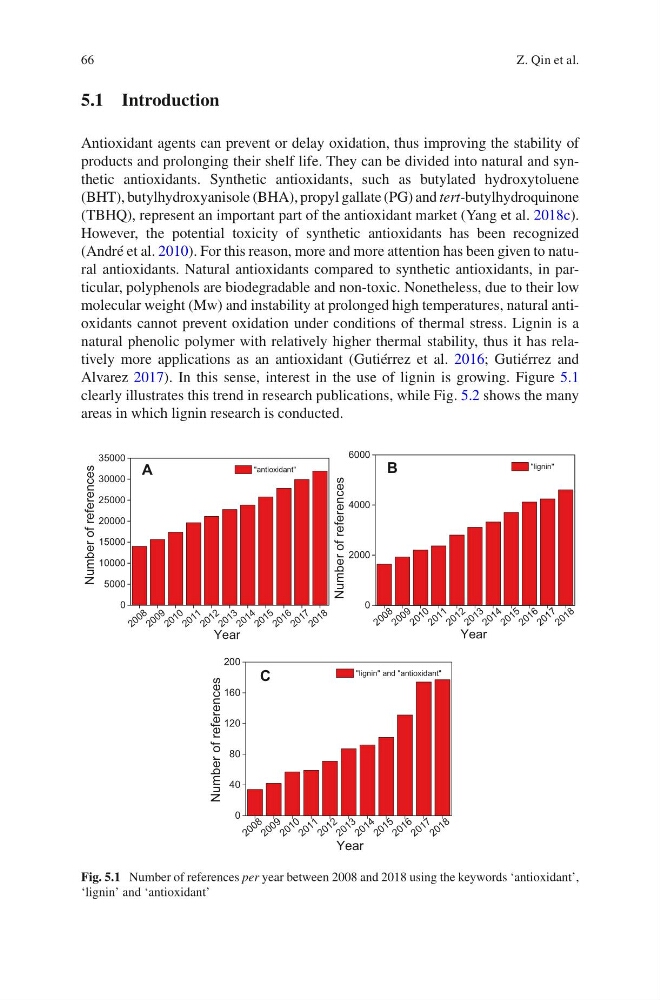
Alvarez 2017). In this sense, interest in the use of lignin is growing. Figure 5.1
clearly illustrates this trend in research publications, while Fig. 5.2 shows the many
areas in which lignin research is conducted.
2 0 0 8
2 0 0 9
2 0 1 0
2 0 1 1
2 0 1 2
2 0 1 3
2 0 1 4
2 0 1 5
2 0 1 6
2 0 1 7
2 0 1 8
0
5000
10000
15000
20000
25000
30000
35000
Year
"antioxidant"
A
2 0 0 8
2 0 0 9
2 0 1 0
2 0 1 1
2 0 1 2
2 0 1 3
2 0 1 4
2 0 1 5
2 0 1 6
2 0 1 7
2 0 1 8
0
2000
4000
6000
"lignin"
Number of references
Year
B
2 0 0 8
2 0 0 9
2 0 1 0
2 0 1 1
2 0 1 2
2 0 1 3
2 0 1 4
2 0 1 5
2 0 1 6
2 0 1 7
2 0 1 8
0
40
80
120
160
200
Number of references
Year
"lignin" and "antioxidant"
C
Number of references
Fig. 5.1 Number of references per year between 2008 and 2018 using the keywords ‘antioxidant’,
‘lignin’ and ‘antioxidant’
Z. Qin et al.
5.1 Introduction
Antioxidant agents can prevent or delay oxidation, thus improving the stability of
products and prolonging their shelf life. They can be divided into natural and synthetic antioxidants. Synthetic antioxidants, such as butylated hydroxytoluene
(BHT), butylhydroxyanisole (BHA), propyl gallate (PG) and tert- butylhydroquinone
(TBHQ), represent an important part of the antioxidant market (Yang et al. 2018c).
However, the potential toxicity of synthetic antioxidants has been recognized
(André et al. 2010). For this reason, more and more attention has been given to natural antioxidants. Natural antioxidants compared to synthetic antioxidants, in particular, polyphenols are biodegradable and non-toxic. Nonetheless, due to their low
molecular weight (Mw) and instability at prolonged high temperatures, natural antioxidants cannot prevent oxidation under conditions of thermal stress. Lignin is a
natural phenolic polymer with relatively higher thermal stability, thus it has relatively more applications as an antioxidant (Gutiérrez et al. 2016; Gutiérrez and
Alvarez 2017). In this sense, interest in the use of lignin is growing. Figure 5.1
clearly illustrates this trend in research publications, while Fig. 5.2 shows the many
areas in which lignin research is conducted.
2 0 0 8
2 0 0 9
2 0 1 0
2 0 1 1
2 0 1 2
2 0 1 3
2 0 1 4
2 0 1 5
2 0 1 6
2 0 1 7
2 0 1 8
0
5000
10000
15000
20000
25000
30000
35000
Year
"antioxidant"
A
2 0 0 8
2 0 0 9
2 0 1 0
2 0 1 1
2 0 1 2
2 0 1 3
2 0 1 4
2 0 1 5
2 0 1 6
2 0 1 7
2 0 1 8
0
2000
4000
6000
"lignin"
Number of references
Year
B
2 0 0 8
2 0 0 9
2 0 1 0
2 0 1 1
2 0 1 2
2 0 1 3
2 0 1 4
2 0 1 5
2 0 1 6
2 0 1 7
2 0 1 8
0
40
80
120
160
200
Number of references
Year
"lignin" and "antioxidant"
C
Number of references
Fig. 5.1 Number of references per year between 2008 and 2018 using the keywords ‘antioxidant’,
‘lignin’ and ‘antioxidant’
Z. Qin et al.