

54
4.3.2 Increasing the Polarity of the GTR Surface
Other attempts to improve adhesion between the polymer matrix and the GTR have
been conducted by the chemical etching of the GTR surface, creating porosity and
improving the possibilities of a better interlocking between the polymer matrix and
the GTR as a semi-reinforcement filler. With this in mind, Manchón et al. (2004)
subjected GTR to acidic treatments (H 2 SO 4 , HNO 3 and H 2 SO 4 /HNO 3 mixtures) with
the aim of using waste tires as a carbonaceous adsorbent. The rubber surface was
modified by the action of acids in terms of pore size distribution in the range of
mesopores and macropores. These authors concluded that the development of
porosity caused by chemical treatments produced changes in the macropore range.
The effect of HNO 3 specifically was decisive for creating large pores in the material.
Other researchers have also worked on the preparation of highly mesoporous activated carbons from tire wastes as a promising and effective way to treat wastewater
(Li et al. 2010) or capture SO 2 (Nieto-Márquez et al. 2016).
Colom et al. (2009) also found that acid treatment improves tensile properties
when applied to composites constituted by thermoplastic matrices such as high density polyethylene (HDPE) and GTR.
Acidic treatments generate functional groups on the surface of the GTR, such as
C=O, C=C, peroxides and specific groups related to the nature of the acid applied.
This phenomenon improves the compatibility due to better mechanical adhesion
and the elimination of moieties and residues on the surface of GTR. The treatment
with sulfonitric mixtures also produces better results in terms of tensile properties,
but only H 2 SO 4 has shown a remarkable effect. The effect of the acidic pretreatment
is more intense when particles of smaller sizes are used, and consequently samples
with higher tensile strength and Young’s modulus are produced. The mechanism of
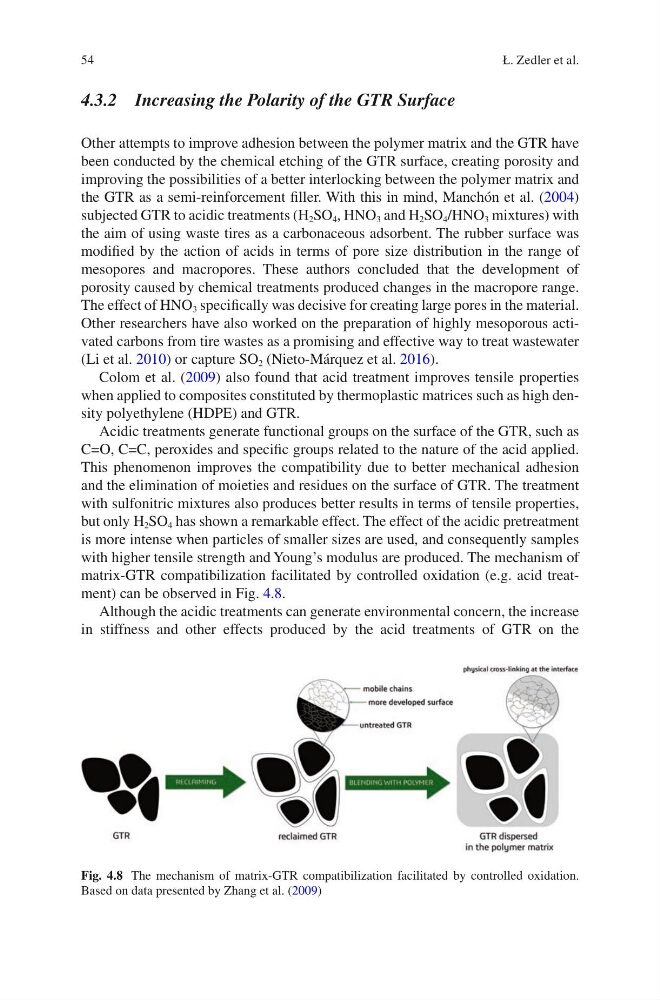
matrix-GTR compatibilization facilitated by controlled oxidation (e.g. acid treatment) can be observed in Fig. 4.8.
Although the acidic treatments can generate environmental concern, the increase
in stiffness and other effects produced by the acid treatments of GTR on the
Fig. 4.8 The mechanism of matrix-GTR compatibilization facilitated by controlled oxidation.
Based on data presented by Zhang et al. (2009)
Ł. Zedler et al.
4.3.2 Increasing the Polarity of the GTR Surface
Other attempts to improve adhesion between the polymer matrix and the GTR have
been conducted by the chemical etching of the GTR surface, creating porosity and
improving the possibilities of a better interlocking between the polymer matrix and
the GTR as a semi-reinforcement filler. With this in mind, Manchón et al. (2004)
subjected GTR to acidic treatments (H 2 SO 4 , HNO 3 and H 2 SO 4 /HNO 3 mixtures) with
the aim of using waste tires as a carbonaceous adsorbent. The rubber surface was
modified by the action of acids in terms of pore size distribution in the range of
mesopores and macropores. These authors concluded that the development of
porosity caused by chemical treatments produced changes in the macropore range.
The effect of HNO 3 specifically was decisive for creating large pores in the material.
Other researchers have also worked on the preparation of highly mesoporous activated carbons from tire wastes as a promising and effective way to treat wastewater
(Li et al. 2010) or capture SO 2 (Nieto-Márquez et al. 2016).
Colom et al. (2009) also found that acid treatment improves tensile properties
when applied to composites constituted by thermoplastic matrices such as high density polyethylene (HDPE) and GTR.
Acidic treatments generate functional groups on the surface of the GTR, such as
C=O, C=C, peroxides and specific groups related to the nature of the acid applied.
This phenomenon improves the compatibility due to better mechanical adhesion
and the elimination of moieties and residues on the surface of GTR. The treatment
with sulfonitric mixtures also produces better results in terms of tensile properties,
but only H 2 SO 4 has shown a remarkable effect. The effect of the acidic pretreatment
is more intense when particles of smaller sizes are used, and consequently samples
with higher tensile strength and Young’s modulus are produced. The mechanism of
matrix-GTR compatibilization facilitated by controlled oxidation (e.g. acid treatment) can be observed in Fig. 4.8.
Although the acidic treatments can generate environmental concern, the increase
in stiffness and other effects produced by the acid treatments of GTR on the
Fig. 4.8 The mechanism of matrix-GTR compatibilization facilitated by controlled oxidation.
Based on data presented by Zhang et al. (2009)
Ł. Zedler et al.