

53
Gibala et al. (1996, 1999) and Gibala & Hamed (1994) pointed out that the
selected curing additives can migrate from the GTR to the polymer matrix, as well
as in the opposite direction. It is worth mentioning that this phenomenon is also
affected by the degree of GTR degradation.
Recent studies have shown that low-temperature reclaiming can improve carbon
black migration from GTR (Formela and Haponiuk 2014, Song et al. 2018). This
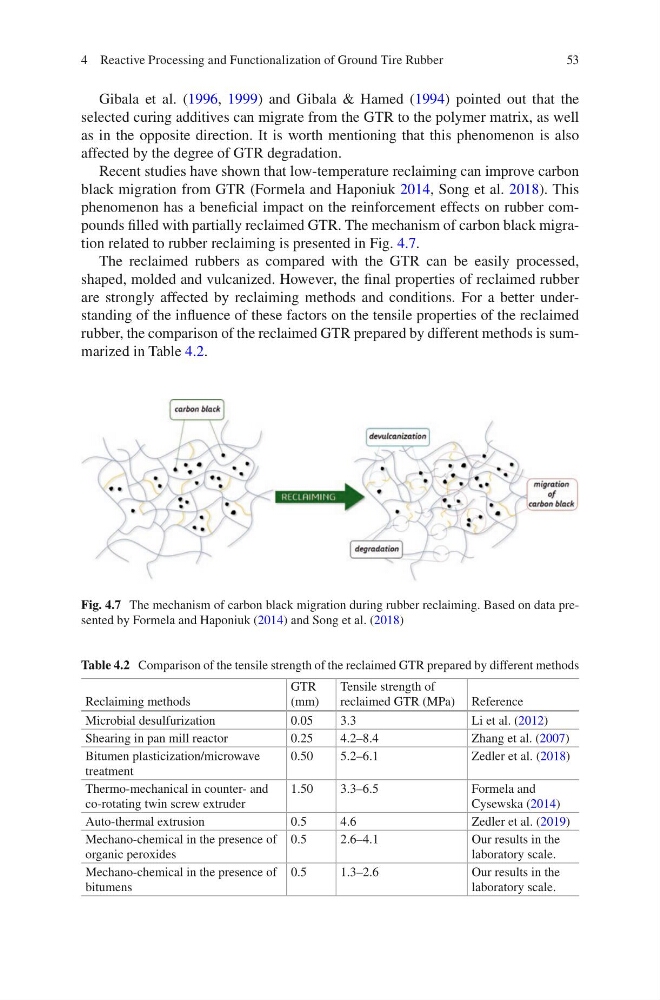
phenomenon has a beneficial impact on the reinforcement effects on rubber compounds filled with partially reclaimed GTR. The mechanism of carbon black migration related to rubber reclaiming is presented in Fig. 4.7.
The reclaimed rubbers as compared with the GTR can be easily processed,
shaped, molded and vulcanized. However, the final properties of reclaimed rubber
are strongly affected by reclaiming methods and conditions. For a better understanding of the influence of these factors on the tensile properties of the reclaimed
rubber, the comparison of the reclaimed GTR prepared by different methods is summarized in Table 4.2.
Fig. 4.7 The mechanism of carbon black migration during rubber reclaiming. Based on data presented by Formela and Haponiuk (2014) and Song et al. (2018)
Table 4.2 Comparison of the tensile strength of the reclaimed GTR prepared by different methods
Reclaiming methods
GTR
(mm)
Tensile strength of
reclaimed GTR (MPa) Reference
Microbial desulfurization
0.05
3.3
Li et al. (2012)
Shearing in pan mill reactor
0.25
4.2–8.4
Zhang et al. (2007)
Bitumen plasticization/microwave
treatment
0.50
5.2–6.1
Zedler et al. (2018)
Thermo-mechanical in counter- and
co-rotating twin screw extruder
1.50
3.3–6.5
Formela and
Cysewska (2014)
Auto-thermal extrusion
0.5
4.6
Zedler et al. (2019)
Mechano-chemical in the presence of
organic peroxides
0.5
2.6–4.1
Our results in the
laboratory scale.
Mechano-chemical in the presence of
bitumens
0.5
1.3–2.6
Our results in the
laboratory scale.
4 Reactive Processing and Functionalization of Ground Tire Rubber
Gibala et al. (1996, 1999) and Gibala & Hamed (1994) pointed out that the
selected curing additives can migrate from the GTR to the polymer matrix, as well
as in the opposite direction. It is worth mentioning that this phenomenon is also
affected by the degree of GTR degradation.
Recent studies have shown that low-temperature reclaiming can improve carbon
black migration from GTR (Formela and Haponiuk 2014, Song et al. 2018). This
phenomenon has a beneficial impact on the reinforcement effects on rubber compounds filled with partially reclaimed GTR. The mechanism of carbon black migration related to rubber reclaiming is presented in Fig. 4.7.
The reclaimed rubbers as compared with the GTR can be easily processed,
shaped, molded and vulcanized. However, the final properties of reclaimed rubber
are strongly affected by reclaiming methods and conditions. For a better understanding of the influence of these factors on the tensile properties of the reclaimed
rubber, the comparison of the reclaimed GTR prepared by different methods is summarized in Table 4.2.
Fig. 4.7 The mechanism of carbon black migration during rubber reclaiming. Based on data presented by Formela and Haponiuk (2014) and Song et al. (2018)
Table 4.2 Comparison of the tensile strength of the reclaimed GTR prepared by different methods
Reclaiming methods
GTR
(mm)
Tensile strength of
reclaimed GTR (MPa) Reference
Microbial desulfurization
0.05
3.3
Li et al. (2012)
Shearing in pan mill reactor
0.25
4.2–8.4
Zhang et al. (2007)
Bitumen plasticization/microwave
treatment
0.50
5.2–6.1
Zedler et al. (2018)
Thermo-mechanical in counter- and
co-rotating twin screw extruder
1.50
3.3–6.5
Formela and
Cysewska (2014)
Auto-thermal extrusion
0.5
4.6
Zedler et al. (2019)
Mechano-chemical in the presence of
organic peroxides
0.5
2.6–4.1
Our results in the
laboratory scale.
Mechano-chemical in the presence of
bitumens
0.5
1.3–2.6
Our results in the
laboratory scale.
4 Reactive Processing and Functionalization of Ground Tire Rubber