

12
2.4 PLGA as a Selected Amphiphilic Polymer
Amphiphilic polymers are a type of macromolecular compounds with low surface
tension consisting of hydrophilic and lipophilic segments. Amphiphilic polymers
due to their chemical characteristics tend to form the separation of microphases,
which can be self-assembled in certain solvents, and surface and bulk structures.
Therefore, amphiphilic polymers are widely used as surfactants, nanomaterials,
drug carriers, coatings, adhesives, separation membranes and thermoplastic
elastomers.
In recent years, nanomaterials have received attention and have become the critical research points. Many types of amphiphilic polymers have been synthesized to
conduct a thorough investigation of their physicochemical properties. In terms of
composition, the hydrophilic segment is generally composed of non-ionic polymers
such as PVA, poly(acrylamide) (PAM), poly(ethylene glycol) (PEG),
poly(ethyleneimine), poly(vinyl ether) (PVE), poly(vinylpyridine) (PVP) and
poly(vinylpyrrolidone). Amphiphilic polymers from the perspective of topology
can simply be classified as blocks, dendrimers, grafts, ignoring gradients and starshaped (Fig. 2.2). The amphiphilic block copolymers are formed by a linear arrangement of the hydrophilic and hydrophobic chains with a certain order, such as AB,
ABA, ABC, ABCD, ABCBA, (AB) n . The block length of the hydrophilic and
hydrophobic chains can be controlled by the preparation process, and in particular
the AB block copolymer can be used as a surfactant. Interestingly, amphiphilic
polymers can be self-assembled to form different morphologies, such as spherical
micelles, rod-shaped micelles, large compound micelles, vesicles and various
bilayer structures (Fig. 2.3).
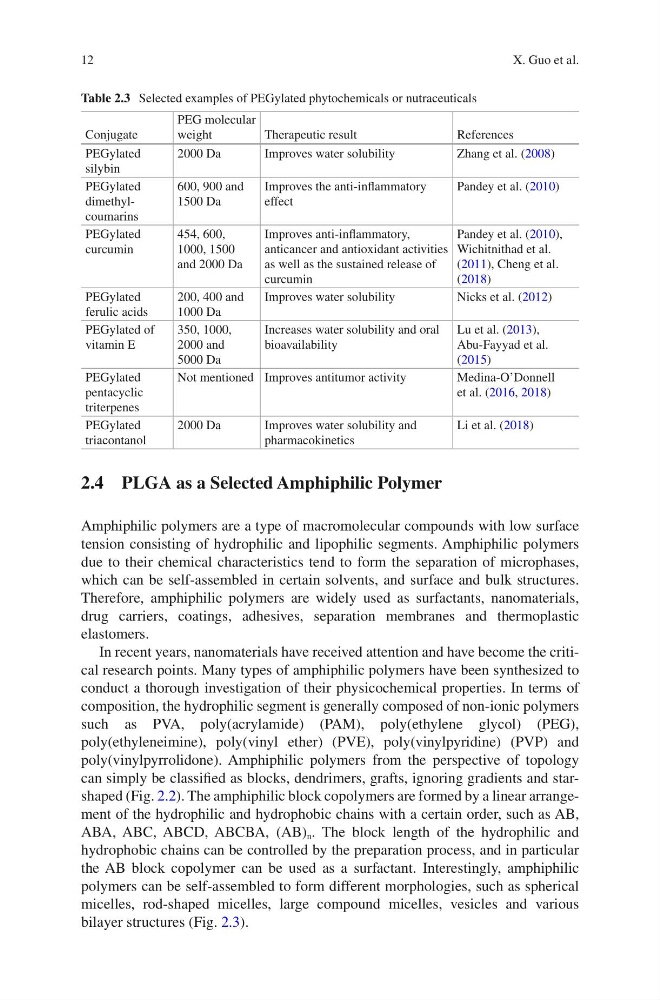
Table 2.3 Selected examples of PEGylated phytochemicals or nutraceuticals
Conjugate
PEG molecular
weight
Therapeutic result
References
PEGylated
silybin
2000 Da
Improves water solubility
Zhang et al. (2008)
PEGylated
dimethylcoumarins
600, 900 and
1500 Da
Improves the anti-inflammatory
effect
Pandey et al. (2010)
PEGylated
curcumin
454, 600,
1000, 1500
and 2000 Da
Improves anti-inflammatory,
anticancer and antioxidant activities
as well as the sustained release of
curcumin
Pandey et al. (2010),
Wichitnithad et al.
(2011), Cheng et al.
(2018)
PEGylated
ferulic acids
200, 400 and
1000 Da
Improves water solubility
Nicks et al. (2012)
PEGylated of
vitamin E
350, 1000,
2000 and
5000 Da
Increases water solubility and oral
bioavailability
Lu et al. (2013),
Abu-Fayyad et al.
(2015)
PEGylated
pentacyclic
triterpenes
Not mentioned Improves antitumor activity
Medina-O’Donnell
et al. (2016, 2018)
PEGylated
triacontanol
2000 Da
Improves water solubility and
pharmacokinetics
Li et al. (2018)
X. Guo et al.
2.4 PLGA as a Selected Amphiphilic Polymer
Amphiphilic polymers are a type of macromolecular compounds with low surface
tension consisting of hydrophilic and lipophilic segments. Amphiphilic polymers
due to their chemical characteristics tend to form the separation of microphases,
which can be self-assembled in certain solvents, and surface and bulk structures.
Therefore, amphiphilic polymers are widely used as surfactants, nanomaterials,
drug carriers, coatings, adhesives, separation membranes and thermoplastic
elastomers.
In recent years, nanomaterials have received attention and have become the critical research points. Many types of amphiphilic polymers have been synthesized to
conduct a thorough investigation of their physicochemical properties. In terms of
composition, the hydrophilic segment is generally composed of non-ionic polymers
such as PVA, poly(acrylamide) (PAM), poly(ethylene glycol) (PEG),
poly(ethyleneimine), poly(vinyl ether) (PVE), poly(vinylpyridine) (PVP) and
poly(vinylpyrrolidone). Amphiphilic polymers from the perspective of topology
can simply be classified as blocks, dendrimers, grafts, ignoring gradients and starshaped (Fig. 2.2). The amphiphilic block copolymers are formed by a linear arrangement of the hydrophilic and hydrophobic chains with a certain order, such as AB,
ABA, ABC, ABCD, ABCBA, (AB) n . The block length of the hydrophilic and
hydrophobic chains can be controlled by the preparation process, and in particular
the AB block copolymer can be used as a surfactant. Interestingly, amphiphilic
polymers can be self-assembled to form different morphologies, such as spherical
micelles, rod-shaped micelles, large compound micelles, vesicles and various
bilayer structures (Fig. 2.3).
Table 2.3 Selected examples of PEGylated phytochemicals or nutraceuticals
Conjugate
PEG molecular
weight
Therapeutic result
References
PEGylated
silybin
2000 Da
Improves water solubility
Zhang et al. (2008)
PEGylated
dimethylcoumarins
600, 900 and
1500 Da
Improves the anti-inflammatory
effect
Pandey et al. (2010)
PEGylated
curcumin
454, 600,
1000, 1500
and 2000 Da
Improves anti-inflammatory,
anticancer and antioxidant activities
as well as the sustained release of
curcumin
Pandey et al. (2010),
Wichitnithad et al.
(2011), Cheng et al.
(2018)
PEGylated
ferulic acids
200, 400 and
1000 Da
Improves water solubility
Nicks et al. (2012)
PEGylated of
vitamin E
350, 1000,
2000 and
5000 Da
Increases water solubility and oral
bioavailability
Lu et al. (2013),
Abu-Fayyad et al.
(2015)
PEGylated
pentacyclic
triterpenes
Not mentioned Improves antitumor activity
Medina-O’Donnell
et al. (2016, 2018)
PEGylated
triacontanol
2000 Da
Improves water solubility and
pharmacokinetics
Li et al. (2018)
X. Guo et al.