

8
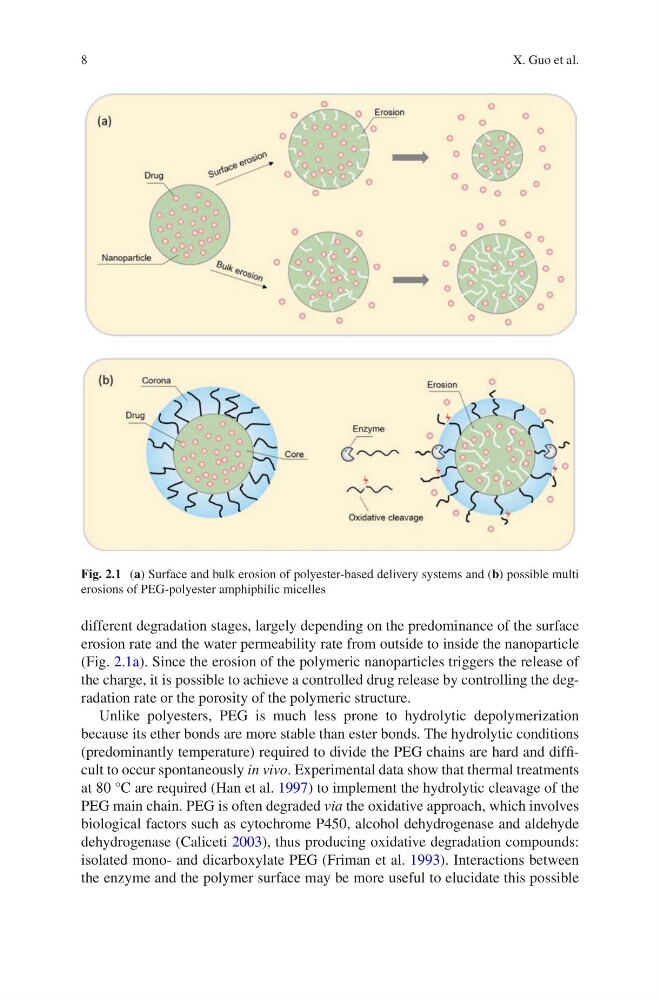
different degradation stages, largely depending on the predominance of the surface
erosion rate and the water permeability rate from outside to inside the nanoparticle
(Fig. 2.1a). Since the erosion of the polymeric nanoparticles triggers the release of
the charge, it is possible to achieve a controlled drug release by controlling the degradation rate or the porosity of the polymeric structure.
Unlike polyesters, PEG is much less prone to hydrolytic depolymerization
because its ether bonds are more stable than ester bonds. The hydrolytic conditions
(predominantly temperature) required to divide the PEG chains are hard and difficult to occur spontaneously in vivo. Experimental data show that thermal treatments
at 80 °C are required (Han et al. 1997) to implement the hydrolytic cleavage of the
PEG main chain. PEG is often degraded via the oxidative approach, which involves
biological factors such as cytochrome P450, alcohol dehydrogenase and aldehyde
dehydrogenase (Caliceti 2003), thus producing oxidative degradation compounds:
isolated mono- and dicarboxylate PEG (Friman et al. 1993). Interactions between
the enzyme and the polymer surface may be more useful to elucidate this possible
Fig. 2.1 (a) Surface and bulk erosion of polyester-based delivery systems and (b) possible multi
erosions of PEG-polyester amphiphilic micelles
X. Guo et al.
different degradation stages, largely depending on the predominance of the surface
erosion rate and the water permeability rate from outside to inside the nanoparticle
(Fig. 2.1a). Since the erosion of the polymeric nanoparticles triggers the release of
the charge, it is possible to achieve a controlled drug release by controlling the degradation rate or the porosity of the polymeric structure.
Unlike polyesters, PEG is much less prone to hydrolytic depolymerization
because its ether bonds are more stable than ester bonds. The hydrolytic conditions
(predominantly temperature) required to divide the PEG chains are hard and difficult to occur spontaneously in vivo. Experimental data show that thermal treatments
at 80 °C are required (Han et al. 1997) to implement the hydrolytic cleavage of the
PEG main chain. PEG is often degraded via the oxidative approach, which involves
biological factors such as cytochrome P450, alcohol dehydrogenase and aldehyde
dehydrogenase (Caliceti 2003), thus producing oxidative degradation compounds:
isolated mono- and dicarboxylate PEG (Friman et al. 1993). Interactions between
the enzyme and the polymer surface may be more useful to elucidate this possible
Fig. 2.1 (a) Surface and bulk erosion of polyester-based delivery systems and (b) possible multi
erosions of PEG-polyester amphiphilic micelles
X. Guo et al.