

7
the biodegradable properties of polymers in vivo suggests that their biodegradation
can be driven by hydrolytic depolymerization and, alternatively, by thermal and
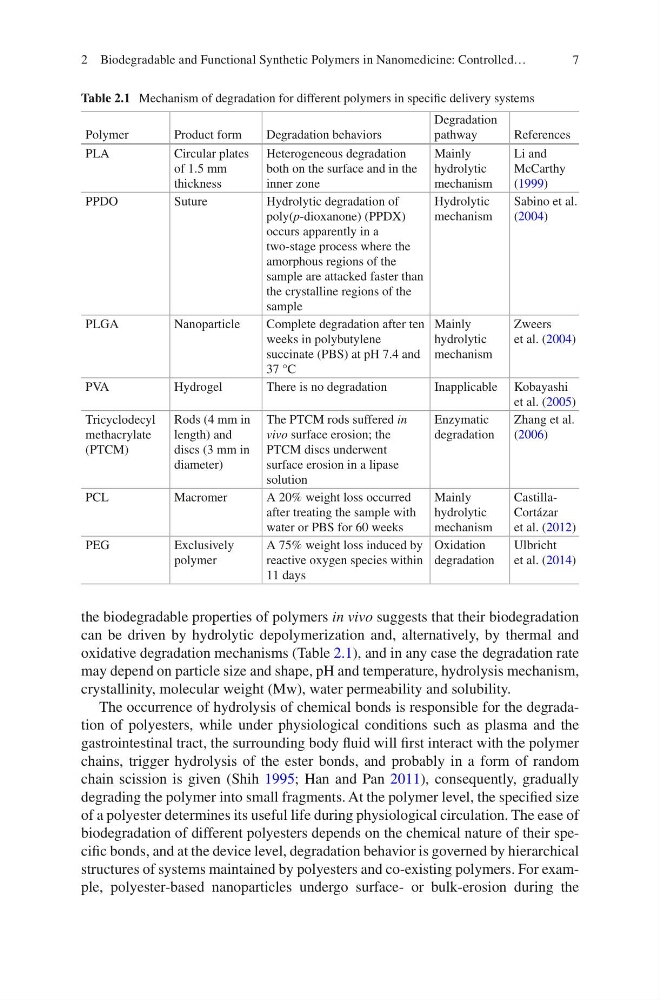
oxidative degradation mechanisms (Table 2.1), and in any case the degradation rate
may depend on particle size and shape, pH and temperature, hydrolysis mechanism,
crystallinity, molecular weight (Mw), water permeability and solubility.
The occurrence of hydrolysis of chemical bonds is responsible for the degradation of polyesters, while under physiological conditions such as plasma and the
gastrointestinal tract, the surrounding body fluid will first interact with the polymer
chains, trigger hydrolysis of the ester bonds, and probably in a form of random
chain scission is given (Shih 1995; Han and Pan 2011), consequently, gradually
degrading the polymer into small fragments. At the polymer level, the specified size
of a polyester determines its useful life during physiological circulation. The ease of
biodegradation of different polyesters depends on the chemical nature of their specific bonds, and at the device level, degradation behavior is governed by hierarchical
structures of systems maintained by polyesters and co-existing polymers. For example, polyester-based nanoparticles undergo surface- or bulk-erosion during the
Table 2.1 Mechanism of degradation for different polymers in specific delivery systems
Polymer
Product form
Degradation behaviors
Degradation
pathway
References
PLA
Circular plates
of 1.5 mm
thickness
Heterogeneous degradation
both on the surface and in the
inner zone
Mainly
hydrolytic
mechanism
Li and
McCarthy
(1999)
PPDO
Suture
Hydrolytic degradation of
poly(p-dioxanone) (PPDX)
occurs apparently in a
two-stage process where the
amorphous regions of the
sample are attacked faster than
the crystalline regions of the
sample
Hydrolytic
mechanism
Sabino et al.
(2004)
PLGA
Nanoparticle
Complete degradation after ten
weeks in polybutylene
succinate (PBS) at pH 7.4 and
37 °C
Mainly
hydrolytic
mechanism
Zweers
et al. (2004)
PVA
Hydrogel
There is no degradation
Inapplicable Kobayashi
et al. (2005)
Tricyclodecyl
methacrylate
(PTCM)
Rods (4 mm in
length) and
discs (3 mm in
diameter)
The PTCM rods suffered in
vivo surface erosion; the
PTCM discs underwent
surface erosion in a lipase
solution
Enzymatic
degradation
Zhang et al.
(2006)
PCL
Macromer
A 20% weight loss occurred
after treating the sample with
water or PBS for 60 weeks
Mainly
hydrolytic
mechanism
CastillaCortázar
et al. (2012)
PEG
Exclusively
polymer
A 75% weight loss induced by
reactive oxygen species within
11 days
Oxidation
degradation
Ulbricht
et al. (2014)
2 Biodegradable and Functional Synthetic Polymers in Nanomedicine: Controlled…
the biodegradable properties of polymers in vivo suggests that their biodegradation
can be driven by hydrolytic depolymerization and, alternatively, by thermal and
oxidative degradation mechanisms (Table 2.1), and in any case the degradation rate
may depend on particle size and shape, pH and temperature, hydrolysis mechanism,
crystallinity, molecular weight (Mw), water permeability and solubility.
The occurrence of hydrolysis of chemical bonds is responsible for the degradation of polyesters, while under physiological conditions such as plasma and the
gastrointestinal tract, the surrounding body fluid will first interact with the polymer
chains, trigger hydrolysis of the ester bonds, and probably in a form of random
chain scission is given (Shih 1995; Han and Pan 2011), consequently, gradually
degrading the polymer into small fragments. At the polymer level, the specified size
of a polyester determines its useful life during physiological circulation. The ease of
biodegradation of different polyesters depends on the chemical nature of their specific bonds, and at the device level, degradation behavior is governed by hierarchical
structures of systems maintained by polyesters and co-existing polymers. For example, polyester-based nanoparticles undergo surface- or bulk-erosion during the
Table 2.1 Mechanism of degradation for different polymers in specific delivery systems
Polymer
Product form
Degradation behaviors
Degradation
pathway
References
PLA
Circular plates
of 1.5 mm
thickness
Heterogeneous degradation
both on the surface and in the
inner zone
Mainly
hydrolytic
mechanism
Li and
McCarthy
(1999)
PPDO
Suture
Hydrolytic degradation of
poly(p-dioxanone) (PPDX)
occurs apparently in a
two-stage process where the
amorphous regions of the
sample are attacked faster than
the crystalline regions of the
sample
Hydrolytic
mechanism
Sabino et al.
(2004)
PLGA
Nanoparticle
Complete degradation after ten
weeks in polybutylene
succinate (PBS) at pH 7.4 and
37 °C
Mainly
hydrolytic
mechanism
Zweers
et al. (2004)
PVA
Hydrogel
There is no degradation
Inapplicable Kobayashi
et al. (2005)
Tricyclodecyl
methacrylate
(PTCM)
Rods (4 mm in
length) and
discs (3 mm in
diameter)
The PTCM rods suffered in
vivo surface erosion; the
PTCM discs underwent
surface erosion in a lipase
solution
Enzymatic
degradation
Zhang et al.
(2006)
PCL
Macromer
A 20% weight loss occurred
after treating the sample with
water or PBS for 60 weeks
Mainly
hydrolytic
mechanism
CastillaCortázar
et al. (2012)
PEG
Exclusively
polymer
A 75% weight loss induced by
reactive oxygen species within
11 days
Oxidation
degradation
Ulbricht
et al. (2014)
2 Biodegradable and Functional Synthetic Polymers in Nanomedicine: Controlled…