

for this prototypical analysis, Jurkat wild-type cells were processed
as outlined above. Sixty fractions were sampled across the gradient.
In addition, a full proteome map of the sample that later separated
by SEC was acquired. The results of SEC-SWATH measurements
were analyzed with the CCprofiler tool [20], which identifies protein complexes from protein co-elution profiles using a complexcentric strategy.
1. The OpenSWATH workflow (OSW) is a computational tool
for extracting quantitative data from SWATH or DIA measurements. The OSW is described in detail in tutorials [30, 31] that
cover installation instructions, explanations for the various settings, and offer examples for reanalysis and optimization. The
aim of this section is to highlight the applicability of the OSW
for Evosep One data. To test the workflow, download the
Jurkat example from ProteomeXchange (data set identifier:
PXD018033). Save the spectral assay library, which contains
proteotypic peptides from the PanHuman library supplemented with Decoys and iRT-peptide sequences (see Note 21) in a
folder. Download the cIRT and the *mzXML files and save it in
the same folder. For a brief overview and comments on the
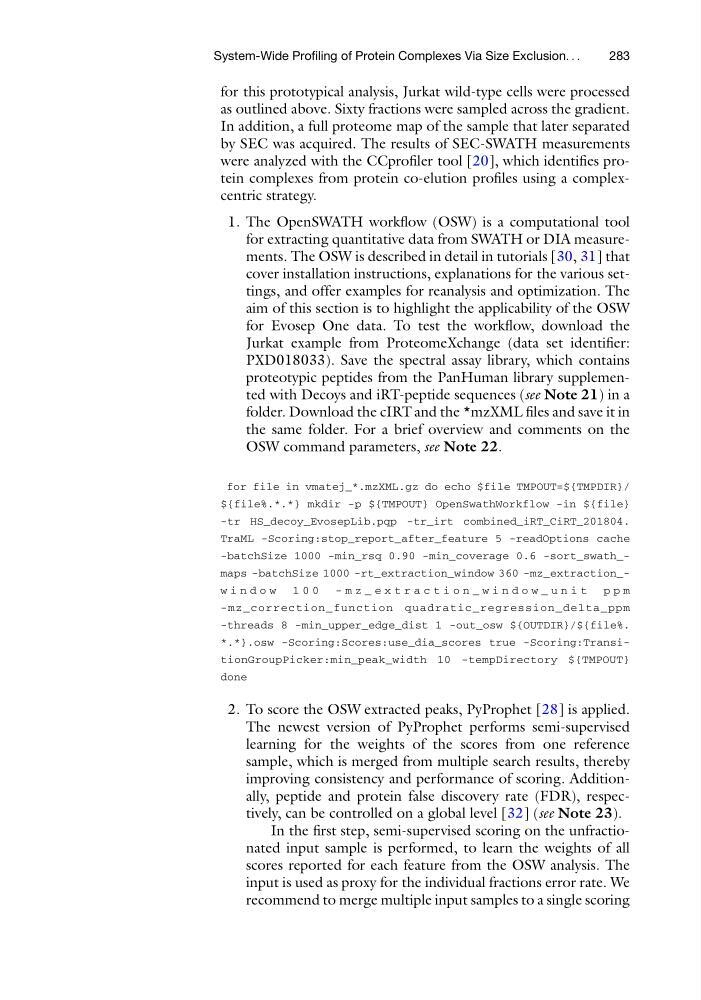
OSW command parameters, see Note 22.
for file in vmatej_*.mzXML.gz do echo $file TMPOUT=${TMPDIR}/
${file%.*.*} mkdir -p ${TMPOUT} OpenSwathWorkflow -in ${file}
-tr HS_decoy_EvosepLib.pqp -tr_irt combined_iRT_CiRT_201804.
TraML -Scoring:stop_report_after_feature 5 -readOptions cache
-batchSize 1000 -min_rsq 0.90 -min_coverage 0.6 -sort_swath_maps -batchSize 1000 -rt_extraction_window 360 -mz_extraction_w i n d o w 1 0 0 - m z _ e x t r a c t i o n _ w i n d o w _ u n i t p p m
-mz_correction_function quadratic_regression_delta_ppm
-threads 8 -min_upper_edge_dist 1 -out_osw ${OUTDIR}/${file%.
*.*}.osw -Scoring:Scores:use_dia_scores true -Scoring:TransitionGroupPicker:min_peak_width 10 -tempDirectory ${TMPOUT}
done
2. To score the OSW extracted peaks, PyProphet [28] is applied.
The newest version of PyProphet performs semi-supervised
learning for the weights of the scores from one reference
sample, which is merged from multiple search results, thereby
improving consistency and performance of scoring. Additionally, peptide and protein false discovery rate (FDR), respectively, can be controlled on a global level [32] (see Note 23).
In the first step, semi-supervised scoring on the unfractionated input sample is performed, to learn the weights of all
scores reported for each feature from the OSW analysis. The
input is used as proxy for the individual fractions error rate. We
recommend to merge multiple input samples to a single scoring
System-Wide Profiling of Protein Complexes Via Size Exclusion. . .
283
as outlined above. Sixty fractions were sampled across the gradient.
In addition, a full proteome map of the sample that later separated
by SEC was acquired. The results of SEC-SWATH measurements
were analyzed with the CCprofiler tool [20], which identifies protein complexes from protein co-elution profiles using a complexcentric strategy.
1. The OpenSWATH workflow (OSW) is a computational tool
for extracting quantitative data from SWATH or DIA measurements. The OSW is described in detail in tutorials [30, 31] that
cover installation instructions, explanations for the various settings, and offer examples for reanalysis and optimization. The
aim of this section is to highlight the applicability of the OSW
for Evosep One data. To test the workflow, download the
Jurkat example from ProteomeXchange (data set identifier:
PXD018033). Save the spectral assay library, which contains
proteotypic peptides from the PanHuman library supplemented with Decoys and iRT-peptide sequences (see Note 21) in a
folder. Download the cIRT and the *mzXML files and save it in
the same folder. For a brief overview and comments on the
OSW command parameters, see Note 22.
for file in vmatej_*.mzXML.gz do echo $file TMPOUT=${TMPDIR}/
${file%.*.*} mkdir -p ${TMPOUT} OpenSwathWorkflow -in ${file}
-tr HS_decoy_EvosepLib.pqp -tr_irt combined_iRT_CiRT_201804.
TraML -Scoring:stop_report_after_feature 5 -readOptions cache
-batchSize 1000 -min_rsq 0.90 -min_coverage 0.6 -sort_swath_maps -batchSize 1000 -rt_extraction_window 360 -mz_extraction_w i n d o w 1 0 0 - m z _ e x t r a c t i o n _ w i n d o w _ u n i t p p m
-mz_correction_function quadratic_regression_delta_ppm
-threads 8 -min_upper_edge_dist 1 -out_osw ${OUTDIR}/${file%.
*.*}.osw -Scoring:Scores:use_dia_scores true -Scoring:TransitionGroupPicker:min_peak_width 10 -tempDirectory ${TMPOUT}
done
2. To score the OSW extracted peaks, PyProphet [28] is applied.
The newest version of PyProphet performs semi-supervised
learning for the weights of the scores from one reference
sample, which is merged from multiple search results, thereby
improving consistency and performance of scoring. Additionally, peptide and protein false discovery rate (FDR), respectively, can be controlled on a global level [32] (see Note 23).
In the first step, semi-supervised scoring on the unfractionated input sample is performed, to learn the weights of all
scores reported for each feature from the OSW analysis. The
input is used as proxy for the individual fractions error rate. We
recommend to merge multiple input samples to a single scoring
System-Wide Profiling of Protein Complexes Via Size Exclusion. . .
283