

4. MS acquisition parameters.
Acquire the data in SWATH mode [23] with 64 variably
sized precursor co-isolation windows [24]. For the TripleTOF
6600, use the following parameters:
(a) Acquisition time per run was set to 20.996 min. Precursor
ions were selected from a m/z range 350–1500 m/z with
a maximum MS1 survey scan fill time of 100 ms. Fragment ions were acquired from 350 to 1500 m/z with
20 ms scan time for each variable SWATH window
(updated SWATH windows are essentially described in
[24]), resulting in a total cycle time of 1.431 s. For
SWATH measurements the TripleTOF 6600 was operated
in high sensitivity scan mode.
(b) MS parameter setting:
l
Declustering potential (DP): 100.
l
Collision energy (CE): The collision energy for each
window was set using the collision energy of a 2+ ion
centered in the middle of the window (equation:
0.0625 Â m/z—3.5) with a collision energy spread
(CES) of 15.0 eV.
l
Ion release delay (IRD): 30.
l
Ion release width (IRW): 15.
5. Sample injection with the Evosep One.
(a) Place the Evotips box with peptides bound to the resin, in
one of the source tray positions, and remove the box
cover-lid.
(b) Start Chronos and Analyst and submit the queue.
3.7 Data Analysis
Pipeline
In the following sections, we provide a brief overview of how to
analyze SEC-Evosep One-SWATH data employing OpenSWATH,
PyProphet [28], and TRIC [29] (see Note 20). To generate data
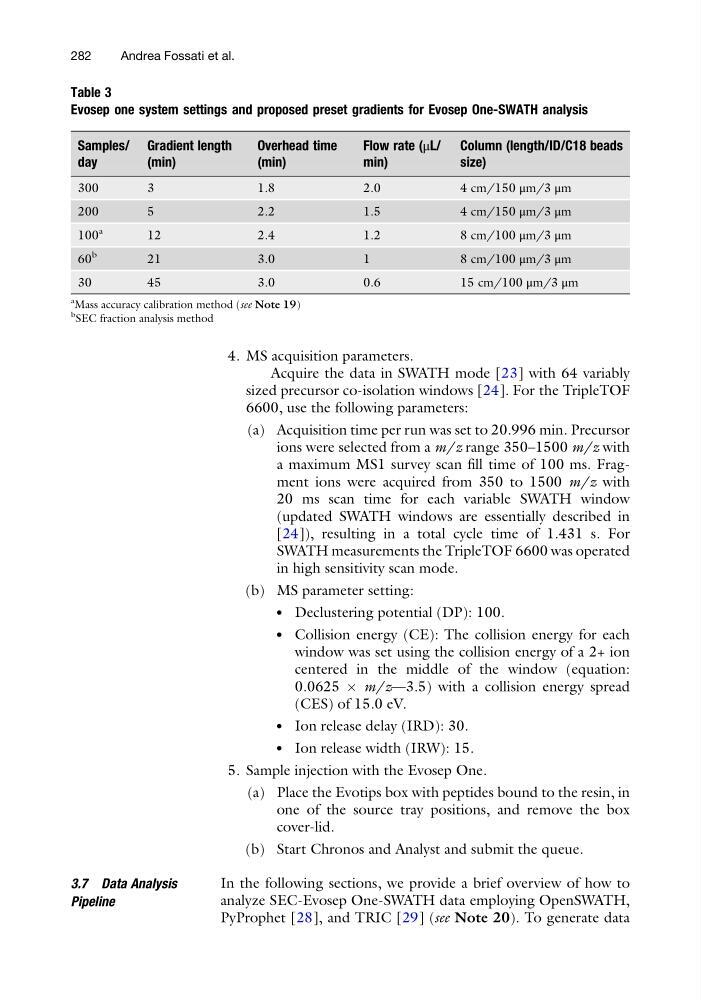
Table 3
Evosep one system settings and proposed preset gradients for Evosep One-SWATH analysis
Samples/
day
Gradient length
(min)
Overhead time
(min)
Flow rate (μL/
min)
Column (length/ID/C18 beads
size)
300
3
1.8
2.0
4 cm/150 μm/3 μm
200
5
2.2
1.5
4 cm/150 μm/3 μm
100
a
12
2.4
1.2
8 cm/100 μm/3 μm
60
b
21
3.0
1
8 cm/100 μm/3 μm
30
45
3.0
0.6
15 cm/100 μm/3 μm
a
Mass accuracy calibration method (see Note 19)
b
SEC fraction analysis method
282
Andrea Fossati et al.
Acquire the data in SWATH mode [23] with 64 variably
sized precursor co-isolation windows [24]. For the TripleTOF
6600, use the following parameters:
(a) Acquisition time per run was set to 20.996 min. Precursor
ions were selected from a m/z range 350–1500 m/z with
a maximum MS1 survey scan fill time of 100 ms. Fragment ions were acquired from 350 to 1500 m/z with
20 ms scan time for each variable SWATH window
(updated SWATH windows are essentially described in
[24]), resulting in a total cycle time of 1.431 s. For
SWATH measurements the TripleTOF 6600 was operated
in high sensitivity scan mode.
(b) MS parameter setting:
l
Declustering potential (DP): 100.
l
Collision energy (CE): The collision energy for each
window was set using the collision energy of a 2+ ion
centered in the middle of the window (equation:
0.0625 Â m/z—3.5) with a collision energy spread
(CES) of 15.0 eV.
l
Ion release delay (IRD): 30.
l
Ion release width (IRW): 15.
5. Sample injection with the Evosep One.
(a) Place the Evotips box with peptides bound to the resin, in
one of the source tray positions, and remove the box
cover-lid.
(b) Start Chronos and Analyst and submit the queue.
3.7 Data Analysis
Pipeline
In the following sections, we provide a brief overview of how to
analyze SEC-Evosep One-SWATH data employing OpenSWATH,
PyProphet [28], and TRIC [29] (see Note 20). To generate data
Table 3
Evosep one system settings and proposed preset gradients for Evosep One-SWATH analysis
Samples/
day
Gradient length
(min)
Overhead time
(min)
Flow rate (μL/
min)
Column (length/ID/C18 beads
size)
300
3
1.8
2.0
4 cm/150 μm/3 μm
200
5
2.2
1.5
4 cm/150 μm/3 μm
100
a
12
2.4
1.2
8 cm/100 μm/3 μm
60
b
21
3.0
1
8 cm/100 μm/3 μm
30
45
3.0
0.6
15 cm/100 μm/3 μm
a
Mass accuracy calibration method (see Note 19)
b
SEC fraction analysis method
282
Andrea Fossati et al.