

(19.196) and (19.197). Thus, total eight linear combinations constitute MOs of
methane.
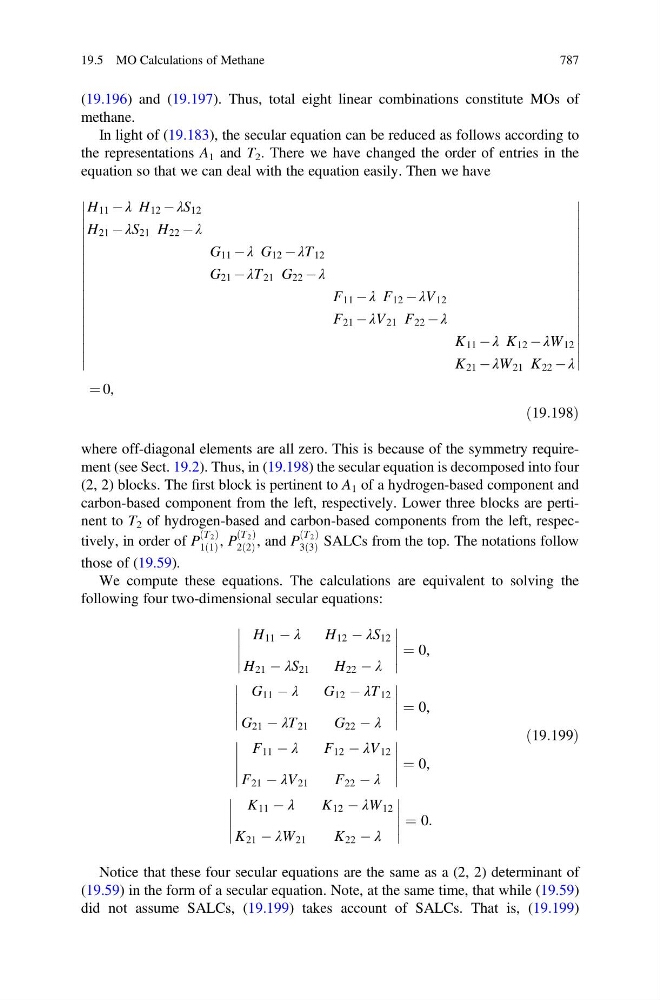
In light of (19.183), the secular equation can be reduced as follows according to
the representations A 1 and T 2 . There we have changed the order of entries in the
equation so that we can deal with the equation easily. Then we have
H 11 À λ H 12 À λS 12
H 21 À λS 21 H 22 À λ
G 11 À λ G 12 À λT 12
G 21 À λT 21 G 22 À λ
F 11 À λ F 12 À λV 12
F 21 À λV 21 F 22 À λ
K 11 À λ K 12 À λW 12
K 21 À λW 21 K 22 À λ
¼ 0,
ð19:198Þ
where off-diagonal elements are all zero. This is because of the symmetry requirement (see Sect. 19.2). Thus, in (19.198) the secular equation is decomposed into four
(2, 2) blocks. The first block is pertinent to A 1 of a hydrogen-based component and
carbon-based component from the left, respectively. Lower three blocks are pertinent to T 2 of hydrogen-based and carbon-based components from the left, respectively, in order of P
T 2
ð Þ
1 1
ð Þ , P
T 2
ð Þ
2 2
ð Þ , and P
T 2
ð Þ
3 3
ð Þ SALCs from the top. The notations follow
those of (19.59).
We compute these equations. The calculations are equivalent to solving the
following four two-dimensional secular equations:
H 11 À λ
H 12 À λS 12
H 21 À λS 21
H 22 À λ
¼ 0,
G 11 À λ
G 12 À λT 12
G 21 À λT 21
G 22 À λ
¼ 0,
F 11 À λ
F 12 À λV 12
F 21 À λV 21
F 22 À λ
¼ 0,
K 11 À λ
K 12 À λW 12
K 21 À λW 21
K 22 À λ
¼ 0:
ð19:199Þ
Notice that these four secular equations are the same as a (2, 2) determinant of
(19.59) in the form of a secular equation. Note, at the same time, that while (19.59)
did not assume SALCs, (19.199) takes account of SALCs. That is, (19.199)
19.5 MO Calculations of Methane
787