

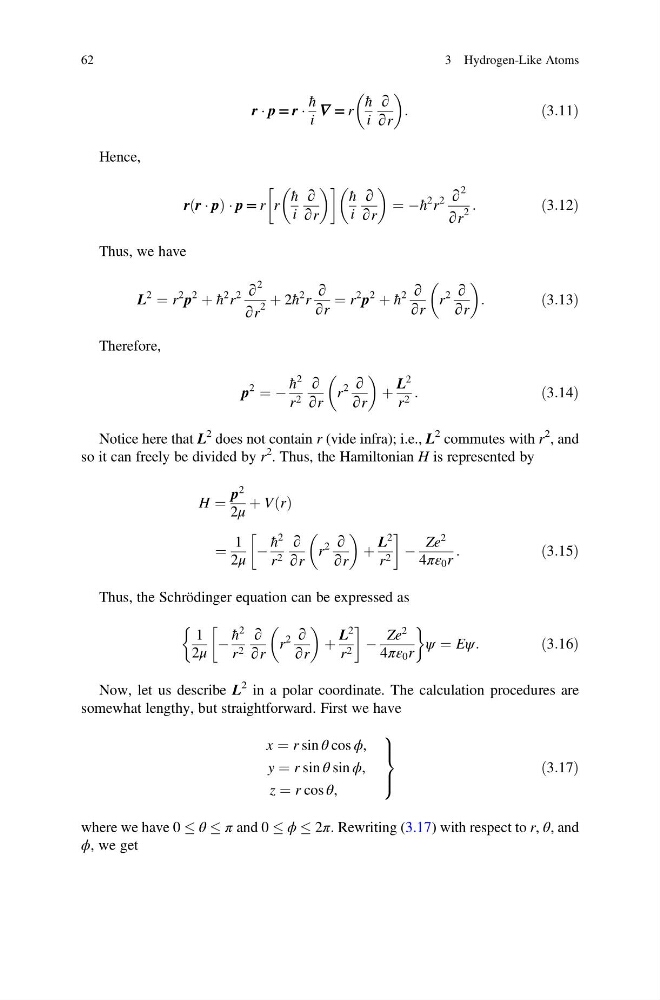
r Á p = r Á
ħ
i
— = r
ħ
i
∂
∂r
:
ð3:11Þ
Hence,
r r Á p
ð
ÞÁp = r r
ħ
i
∂
∂r
! ħ
i
∂
∂r
¼ Àħ
2 r
2 ∂
2
∂r
2
:
ð3:12Þ
Thus, we have
L
2
¼ r
2 p
2
þ ħ
2 r
2 ∂
2
∂r
2
þ 2ħ
2 r
∂
∂r
¼ r
2 p
2
þ ħ
2 ∂
∂r
r
2 ∂
∂r
:
ð3:13Þ
Therefore,
p
2
¼ À
ħ
2
r 2
∂
∂r
r
2 ∂
∂r
þ
L
2
r 2 :
ð3:14Þ
Notice here that L
2 does not contain r (vide infra); i.e., L
2 commutes with r
2 , and
so it can freely be divided by r
2 . Thus, the Hamiltonian H is represented by
H ¼
p
2
2μ
þ V r
ð Þ
¼
1
2μ
À
ħ
2
r 2
∂
∂r
r
2 ∂
∂r
þ
L
2
r 2
!
À
Ze
2
4πε 0 r
:
ð3:15Þ
Thus, the Schrödinger equation can be expressed as
1
2μ
À
ħ
2
r 2
∂
∂r
r
2 ∂
∂r
þ
L
2
r 2
!
À
Ze
2
4πε 0 r
&
'
ψ ¼ Eψ:
ð3:16Þ
Now, let us describe L
2 in a polar coordinate. The calculation procedures are
somewhat lengthy, but straightforward. First we have
x ¼ r sin θ cos ϕ,
y ¼ r sin θ sin ϕ,
z ¼ r cos θ,
9
> =
> ;
ð3:17Þ
where we have 0 θ π and 0 ϕ 2π. Rewriting (3.17) with respect to r, θ, and
ϕ, we get
62
3 Hydrogen-Like Atoms
ħ
i
— = r
ħ
i
∂
∂r
:
ð3:11Þ
Hence,
r r Á p
ð
ÞÁp = r r
ħ
i
∂
∂r
! ħ
i
∂
∂r
¼ Àħ
2 r
2 ∂
2
∂r
2
:
ð3:12Þ
Thus, we have
L
2
¼ r
2 p
2
þ ħ
2 r
2 ∂
2
∂r
2
þ 2ħ
2 r
∂
∂r
¼ r
2 p
2
þ ħ
2 ∂
∂r
r
2 ∂
∂r
:
ð3:13Þ
Therefore,
p
2
¼ À
ħ
2
r 2
∂
∂r
r
2 ∂
∂r
þ
L
2
r 2 :
ð3:14Þ
Notice here that L
2 does not contain r (vide infra); i.e., L
2 commutes with r
2 , and
so it can freely be divided by r
2 . Thus, the Hamiltonian H is represented by
H ¼
p
2
2μ
þ V r
ð Þ
¼
1
2μ
À
ħ
2
r 2
∂
∂r
r
2 ∂
∂r
þ
L
2
r 2
!
À
Ze
2
4πε 0 r
:
ð3:15Þ
Thus, the Schrödinger equation can be expressed as
1
2μ
À
ħ
2
r 2
∂
∂r
r
2 ∂
∂r
þ
L
2
r 2
!
À
Ze
2
4πε 0 r
&
'
ψ ¼ Eψ:
ð3:16Þ
Now, let us describe L
2 in a polar coordinate. The calculation procedures are
somewhat lengthy, but straightforward. First we have
x ¼ r sin θ cos ϕ,
y ¼ r sin θ sin ϕ,
z ¼ r cos θ,
9
> =
> ;
ð3:17Þ
where we have 0 θ π and 0 ϕ 2π. Rewriting (3.17) with respect to r, θ, and
ϕ, we get
62
3 Hydrogen-Like Atoms