

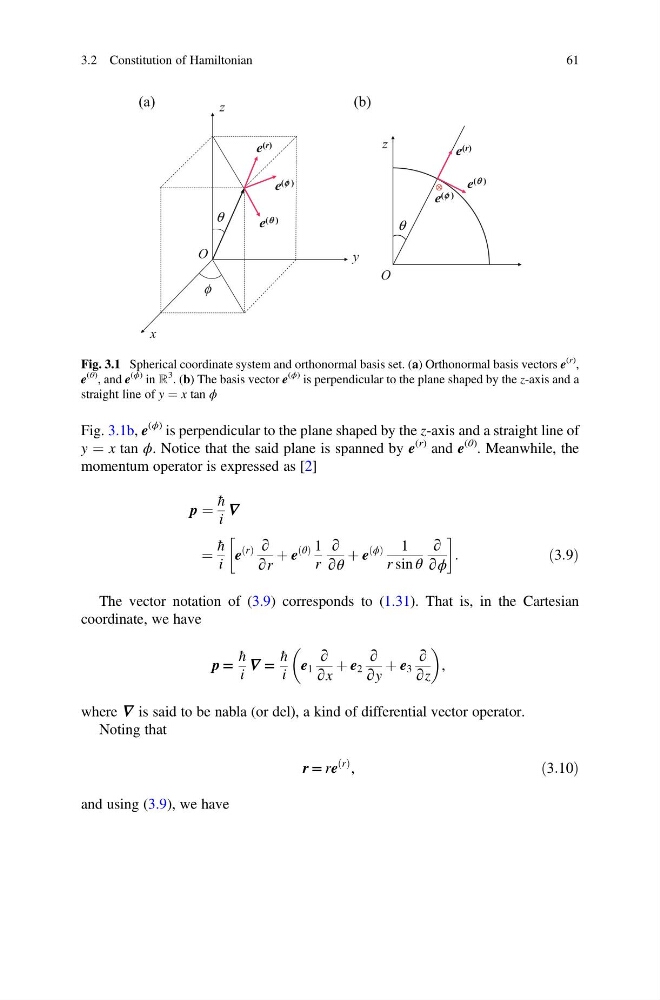
Fig. 3.1b, e
(ϕ) is perpendicular to the plane shaped by the z-axis and a straight line of
y ¼ x tan ϕ. Notice that the said plane is spanned by e
(r) and e
(θ)
. Meanwhile, the
momentum operator is expressed as [2]
p ¼
ħ
i
—
¼
ħ
i
e
r
ð Þ ∂
∂r
þ e
θ
ð Þ 1
r
∂
∂θ
þ e
ϕ
ð Þ
1
r sin θ
∂
∂ϕ
!
:
ð3:9Þ
The vector notation of (3.9) corresponds to (1.31). That is, in the Cartesian
coordinate, we have
p =
ħ
i
— =
ħ
i
e 1
∂
∂x
þ e 2
∂
∂y
þ e 3
∂
∂z
,
where — is said to be nabla (or del), a kind of differential vector operator.
Noting that
r = re
r
ð Þ ,
ð3:10Þ
and using (3.9), we have
y
x
z
θ
φ
e (r)
e (θ )
e (φ )
O
(a)
(b)
θ
e (r)
e (θ )
e (φ )
z
O
Fig. 3.1 Spherical coordinate system and orthonormal basis set. (a) Orthonormal basis vectors e
(r) ,
e
(θ) , and e
(ϕ) in ℝ
3
. (b) The basis vector e
(ϕ) is perpendicular to the plane shaped by the z-axis and a
straight line of y ¼ x tan ϕ
3.2 Constitution of Hamiltonian
61
(ϕ) is perpendicular to the plane shaped by the z-axis and a straight line of
y ¼ x tan ϕ. Notice that the said plane is spanned by e
(r) and e
(θ)
. Meanwhile, the
momentum operator is expressed as [2]
p ¼
ħ
i
—
¼
ħ
i
e
r
ð Þ ∂
∂r
þ e
θ
ð Þ 1
r
∂
∂θ
þ e
ϕ
ð Þ
1
r sin θ
∂
∂ϕ
!
:
ð3:9Þ
The vector notation of (3.9) corresponds to (1.31). That is, in the Cartesian
coordinate, we have
p =
ħ
i
— =
ħ
i
e 1
∂
∂x
þ e 2
∂
∂y
þ e 3
∂
∂z
,
where — is said to be nabla (or del), a kind of differential vector operator.
Noting that
r = re
r
ð Þ ,
ð3:10Þ
and using (3.9), we have
y
x
z
θ
φ
e (r)
e (θ )
e (φ )
O
(a)
(b)
θ
e (r)
e (θ )
e (φ )
z
O
Fig. 3.1 Spherical coordinate system and orthonormal basis set. (a) Orthonormal basis vectors e
(r) ,
e
(θ) , and e
(ϕ) in ℝ
3
. (b) The basis vector e
(ϕ) is perpendicular to the plane shaped by the z-axis and a
straight line of y ¼ x tan ϕ
3.2 Constitution of Hamiltonian
61