

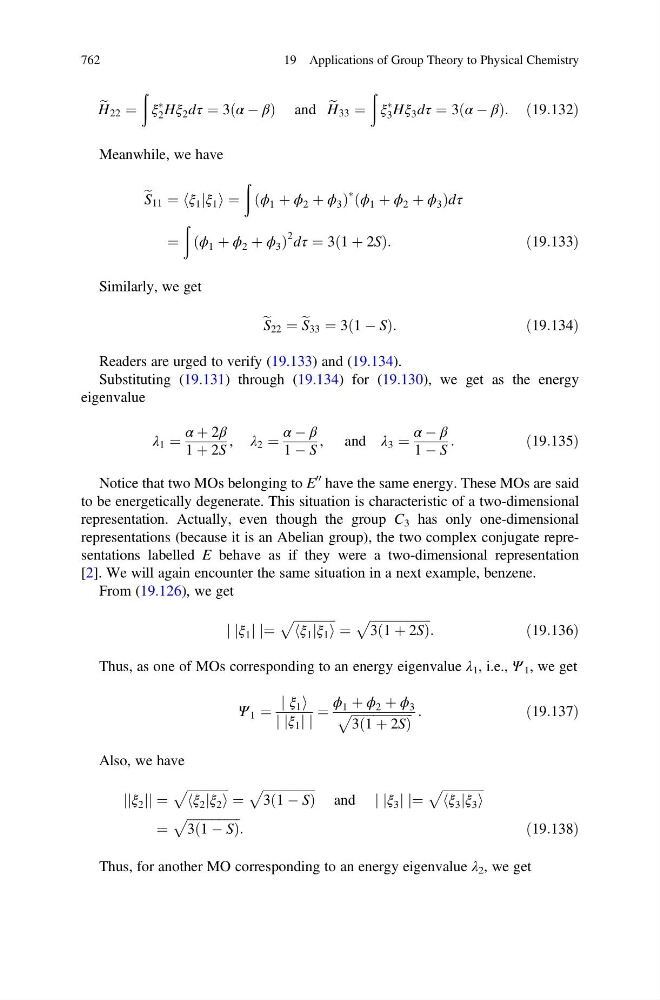
e
H 22 ¼
ð
ξ
Ã
2 Hξ 2 dτ ¼ 3 α À β
ð
Þ and e
H 33 ¼
ð
ξ
Ã
3 Hξ 3 dτ ¼ 3 α À β
ð
Þ: ð19:132Þ
Meanwhile, we have
e S 11 ¼ ξ 1 jξ 1
h
i¼
ð
ϕ 1 þ ϕ 2 þ ϕ 3
ð
Þ
à ϕ 1 þ ϕ 2 þ ϕ 3
ð
Þ dτ
¼
ð
ϕ 1 þ ϕ 2 þ ϕ 3
ð
Þ
2 dτ ¼ 3 1 þ 2S
ð
Þ:
ð19:133Þ
Similarly, we get
e S 22 ¼ e S 33 ¼ 3 1 À S
ð
Þ:
ð19:134Þ
Readers are urged to verify (19.133) and (19.134).
Substituting (19.131) through (19.134) for (19.130), we get as the energy
eigenvalue
λ 1 ¼
α þ 2β
1 þ 2S
, λ 2 ¼
α À β
1 À S
, and λ 3 ¼
α À β
1 À S
:
ð19:135Þ
Notice that two MOs belonging to E
00 have the same energy. These MOs are said
to be energetically degenerate. This situation is characteristic of a two-dimensional
representation. Actually, even though the group C 3 has only one-dimensional
representations (because it is an Abelian group), the two complex conjugate representations labelled E behave as if they were a two-dimensional representation
[2]. We will again encounter the same situation in a next example, benzene.
From (19.126), we get
j ξ 1
j j j¼
ffiffiffiffiffiffiffiffiffiffiffiffiffi ffi
ξ 1 jξ 1
h
i
p
¼
ffiffiffiffiffiffiffiffiffiffiffiffiffiffiffiffiffiffiffi ffi
3 1 þ 2S
ð
Þ
p
:
ð19:136Þ
Thus, as one of MOs corresponding to an energy eigenvalue λ 1 , i.e., Ψ 1 , we get
Ψ 1 ¼
j ξ 1 i
j ξ 1
j j j
¼
ϕ 1 þ ϕ 2 þ ϕ 3
ffiffiffiffiffiffiffiffiffiffiffiffiffiffiffiffiffiffiffi ffi
3 1 þ 2S
ð
Þ
p
:
ð19:137Þ
Also, we have
ξ 2
j j
j j ¼
ffiffiffiffiffiffiffiffiffiffiffiffiffi ffi
ξ 2 jξ 2
h
i
p
¼
ffiffiffiffiffiffiffiffiffiffiffiffiffiffiffiffiffi
3 1 À S
ð
Þ
p
and j ξ 3
j j j¼
ffiffiffiffiffiffiffiffiffiffiffiffiffi ffi
ξ 3 jξ 3
h
i
p
¼
ffiffiffiffiffiffiffiffiffiffiffiffiffiffiffiffiffi
3 1 À S
ð
Þ
p
:
ð19:138Þ
Thus, for another MO corresponding to an energy eigenvalue λ 2 , we get
762
19 Applications of Group Theory to Physical Chemistry