

L ¼ e 1 e 2 e 3
ð
Þ
L x
L y
L z
0
B
@
1
C
A,
ð3:4Þ
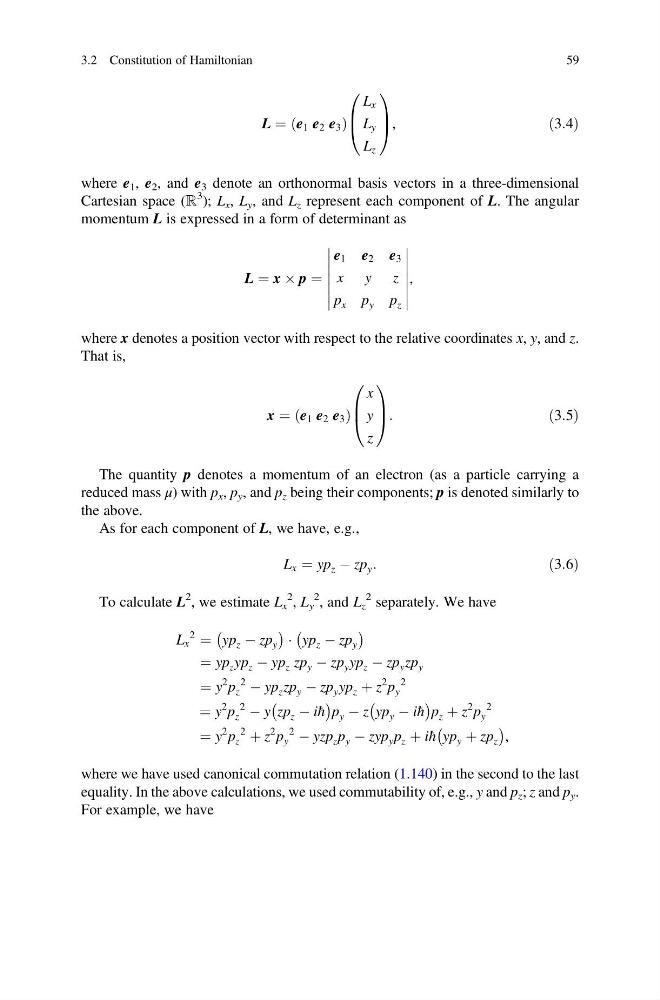
where e 1 , e 2 , and e 3 denote an orthonormal basis vectors in a three-dimensional
Cartesian space (ℝ
3 ); L x , L y , and L z represent each component of L. The angular
momentum L is expressed in a form of determinant as
L ¼ x  p ¼
e 1 e 2 e 3
x y z
p x p y p z
,
where x denotes a position vector with respect to the relative coordinates x, y, and z.
That is,
x ¼ e 1 e 2 e 3
ð
Þ
x
y
z
0
B
@
1
C
A:
ð3:5Þ
The quantity p denotes a momentum of an electron (as a particle carrying a
reduced mass μ) with p x , p y , and p z being their components; p is denoted similarly to
the above.
As for each component of L, we have, e.g.,
L x ¼ yp z À zp y :
ð3:6Þ
To calculate L
2 , we estimate L x
2 , L y
2 , and L z
2 separately. We have
L x
2
¼ yp z À zp y
À
Á Á yp z À zp y
À
Á
¼ yp z yp z À yp z zp y À zp y yp z À zp y zp y
¼ y
2 p z
2
À yp z zp y À zp y yp z þ z
2 p y
2
¼ y
2 p z
2
À y zp z À iħ
À
Á
p y À z yp y À iħ
À
Á
p z þ z
2 p y
2
¼ y
2 p z
2
þ z
2 p y
2
À yzp z p y À zyp y p z þ iħ yp y þ zp z
À
Á
,
where we have used canonical commutation relation (1.140) in the second to the last
equality. In the above calculations, we used commutability of, e.g., y and p z ; z and p y .
For example, we have
3.2 Constitution of Hamiltonian
59
ð
Þ
L x
L y
L z
0
B
@
1
C
A,
ð3:4Þ
where e 1 , e 2 , and e 3 denote an orthonormal basis vectors in a three-dimensional
Cartesian space (ℝ
3 ); L x , L y , and L z represent each component of L. The angular
momentum L is expressed in a form of determinant as
L ¼ x  p ¼
e 1 e 2 e 3
x y z
p x p y p z
,
where x denotes a position vector with respect to the relative coordinates x, y, and z.
That is,
x ¼ e 1 e 2 e 3
ð
Þ
x
y
z
0
B
@
1
C
A:
ð3:5Þ
The quantity p denotes a momentum of an electron (as a particle carrying a
reduced mass μ) with p x , p y , and p z being their components; p is denoted similarly to
the above.
As for each component of L, we have, e.g.,
L x ¼ yp z À zp y :
ð3:6Þ
To calculate L
2 , we estimate L x
2 , L y
2 , and L z
2 separately. We have
L x
2
¼ yp z À zp y
À
Á Á yp z À zp y
À
Á
¼ yp z yp z À yp z zp y À zp y yp z À zp y zp y
¼ y
2 p z
2
À yp z zp y À zp y yp z þ z
2 p y
2
¼ y
2 p z
2
À y zp z À iħ
À
Á
p y À z yp y À iħ
À
Á
p z þ z
2 p y
2
¼ y
2 p z
2
þ z
2 p y
2
À yzp z p y À zyp y p z þ iħ yp y þ zp z
À
Á
,
where we have used canonical commutation relation (1.140) in the second to the last
equality. In the above calculations, we used commutability of, e.g., y and p z ; z and p y .
For example, we have
3.2 Constitution of Hamiltonian
59