

two particles are moving under control only by a force field between the two
particles without other external force fields [1].
In the classical mechanics, equation of motion is separated into two equations
related to the relative coordinates and center-of-mass coordinates accordingly. Of
these, a term of the potential field is only included in the equation of motion with
respect to the relative coordinates.
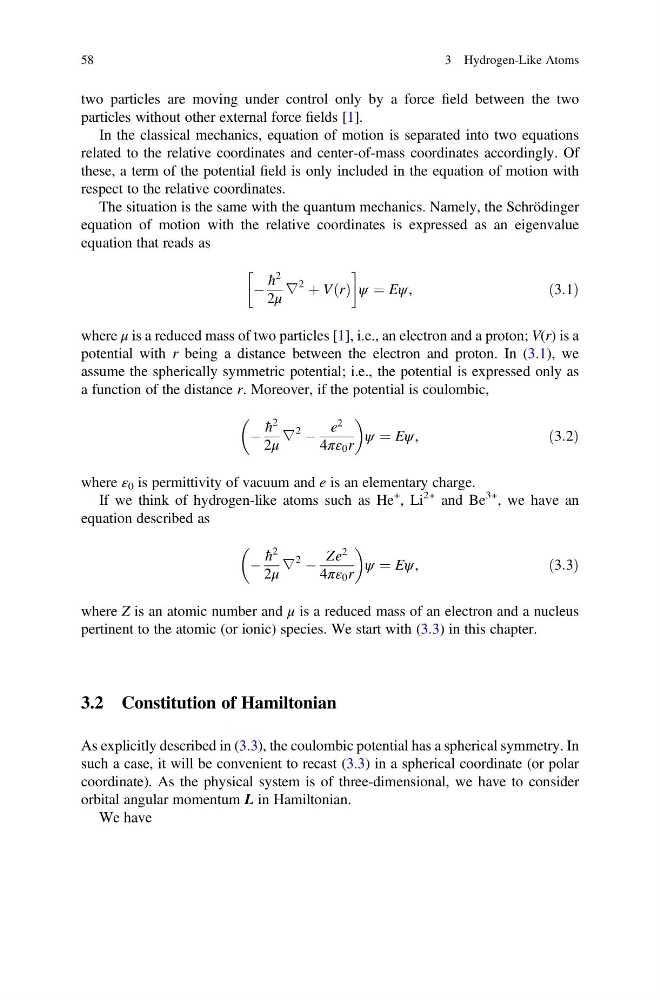
The situation is the same with the quantum mechanics. Namely, the Schrödinger
equation of motion with the relative coordinates is expressed as an eigenvalue
equation that reads as
À
ħ
2
2μ
∇
2 þ V r
ð Þ
!
ψ ¼ Eψ,
ð3:1Þ
where μ is a reduced mass of two particles [1], i.e., an electron and a proton; V(r) is a
potential with r being a distance between the electron and proton. In (3.1), we
assume the spherically symmetric potential; i.e., the potential is expressed only as
a function of the distance r. Moreover, if the potential is coulombic,
À
ħ
2
2μ
∇
2 À
e
2
4πε 0 r
ψ ¼ Eψ,
ð3:2Þ
where ε 0 is permittivity of vacuum and e is an elementary charge.
If we think of hydrogen-like atoms such as He
+ , Li
2+ and Be
3+ , we have an
equation described as
À
ħ
2
2μ
∇
2 À
Ze
2
4πε 0 r
ψ ¼ Eψ,
ð3:3Þ
where Z is an atomic number and μ is a reduced mass of an electron and a nucleus
pertinent to the atomic (or ionic) species. We start with (3.3) in this chapter.
3.2 Constitution of Hamiltonian
As explicitly described in (3.3), the coulombic potential has a spherical symmetry. In
such a case, it will be convenient to recast (3.3) in a spherical coordinate (or polar
coordinate). As the physical system is of three-dimensional, we have to consider
orbital angular momentum L in Hamiltonian.
We have
58
3 Hydrogen-Like Atoms
particles without other external force fields [1].
In the classical mechanics, equation of motion is separated into two equations
related to the relative coordinates and center-of-mass coordinates accordingly. Of
these, a term of the potential field is only included in the equation of motion with
respect to the relative coordinates.
The situation is the same with the quantum mechanics. Namely, the Schrödinger
equation of motion with the relative coordinates is expressed as an eigenvalue
equation that reads as
À
ħ
2
2μ
∇
2 þ V r
ð Þ
!
ψ ¼ Eψ,
ð3:1Þ
where μ is a reduced mass of two particles [1], i.e., an electron and a proton; V(r) is a
potential with r being a distance between the electron and proton. In (3.1), we
assume the spherically symmetric potential; i.e., the potential is expressed only as
a function of the distance r. Moreover, if the potential is coulombic,
À
ħ
2
2μ
∇
2 À
e
2
4πε 0 r
ψ ¼ Eψ,
ð3:2Þ
where ε 0 is permittivity of vacuum and e is an elementary charge.
If we think of hydrogen-like atoms such as He
+ , Li
2+ and Be
3+ , we have an
equation described as
À
ħ
2
2μ
∇
2 À
Ze
2
4πε 0 r
ψ ¼ Eψ,
ð3:3Þ
where Z is an atomic number and μ is a reduced mass of an electron and a nucleus
pertinent to the atomic (or ionic) species. We start with (3.3) in this chapter.
3.2 Constitution of Hamiltonian
As explicitly described in (3.3), the coulombic potential has a spherical symmetry. In
such a case, it will be convenient to recast (3.3) in a spherical coordinate (or polar
coordinate). As the physical system is of three-dimensional, we have to consider
orbital angular momentum L in Hamiltonian.
We have
58
3 Hydrogen-Like Atoms