

matter including atoms and molecular systems. This is also useful to examine
whether a definite integral of a product of functions (or an inner product of vectors)
vanishes.
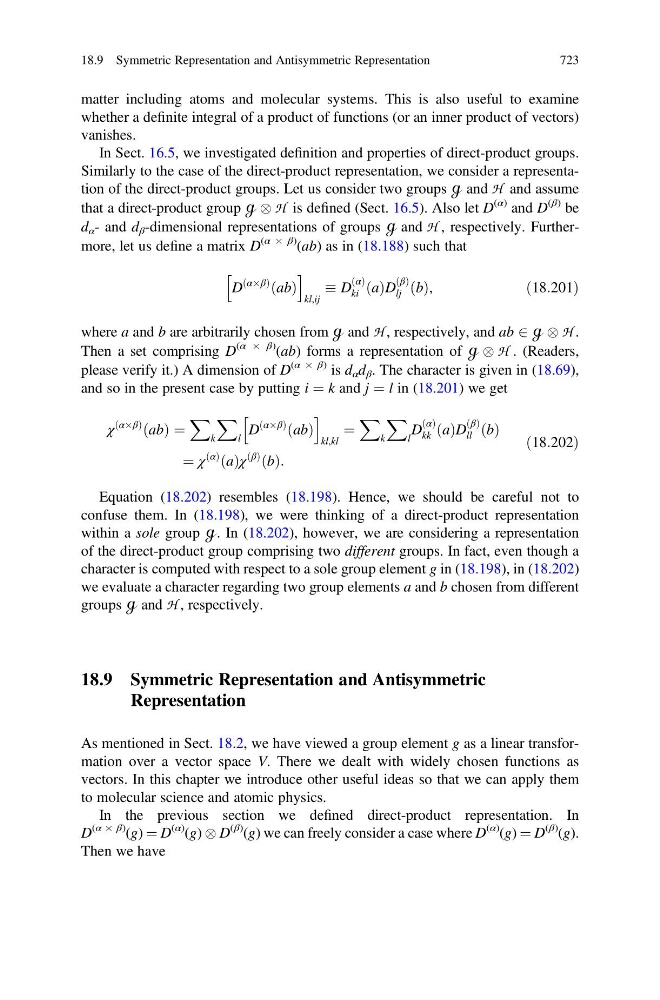
In Sect. 16.5, we investigated definition and properties of direct-product groups.
Similarly to the case of the direct-product representation, we consider a representation of the direct-product groups. Let us consider two groups ℊ and H and assume
that a direct-product group ℊ H is defined (Sect. 16.5). Also let D
(α) and D
(β) be
d α - and d β -dimensional representations of groups ℊ and H , respectively. Furthermore, let us define a matrix D
(α Â β)
(ab) as in (18.188) such that
D
αÂβ
ð
Þ ab
ð Þ
h
i
kl,ij
D
α
ð Þ
ki a
ð ÞD
β
ð Þ
lj b
ð Þ,
ð18:201Þ
where a and b are arbitrarily chosen from ℊ and H , respectively, and ab 2 ℊ H .
Then a set comprising D
(α Â β) (ab) forms a representation of ℊ H . (Readers,
please verify it.) A dimension of D
(α Â β) is d α d β . The character is given in (18.69),
and so in the present case by putting i ¼ k and j ¼ l in (18.201) we get
χ
αÂβ
ð
Þ ab
ð Þ ¼
X
k
X
l
D
αÂβ
ð
Þ ab
ð Þ
h
i
kl,kl
¼
X
k
X
l
D
α
ð Þ
kk a
ð ÞD
β
ð Þ
ll b
ð Þ
¼ χ
α
ð Þ a
ð Þχ
β
ð Þ b
ð Þ:
ð18:202Þ
Equation (18.202) resembles (18.198). Hence, we should be careful not to
confuse them. In (18.198), we were thinking of a direct-product representation
within a sole group ℊ. In (18.202), however, we are considering a representation
of the direct-product group comprising two different groups. In fact, even though a
character is computed with respect to a sole group element g in (18.198), in (18.202)
we evaluate a character regarding two group elements a and b chosen from different
groups ℊ and H , respectively.
18.9 Symmetric Representation and Antisymmetric
Representation
As mentioned in Sect. 18.2, we have viewed a group element g as a linear transformation over a vector space V. There we dealt with widely chosen functions as
vectors. In this chapter we introduce other useful ideas so that we can apply them
to molecular science and atomic physics.
In the previous section we defined direct-product representation. In
D
(α Â β)
(g) ¼ D
(α)
(g) D
(β) (g) we can freely consider a case where D
(α)
(g) ¼ D
(β)
(g).
Then we have
18.9 Symmetric Representation and Antisymmetric Representation
723