

D
αÂβ
ð
Þ gg
0
ð Þ
h
i
kl,ij
¼ D
α
ð Þ
ki gg
0
ð ÞD
β
ð Þ
lj gg
0
ð Þ
¼
X
μ
D
α
ð Þ
kμ g
ð ÞD
α
ð Þ
μi g
0
ð Þ
h
i X
ν
D
β
ð Þ
lν g
ð ÞD
β
ð Þ
νj g
0
ð Þ
h
i
¼
X
μ
X
ν
D
α
ð Þ
kμ g
ð ÞD
β
ð Þ
lν g
ð ÞD
α
ð Þ
μi g
0
ð ÞD
β
ð Þ
νj g
0
ð Þ
¼
X
μ
X
ν
D
αÂβ
ð
Þ g
ð Þ
h
i
kl,μν
D
αÂβ
ð
Þ g
0
ð Þ
h
i
μν,ij
ð18:194Þ
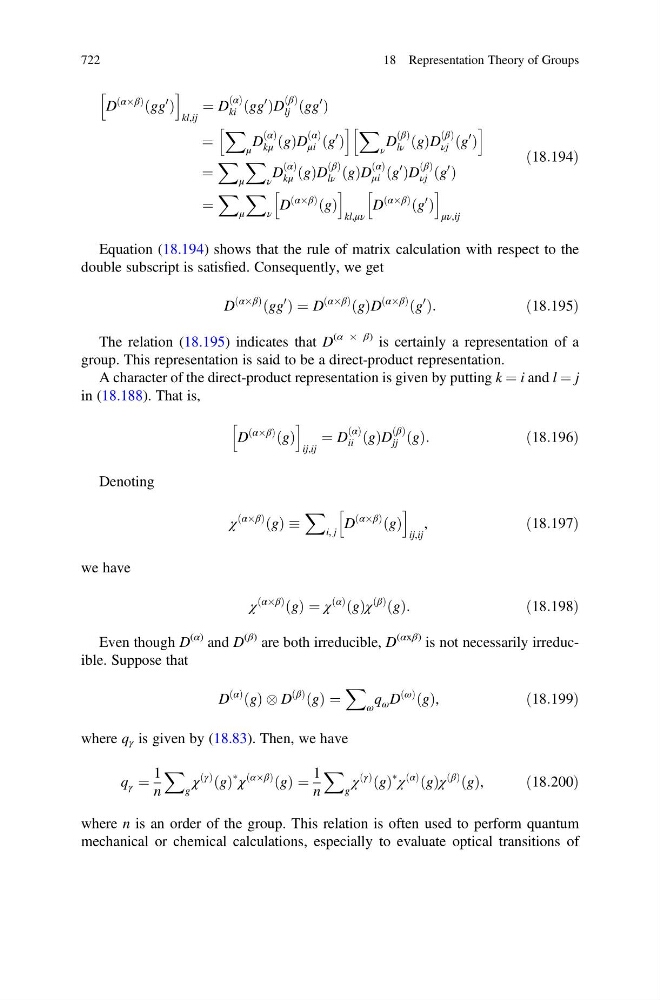
Equation (18.194) shows that the rule of matrix calculation with respect to the
double subscript is satisfied. Consequently, we get
D
αÂβ
ð
Þ gg
0
ð Þ ¼ D
αÂβ
ð
Þ g
ð ÞD
αÂβ
ð
Þ g
0
ð Þ:
ð18:195Þ
The relation (18.195) indicates that D
(α Â β) is certainly a representation of a
group. This representation is said to be a direct-product representation.
A character of the direct-product representation is given by putting k ¼ i and l ¼ j
in (18.188). That is,
D
αÂβ
ð
Þ g
ð Þ
h
i
ij,ij
¼ D
α
ð Þ
ii g
ð ÞD
β
ð Þ
jj g
ð Þ:
ð18:196Þ
Denoting
χ
αÂβ
ð
Þ g
ð Þ
X
i, j
D
αÂβ
ð
Þ g
ð Þ
h
i
ij,ij
,
ð18:197Þ
we have
χ
αÂβ
ð
Þ g
ð Þ ¼ χ
α
ð Þ g
ð Þχ
β
ð Þ g
ð Þ:
ð18:198Þ
Even though D
(α) and D
(β) are both irreducible, D
(αxβ) is not necessarily irreducible. Suppose that
D
α
ð Þ g
ð Þ D
β
ð Þ g
ð Þ ¼
X
ω
q ω D
ω
ð Þ g
ð Þ,
ð18:199Þ
where q γ is given by (18.83). Then, we have
q γ ¼
1
n
X
g
χ
γ
ð Þ g
ð Þ
à χ
αÂβ
ð
Þ g
ð Þ ¼
1
n
X
g
χ
γ
ð Þ g
ð Þ
à χ
α
ð Þ g
ð Þχ
β
ð Þ g
ð Þ,
ð18:200Þ
where n is an order of the group. This relation is often used to perform quantum
mechanical or chemical calculations, especially to evaluate optical transitions of
722
18 Representation Theory of Groups
αÂβ
ð
Þ gg
0
ð Þ
h
i
kl,ij
¼ D
α
ð Þ
ki gg
0
ð ÞD
β
ð Þ
lj gg
0
ð Þ
¼
X
μ
D
α
ð Þ
kμ g
ð ÞD
α
ð Þ
μi g
0
ð Þ
h
i X
ν
D
β
ð Þ
lν g
ð ÞD
β
ð Þ
νj g
0
ð Þ
h
i
¼
X
μ
X
ν
D
α
ð Þ
kμ g
ð ÞD
β
ð Þ
lν g
ð ÞD
α
ð Þ
μi g
0
ð ÞD
β
ð Þ
νj g
0
ð Þ
¼
X
μ
X
ν
D
αÂβ
ð
Þ g
ð Þ
h
i
kl,μν
D
αÂβ
ð
Þ g
0
ð Þ
h
i
μν,ij
ð18:194Þ
Equation (18.194) shows that the rule of matrix calculation with respect to the
double subscript is satisfied. Consequently, we get
D
αÂβ
ð
Þ gg
0
ð Þ ¼ D
αÂβ
ð
Þ g
ð ÞD
αÂβ
ð
Þ g
0
ð Þ:
ð18:195Þ
The relation (18.195) indicates that D
(α Â β) is certainly a representation of a
group. This representation is said to be a direct-product representation.
A character of the direct-product representation is given by putting k ¼ i and l ¼ j
in (18.188). That is,
D
αÂβ
ð
Þ g
ð Þ
h
i
ij,ij
¼ D
α
ð Þ
ii g
ð ÞD
β
ð Þ
jj g
ð Þ:
ð18:196Þ
Denoting
χ
αÂβ
ð
Þ g
ð Þ
X
i, j
D
αÂβ
ð
Þ g
ð Þ
h
i
ij,ij
,
ð18:197Þ
we have
χ
αÂβ
ð
Þ g
ð Þ ¼ χ
α
ð Þ g
ð Þχ
β
ð Þ g
ð Þ:
ð18:198Þ
Even though D
(α) and D
(β) are both irreducible, D
(αxβ) is not necessarily irreducible. Suppose that
D
α
ð Þ g
ð Þ D
β
ð Þ g
ð Þ ¼
X
ω
q ω D
ω
ð Þ g
ð Þ,
ð18:199Þ
where q γ is given by (18.83). Then, we have
q γ ¼
1
n
X
g
χ
γ
ð Þ g
ð Þ
à χ
αÂβ
ð
Þ g
ð Þ ¼
1
n
X
g
χ
γ
ð Þ g
ð Þ
à χ
α
ð Þ g
ð Þχ
β
ð Þ g
ð Þ,
ð18:200Þ
where n is an order of the group. This relation is often used to perform quantum
mechanical or chemical calculations, especially to evaluate optical transitions of
722
18 Representation Theory of Groups