

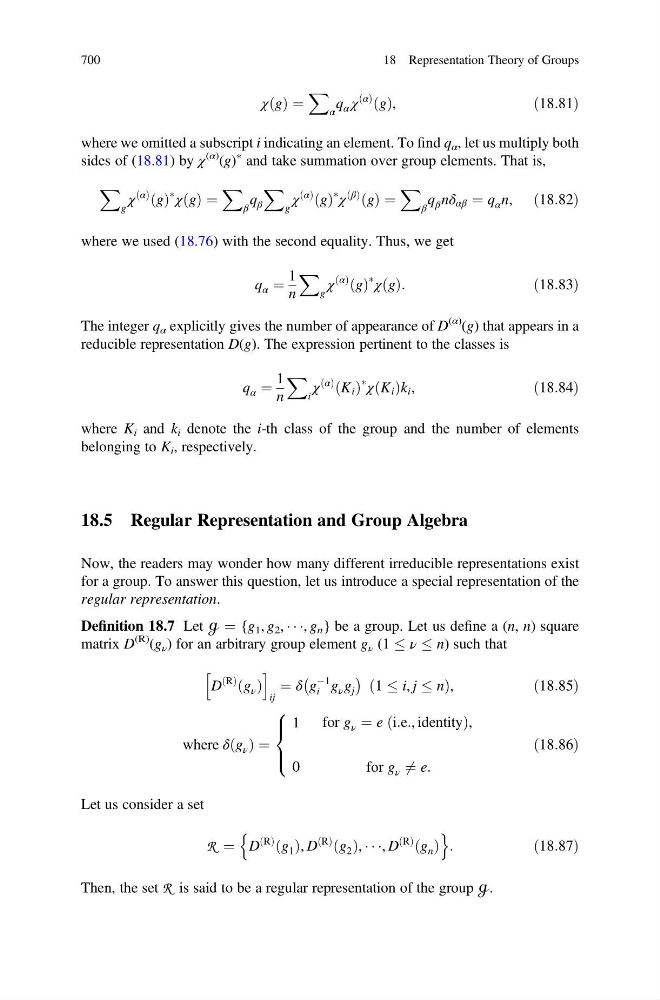
χ g
ð Þ ¼
X
α
q α χ
α
ð Þ g
ð Þ,
ð18:81Þ
where we omitted a subscript i indicating an element. To find q α , let us multiply both
sides of (18.81) by χ
(α) (g)
à and take summation over group elements. That is,
X
g
χ
α
ð Þ g
ð Þ
à χ g
ð Þ ¼
X
β
q β
X
g
χ
α
ð Þ g
ð Þ
à χ
β
ð Þ g
ð Þ ¼
X
β
q β nδ αβ ¼ q α n, ð18:82Þ
where we used (18.76) with the second equality. Thus, we get
q α ¼
1
n
X
g
χ
α
ð Þ g
ð Þ
à χ g
ð Þ:
ð18:83Þ
The integer q α explicitly gives the number of appearance of D
(α)
(g) that appears in a
reducible representation D(g). The expression pertinent to the classes is
q α ¼
1
n
X
i
χ
α
ð Þ K i
ð Þ
à χ K i
ð Þk i ,
ð18:84Þ
where K i and k i denote the i-th class of the group and the number of elements
belonging to K i , respectively.
18.5 Regular Representation and Group Algebra
Now, the readers may wonder how many different irreducible representations exist
for a group. To answer this question, let us introduce a special representation of the
regular representation.
Definition 18.7 Let ℊ ¼ {g 1 , g 2 , Á Á Á, g n } be a group. Let us define a (n, n) square
matrix D
(R) (g ν ) for an arbitrary group element g ν (1 ν n) such that
D
R
ð Þ g ν
ð Þ
h
i
ij
¼ δ g
À1
i g ν g j
À
Á
1 i, j n
ð
Þ ,
ð18:85Þ
where δ g ν
ð Þ ¼
1
0
8
> <
> :
for g ν ¼ e i:e:, identity
ð
Þ ,
for g ν 6 ¼ e:
ð18:86Þ
Let us consider a set
R ¼ D
R
ð Þ g 1
ð Þ, D
R
ð Þ g 2
ð Þ, Á Á Á, D
R
ð Þ g n
ð Þ
n
o
:
ð18:87Þ
Then, the set R is said to be a regular representation of the group ℊ.
700
18 Representation Theory of Groups
ð Þ ¼
X
α
q α χ
α
ð Þ g
ð Þ,
ð18:81Þ
where we omitted a subscript i indicating an element. To find q α , let us multiply both
sides of (18.81) by χ
(α) (g)
à and take summation over group elements. That is,
X
g
χ
α
ð Þ g
ð Þ
à χ g
ð Þ ¼
X
β
q β
X
g
χ
α
ð Þ g
ð Þ
à χ
β
ð Þ g
ð Þ ¼
X
β
q β nδ αβ ¼ q α n, ð18:82Þ
where we used (18.76) with the second equality. Thus, we get
q α ¼
1
n
X
g
χ
α
ð Þ g
ð Þ
à χ g
ð Þ:
ð18:83Þ
The integer q α explicitly gives the number of appearance of D
(α)
(g) that appears in a
reducible representation D(g). The expression pertinent to the classes is
q α ¼
1
n
X
i
χ
α
ð Þ K i
ð Þ
à χ K i
ð Þk i ,
ð18:84Þ
where K i and k i denote the i-th class of the group and the number of elements
belonging to K i , respectively.
18.5 Regular Representation and Group Algebra
Now, the readers may wonder how many different irreducible representations exist
for a group. To answer this question, let us introduce a special representation of the
regular representation.
Definition 18.7 Let ℊ ¼ {g 1 , g 2 , Á Á Á, g n } be a group. Let us define a (n, n) square
matrix D
(R) (g ν ) for an arbitrary group element g ν (1 ν n) such that
D
R
ð Þ g ν
ð Þ
h
i
ij
¼ δ g
À1
i g ν g j
À
Á
1 i, j n
ð
Þ ,
ð18:85Þ
where δ g ν
ð Þ ¼
1
0
8
> <
> :
for g ν ¼ e i:e:, identity
ð
Þ ,
for g ν 6 ¼ e:
ð18:86Þ
Let us consider a set
R ¼ D
R
ð Þ g 1
ð Þ, D
R
ð Þ g 2
ð Þ, Á Á Á, D
R
ð Þ g n
ð Þ
n
o
:
ð18:87Þ
Then, the set R is said to be a regular representation of the group ℊ.
700
18 Representation Theory of Groups