

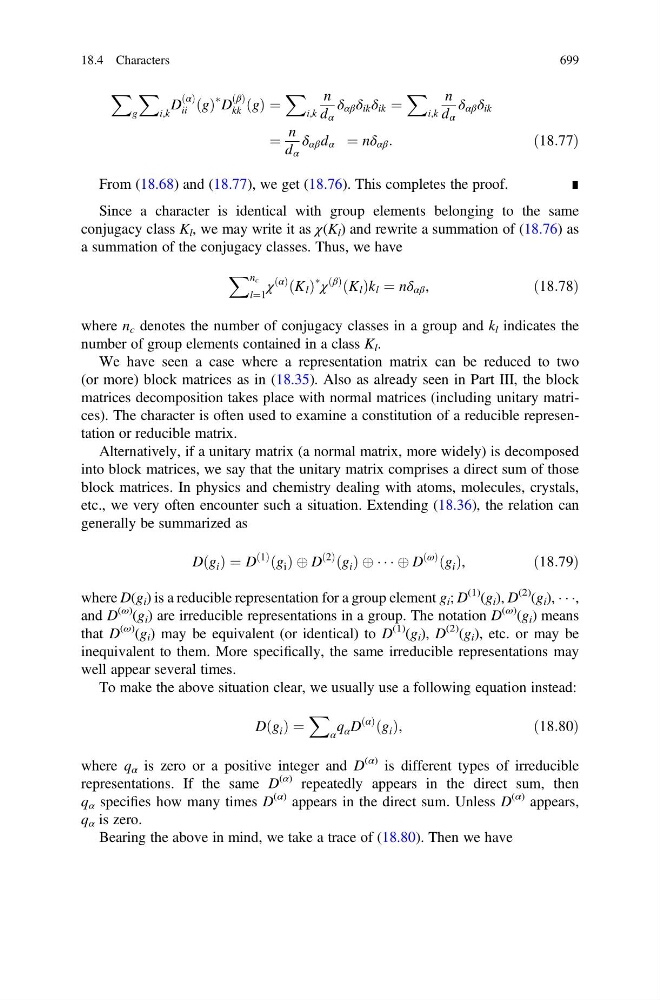
X
g
X
i,k
D
α
ð Þ
ii g
ð Þ
à D
β
ð Þ
kk g
ð Þ ¼
X
i,k
n
d α
δ αβ δ ik δ ik ¼
X
i,k
n
d α
δ αβ δ ik
¼
n
d α
δ αβ d α ¼ nδ αβ :
ð18:77Þ
From (18.68) and (18.77), we get (18.76). This completes the proof.
∎
Since a character is identical with group elements belonging to the same
conjugacy class K l , we may write it as χ(K l ) and rewrite a summation of (18.76) as
a summation of the conjugacy classes. Thus, we have
X n c
l¼1
χ
α
ð Þ K l
ð Þ
à χ
β
ð Þ K l
ð Þk l ¼ nδ αβ ,
ð18:78Þ
where n c denotes the number of conjugacy classes in a group and k l indicates the
number of group elements contained in a class K l .
We have seen a case where a representation matrix can be reduced to two
(or more) block matrices as in (18.35). Also as already seen in Part III, the block
matrices decomposition takes place with normal matrices (including unitary matrices). The character is often used to examine a constitution of a reducible representation or reducible matrix.
Alternatively, if a unitary matrix (a normal matrix, more widely) is decomposed
into block matrices, we say that the unitary matrix comprises a direct sum of those
block matrices. In physics and chemistry dealing with atoms, molecules, crystals,
etc., we very often encounter such a situation. Extending (18.36), the relation can
generally be summarized as
D g i
ð Þ ¼ D
1
ð Þ g i
ð Þ È D
2
ð Þ g i
ð Þ È Á Á Á È D
ω
ð Þ g i
ð Þ,
ð18:79Þ
where D(g i ) is a reducible representation for a group element g i ; D
(1) (g i ), D
(2) (g i ), Á Á Á,
and D
(ω) (g i ) are irreducible representations in a group. The notation D
(ω) (g i ) means
that D
(ω)
(g i ) may be equivalent (or identical) to D
(1) (g i ), D
(2) (g i ), etc. or may be
inequivalent to them. More specifically, the same irreducible representations may
well appear several times.
To make the above situation clear, we usually use a following equation instead:
D g i
ð Þ ¼
X
α
q α D
α
ð Þ g i
ð Þ,
ð18:80Þ
where q α is zero or a positive integer and D
(α) is different types of irreducible
representations. If the same D
(α) repeatedly appears in the direct sum, then
q α specifies how many times D
(α) appears in the direct sum. Unless D
(α) appears,
q α is zero.
Bearing the above in mind, we take a trace of (18.80). Then we have
18.4 Characters
699