

X
g
D
α
ð Þ
ij g
ð Þ
à D
β
ð Þ
kl g
ð Þ ¼
n
d α
δ αβ δ ik δ jl ,
ð18:51Þ
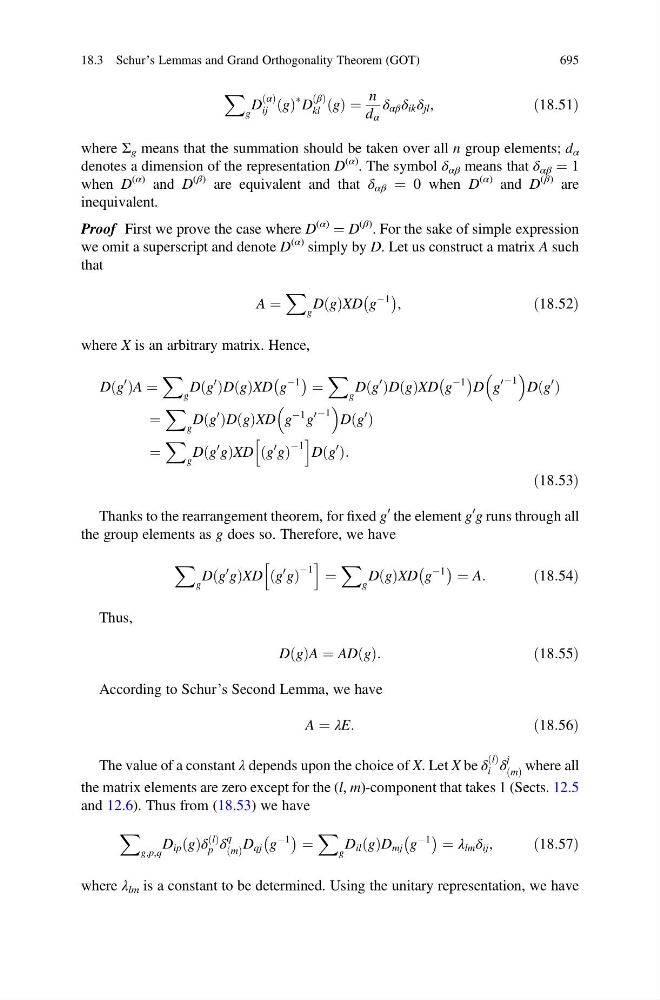
where Σ g means that the summation should be taken over all n group elements; d α
denotes a dimension of the representation D
(α)
. The symbol δ αβ means that δ αβ ¼ 1
when D
(α) and D
(β) are equivalent and that δ αβ ¼ 0 when D
(α) and D
(β) are
inequivalent.
Proof First we prove the case where D
(α)
¼ D
(β) . For the sake of simple expression
we omit a superscript and denote D
(α) simply by D. Let us construct a matrix A such
that
A ¼
X
g
D g
ð ÞXD g
À1
À Á
,
ð18:52Þ
where X is an arbitrary matrix. Hence,
D g
0
ð ÞA ¼
X
g
D g
0
ð ÞD g
ð ÞXD g
À1
À Á ¼
X
g
D g
0
ð ÞD g
ð ÞXD g
À1
À Á
D g
0 À1
D g
0
ð Þ
¼
X
g
D g
0
ð ÞD g
ð ÞXD g
À1 g
0 À1
D g
0
ð Þ
¼
X
g
D g
0 g
ð ÞXD g
0 g
ð Þ
À1
h
i
D g
0
ð Þ:
ð18:53Þ
Thanks to the rearrangement theorem, for fixed g
0 the element g
0 g runs through all
the group elements as g does so. Therefore, we have
X
g
D g
0 g
ð ÞXD g
0 g
ð Þ
À1
h
i
¼
X
g
D g
ð ÞXD g
À1
À Á ¼ A:
ð18:54Þ
Thus,
D g
ð ÞA ¼ AD g
ð Þ:
ð18:55Þ
According to Schur’s Second Lemma, we have
A ¼ λE:
ð18:56Þ
The value of a constant λ depends upon the choice of X. Let X be δ
l
ð Þ
i δ
j
m
ð Þ where all
the matrix elements are zero except for the (l, m)-component that takes 1 (Sects. 12.5
and 12.6). Thus from (18.53) we have
X
g,p,q
D ip g
ð Þδ
l
ð Þ
p δ
q
m
ð Þ D qj g
À1
À Á ¼
X
g
D il g
ð ÞD mj g
À1
À Á ¼ λ lm δ ij ,
ð18:57Þ
where λ lm is a constant to be determined. Using the unitary representation, we have
18.3 Schur’s Lemmas and Grand Orthogonality Theorem (GOT)
695
g
D
α
ð Þ
ij g
ð Þ
à D
β
ð Þ
kl g
ð Þ ¼
n
d α
δ αβ δ ik δ jl ,
ð18:51Þ
where Σ g means that the summation should be taken over all n group elements; d α
denotes a dimension of the representation D
(α)
. The symbol δ αβ means that δ αβ ¼ 1
when D
(α) and D
(β) are equivalent and that δ αβ ¼ 0 when D
(α) and D
(β) are
inequivalent.
Proof First we prove the case where D
(α)
¼ D
(β) . For the sake of simple expression
we omit a superscript and denote D
(α) simply by D. Let us construct a matrix A such
that
A ¼
X
g
D g
ð ÞXD g
À1
À Á
,
ð18:52Þ
where X is an arbitrary matrix. Hence,
D g
0
ð ÞA ¼
X
g
D g
0
ð ÞD g
ð ÞXD g
À1
À Á ¼
X
g
D g
0
ð ÞD g
ð ÞXD g
À1
À Á
D g
0 À1
D g
0
ð Þ
¼
X
g
D g
0
ð ÞD g
ð ÞXD g
À1 g
0 À1
D g
0
ð Þ
¼
X
g
D g
0 g
ð ÞXD g
0 g
ð Þ
À1
h
i
D g
0
ð Þ:
ð18:53Þ
Thanks to the rearrangement theorem, for fixed g
0 the element g
0 g runs through all
the group elements as g does so. Therefore, we have
X
g
D g
0 g
ð ÞXD g
0 g
ð Þ
À1
h
i
¼
X
g
D g
ð ÞXD g
À1
À Á ¼ A:
ð18:54Þ
Thus,
D g
ð ÞA ¼ AD g
ð Þ:
ð18:55Þ
According to Schur’s Second Lemma, we have
A ¼ λE:
ð18:56Þ
The value of a constant λ depends upon the choice of X. Let X be δ
l
ð Þ
i δ
j
m
ð Þ where all
the matrix elements are zero except for the (l, m)-component that takes 1 (Sects. 12.5
and 12.6). Thus from (18.53) we have
X
g,p,q
D ip g
ð Þδ
l
ð Þ
p δ
q
m
ð Þ D qj g
À1
À Á ¼
X
g
D il g
ð ÞD mj g
À1
À Á ¼ λ lm δ ij ,
ð18:57Þ
where λ lm is a constant to be determined. Using the unitary representation, we have
18.3 Schur’s Lemmas and Grand Orthogonality Theorem (GOT)
695