

Schur’s Second Lemma [1, 2] Let D be a representation of ℊ. Suppose that with
8 g 2 ℊ we have
D g
ð ÞM ¼ MD g
ð Þ:
ð18:48Þ
Then, if D is irreducible, M ¼ cE with c being an arbitrary complex number, where
E is an identity matrix.
Proof Let c be an arbitrarily chosen complex number. From (18.48) we have
D g
ð Þ M À cE
ð
Þ¼ M À cE
ð
Þ D g
ð Þ:
ð18:49Þ
If D is irreducible, Schur’s First Lemma implies that we must have either
(i) M À cE ¼ 0 or (ii) det(M À cE) 6 ¼ 0. A matrix M has at least one proper
eigenvalue λ (Sect. 12.1), and so choosing λ for c in (18.49), we have det(M À λE) ¼ 0.
Consequently, only former case is allowed. That is, we have
M ¼ cE:
ð18:50Þ
∎
Schur’s lemmas lead to important orthogonality theorem that plays a fundamental
role in many scientific fields. The orthogonality theorem includes that of matrices
and their traces (or characters).
Theorem 18.3: Grand Orthogonality Theorem (GOT) [5] Let D
(1) , D
(2) , Á Á Á be
all inequivalent irreducible representations of a group ℊ ¼ {g 1 , g 2 , Á Á Á, g n } of order
n. Let D
(α) and D
(β) be two irreducible representations chosen from among D
(1) , D
(2) ,
Á Á Á. Then, regarding their matrix representations, we have the following relationship:
×
=
( )
×
(m, m)
(m, n)
( )
(n, n)
(a):
>
(m, n)
×
=
×
(
)
(m, m)
(n, m)
(
)
(n, n)
(n, m)
(b):
<
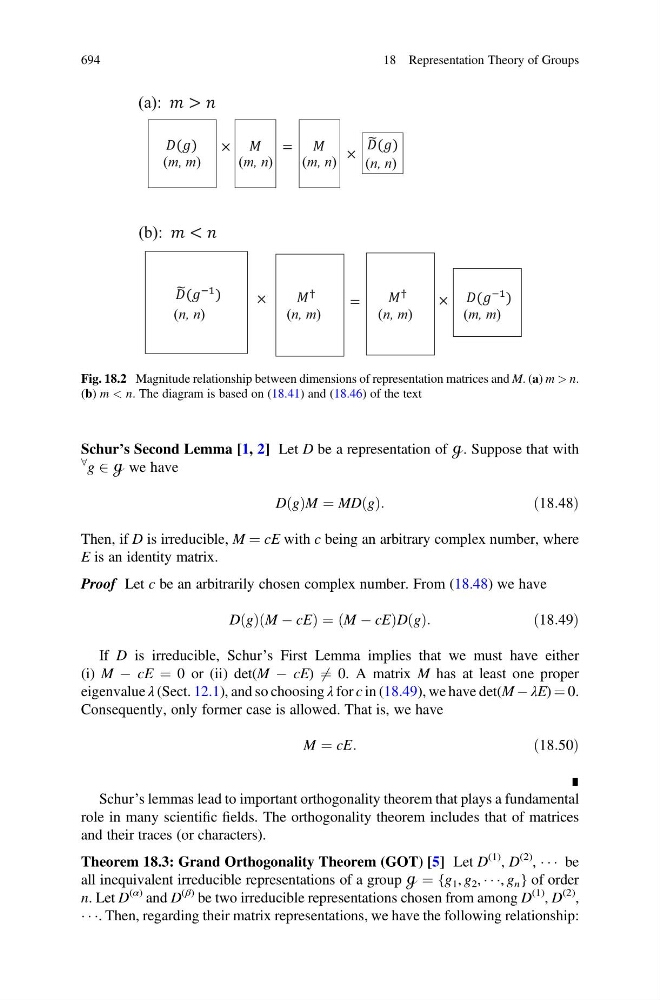
Fig. 18.2 Magnitude relationship between dimensions of representation matrices and M. (a) m > n.
(b) m < n. The diagram is based on (18.41) and (18.46) of the text
694
18 Representation Theory of Groups