

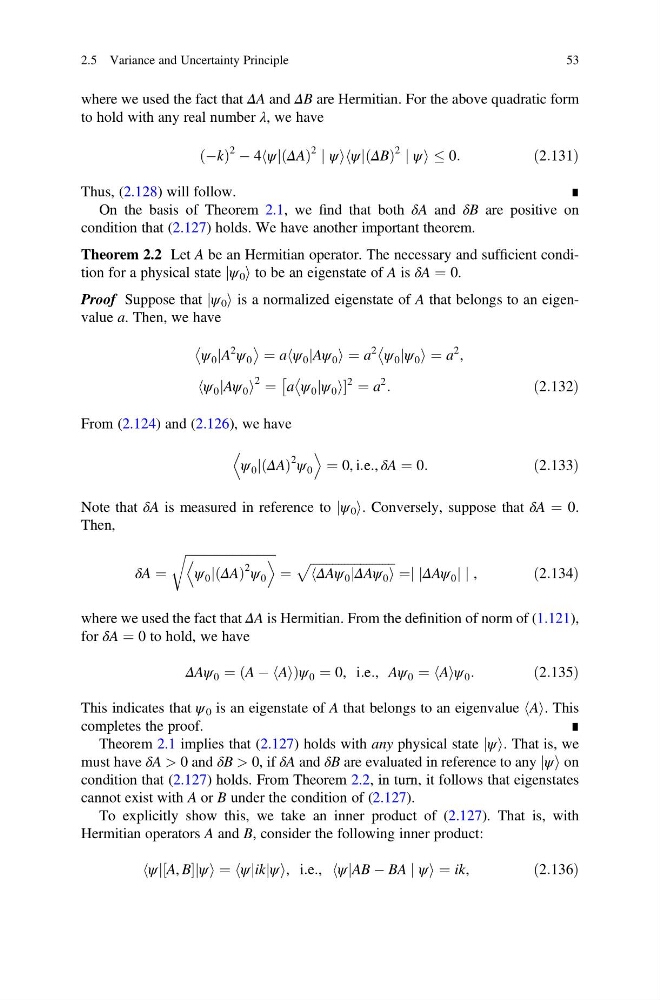
where we used the fact that ΔA and ΔB are Hermitian. For the above quadratic form
to hold with any real number λ, we have
Àk
ð Þ
2 À 4 ψj
h ΔA
ð Þ
2 j ψi ψj
h ΔB
ð Þ
2 j ψi 0:
ð2:131Þ
Thus, (2.128) will follow.
∎
On the basis of Theorem 2.1, we find that both δA and δB are positive on
condition that (2.127) holds. We have another important theorem.
Theorem 2.2 Let A be an Hermitian operator. The necessary and sufficient condition for a physical state jψ 0 i to be an eigenstate of A is δA ¼ 0.
Proof Suppose that jψ 0 i is a normalized eigenstate of A that belongs to an eigenvalue a. Then, we have
ψ 0 jA
2
ψ 0
¼ a ψ 0 jAψ 0 i
h
¼ a
2
ψ 0 jψ 0 i ¼ a
2
,
ψ 0 jAψ 0 i
h
2 ¼ a ψ 0 jψ 0 i
2
¼ a
2
:
Â
ð2:132Þ
From (2.124) and (2.126), we have
ψ 0 j ΔA
ð Þ
2 ψ 0
E
D
¼ 0, i:e:, δA ¼ 0:
ð2:133Þ
Note that δA is measured in reference to jψ 0 i. Conversely, suppose that δA ¼ 0.
Then,
δA ¼
ffiffiffiffiffiffiffiffiffiffiffiffiffiffiffiffiffiffiffiffiffiffiffiffiffiffiffiffiffi
ψ 0 j ΔA
ð Þ
2 ψ 0
E
D
r
¼
ffiffiffiffiffiffiffiffiffiffiffiffiffiffiffiffiffiffiffiffiffiffiffiffiffiffiffi
ΔAψ 0 jΔAψ 0 i
h
p
¼j ΔAψ 0
j
jj ,
ð2:134Þ
where we used the fact that ΔA is Hermitian. From the definition of norm of (1.121),
for δA ¼ 0 to hold, we have
ΔAψ 0 ¼ A À Ai
h
ð
Þ ψ 0 ¼ 0, i:e:, Aψ 0 ¼ Ai
h ψ 0 :
ð2:135Þ
This indicates that ψ 0 is an eigenstate of A that belongs to an eigenvalue hAi. This
completes the proof.
∎
Theorem 2.1 implies that (2.127) holds with any physical state jψi. That is, we
must have δA > 0 and δB > 0, if δA and δB are evaluated in reference to any jψi on
condition that (2.127) holds. From Theorem 2.2, in turn, it follows that eigenstates
cannot exist with A or B under the condition of (2.127).
To explicitly show this, we take an inner product of (2.127). That is, with
Hermitian operators A and B, consider the following inner product:
ψj
h A, B
½
ψi ¼ ψj
h ik
j
j ψi, i:e:, ψj
h AB À BA j ψi ¼ ik,
ð2:136Þ
2.5 Variance and Uncertainty Principle
53
to hold with any real number λ, we have
Àk
ð Þ
2 À 4 ψj
h ΔA
ð Þ
2 j ψi ψj
h ΔB
ð Þ
2 j ψi 0:
ð2:131Þ
Thus, (2.128) will follow.
∎
On the basis of Theorem 2.1, we find that both δA and δB are positive on
condition that (2.127) holds. We have another important theorem.
Theorem 2.2 Let A be an Hermitian operator. The necessary and sufficient condition for a physical state jψ 0 i to be an eigenstate of A is δA ¼ 0.
Proof Suppose that jψ 0 i is a normalized eigenstate of A that belongs to an eigenvalue a. Then, we have
ψ 0 jA
2
ψ 0
¼ a ψ 0 jAψ 0 i
h
¼ a
2
ψ 0 jψ 0 i ¼ a
2
,
ψ 0 jAψ 0 i
h
2 ¼ a ψ 0 jψ 0 i
2
¼ a
2
:
Â
ð2:132Þ
From (2.124) and (2.126), we have
ψ 0 j ΔA
ð Þ
2 ψ 0
E
D
¼ 0, i:e:, δA ¼ 0:
ð2:133Þ
Note that δA is measured in reference to jψ 0 i. Conversely, suppose that δA ¼ 0.
Then,
δA ¼
ffiffiffiffiffiffiffiffiffiffiffiffiffiffiffiffiffiffiffiffiffiffiffiffiffiffiffiffiffi
ψ 0 j ΔA
ð Þ
2 ψ 0
E
D
r
¼
ffiffiffiffiffiffiffiffiffiffiffiffiffiffiffiffiffiffiffiffiffiffiffiffiffiffiffi
ΔAψ 0 jΔAψ 0 i
h
p
¼j ΔAψ 0
j
jj ,
ð2:134Þ
where we used the fact that ΔA is Hermitian. From the definition of norm of (1.121),
for δA ¼ 0 to hold, we have
ΔAψ 0 ¼ A À Ai
h
ð
Þ ψ 0 ¼ 0, i:e:, Aψ 0 ¼ Ai
h ψ 0 :
ð2:135Þ
This indicates that ψ 0 is an eigenstate of A that belongs to an eigenvalue hAi. This
completes the proof.
∎
Theorem 2.1 implies that (2.127) holds with any physical state jψi. That is, we
must have δA > 0 and δB > 0, if δA and δB are evaluated in reference to any jψi on
condition that (2.127) holds. From Theorem 2.2, in turn, it follows that eigenstates
cannot exist with A or B under the condition of (2.127).
To explicitly show this, we take an inner product of (2.127). That is, with
Hermitian operators A and B, consider the following inner product:
ψj
h A, B
½
ψi ¼ ψj
h ik
j
j ψi, i:e:, ψj
h AB À BA j ψi ¼ ik,
ð2:136Þ
2.5 Variance and Uncertainty Principle
53