

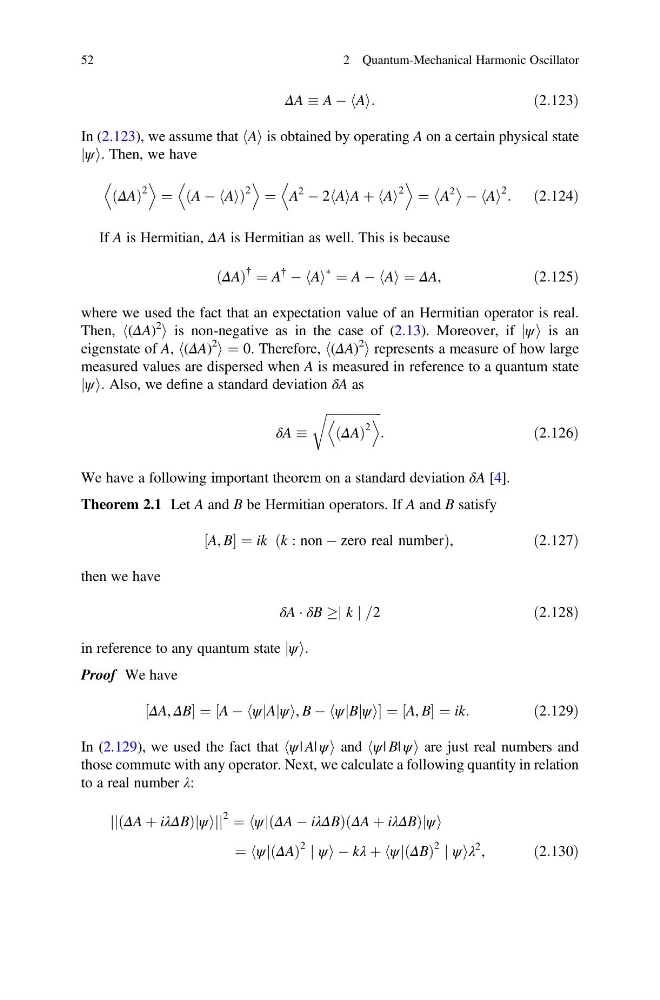
ΔA A À Ai
h :
ð2:123Þ
In (2.123), we assume that hAi is obtained by operating A on a certain physical state
jψi. Then, we have
ΔA
ð Þ
2
E
D
¼ A À Ai
h
ð
Þ
2
E
D
¼ A
2
À 2 Ai
h A þ Ai
h
2
E
D
¼ A
2
À Ai
h
2 : ð2:124Þ
If A is Hermitian, ΔA is Hermitian as well. This is because
ΔA
ð Þ
{ ¼ A
{
À Ai
h
à ¼ A À Ai
h ¼ ΔA,
ð2:125Þ
where we used the fact that an expectation value of an Hermitian operator is real.
Then, h(ΔA)
2
i is non-negative as in the case of (2.13). Moreover, if jψi is an
eigenstate of A, h(ΔA)
2
i ¼ 0. Therefore, h(ΔA)
2
i represents a measure of how large
measured values are dispersed when A is measured in reference to a quantum state
jψi. Also, we define a standard deviation δA as
δA
ffiffiffiffiffiffiffiffiffiffiffiffiffiffiffiffiffi ffi
ΔA
ð Þ
2
E
D
r
:
ð2:126Þ
We have a following important theorem on a standard deviation δA [4].
Theorem 2.1 Let A and B be Hermitian operators. If A and B satisfy
A, B
½
¼ ik k : non À zero real number
ð
Þ ,
ð2:127Þ
then we have
δA Á δB !j k j =2
ð2:128Þ
in reference to any quantum state jψi.
Proof We have
ΔA, ΔB
½
¼ A À ψjAjψ
h
i, B À ψjBjψ
h
i
½
¼ A, B
½
¼ ik:
ð2:129Þ
In (2.129), we used the fact that hψ| A| ψi and hψ| B| ψi are just real numbers and
those commute with any operator. Next, we calculate a following quantity in relation
to a real number λ:
ΔA þ iλΔB
ð
Þ j ψi
j
j
j
j
2 ¼ ψj ΔA À iλΔB
ð
ÞΔA þ iλΔB
ð
Þ j ψi
h
¼ ψj
h ΔA
ð Þ
2 j ψi À kλ þ ψj
h ΔB
ð Þ
2 j ψiλ
2 ,
ð2:130Þ
52
2 Quantum-Mechanical Harmonic Oscillator
h :
ð2:123Þ
In (2.123), we assume that hAi is obtained by operating A on a certain physical state
jψi. Then, we have
ΔA
ð Þ
2
E
D
¼ A À Ai
h
ð
Þ
2
E
D
¼ A
2
À 2 Ai
h A þ Ai
h
2
E
D
¼ A
2
À Ai
h
2 : ð2:124Þ
If A is Hermitian, ΔA is Hermitian as well. This is because
ΔA
ð Þ
{ ¼ A
{
À Ai
h
à ¼ A À Ai
h ¼ ΔA,
ð2:125Þ
where we used the fact that an expectation value of an Hermitian operator is real.
Then, h(ΔA)
2
i is non-negative as in the case of (2.13). Moreover, if jψi is an
eigenstate of A, h(ΔA)
2
i ¼ 0. Therefore, h(ΔA)
2
i represents a measure of how large
measured values are dispersed when A is measured in reference to a quantum state
jψi. Also, we define a standard deviation δA as
δA
ffiffiffiffiffiffiffiffiffiffiffiffiffiffiffiffiffi ffi
ΔA
ð Þ
2
E
D
r
:
ð2:126Þ
We have a following important theorem on a standard deviation δA [4].
Theorem 2.1 Let A and B be Hermitian operators. If A and B satisfy
A, B
½
¼ ik k : non À zero real number
ð
Þ ,
ð2:127Þ
then we have
δA Á δB !j k j =2
ð2:128Þ
in reference to any quantum state jψi.
Proof We have
ΔA, ΔB
½
¼ A À ψjAjψ
h
i, B À ψjBjψ
h
i
½
¼ A, B
½
¼ ik:
ð2:129Þ
In (2.129), we used the fact that hψ| A| ψi and hψ| B| ψi are just real numbers and
those commute with any operator. Next, we calculate a following quantity in relation
to a real number λ:
ΔA þ iλΔB
ð
Þ j ψi
j
j
j
j
2 ¼ ψj ΔA À iλΔB
ð
ÞΔA þ iλΔB
ð
Þ j ψi
h
¼ ψj
h ΔA
ð Þ
2 j ψi À kλ þ ψj
h ΔB
ð Þ
2 j ψiλ
2 ,
ð2:130Þ
52
2 Quantum-Mechanical Harmonic Oscillator