

18.3 Schur’s Lemmas and Grand Orthogonality Theorem
(GOT)
Pivotal notions of the representation theory of finite groups rest upon Schur’s
lemmas (first lemma and second lemma).
Schur’s First Lemma [1, 2] Let D and e
D be two irreducible representations of ℊ.
Let dimensions of representations of D and e
D be m and n, respectively. Suppose that
with
8 g 2 ℊ the following relation holds:
D g
ð ÞM ¼ M e
D g
ð Þ,
ð18:41Þ
where M is a (m, n) matrix. Then we must have
Case (i): M ¼ 0 or
Case (ii): M is a square matrix (i.e., m ¼ n) with detM 6 ¼ 0.
In Case (i), the representations of D and e
D are inequivalent. In Case (ii), on the
other hand, D and e
D are equivalent.
Proof
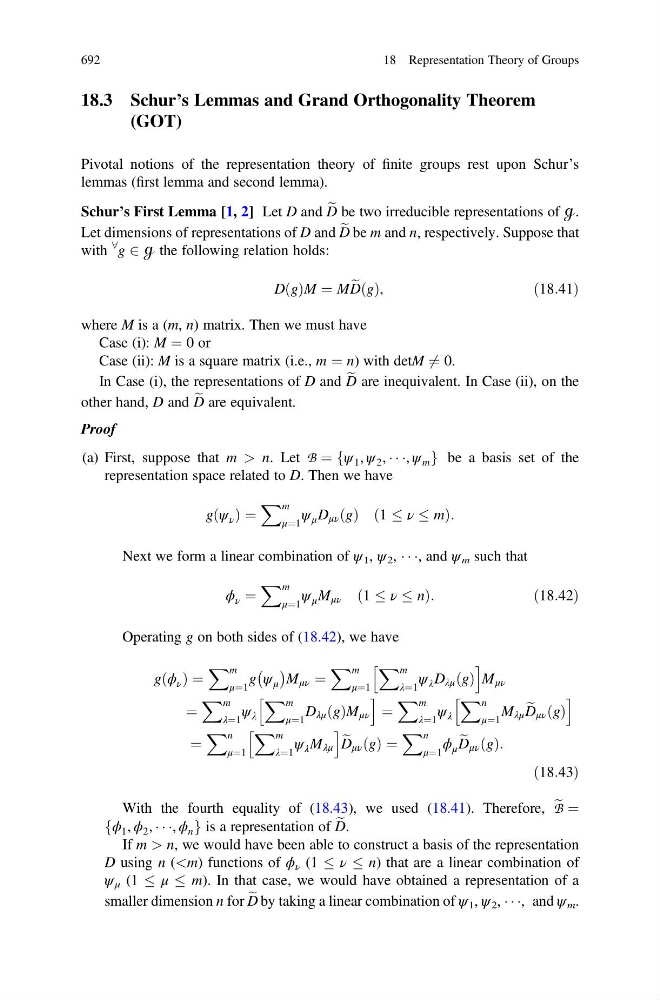
(a) First, suppose that m > n. Let B ¼ ψ 1 , ψ 2 , Á Á Á, ψ m
f
gbe a basis set of the
representation space related to D. Then we have
g ψ ν
ð Þ ¼
X m
μ¼1
ψ μ D μν g
ð Þ 1 ν m
ð
Þ :
Next we form a linear combination of ψ 1 , ψ 2 , Á Á Á, and ψ m such that
ϕ ν ¼
X m
μ¼1
ψ μ M μν 1 ν n
ð
Þ :
ð18:42Þ
Operating g on both sides of (18.42), we have
g ϕ ν
ð Þ ¼
X m
μ¼1
g ψ μ
À Á
M μν ¼
X m
μ¼1
X m
λ¼1
ψ λ D λμ g
ð Þ
h
i
M μν
¼
X m
λ¼1
ψ λ
X m
μ¼1
D λμ g
ð ÞM μν
h
i
¼
X m
λ¼1
ψ λ
X n
μ¼1
M λμ e
D μν g
ð Þ
h
i
¼
X n
μ¼1
X m
λ¼1
ψ λ M λμ
h
i e
D μν g
ð Þ ¼
X n
μ¼1
ϕ μ e
D μν g
ð Þ:
ð18:43Þ
With the fourth equality of (18.43), we used (18.41). Therefore, e
B ¼
ϕ 1 , ϕ 2 , Á Á Á, ϕ n
f
gis a representation of e
D.
If m > n, we would have been able to construct a basis of the representation
D using n (
μ
m). In that case, we would have obtained a representation of a
smaller dimension n for e
D by taking a linear combination of ψ 1 , ψ 2 , Á Á Á, and ψ m .
692
18 Representation Theory of Groups