

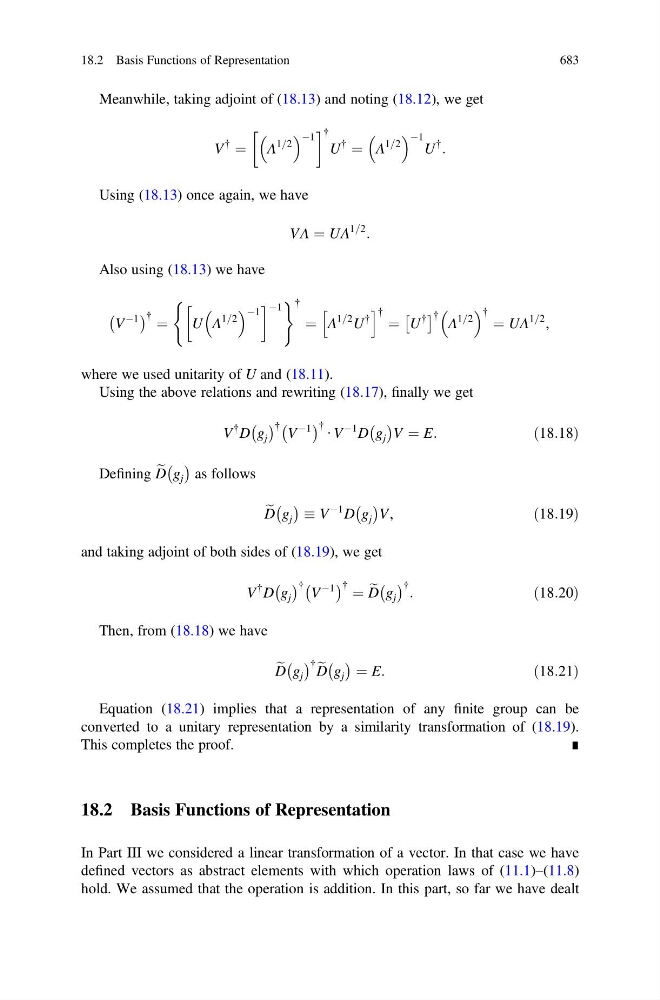
Meanwhile, taking adjoint of (18.13) and noting (18.12), we get
V
{
¼ Λ
1=2
À1
! {
U
{
¼ Λ
1=2
À1
U
{
:
Using (18.13) once again, we have
VΛ ¼ UΛ
1=2
:
Also using (18.13) we have
V
À1
À
Á { ¼
U Λ
1=2
À1
! À1
(
) {
¼ Λ
1=2 U
{
h
i { ¼ U
{
 à { Λ
1=2
{ ¼ UΛ
1=2 ,
where we used unitarity of U and (18.11).
Using the above relations and rewriting (18.17), finally we get
V
{ D g j
À Á { V
À1
À
Á { ∙ V
À1 D g j
À Á
V ¼ E:
ð18:18Þ
Defining e
D g j
À Á
as follows
e
D g j
À Á V
À1 D g j
À Á
V,
ð18:19Þ
and taking adjoint of both sides of (18.19), we get
V
{ D g j
À Á { V
À1
À
Á { ¼ e
D g j
À Á { :
ð18:20Þ
Then, from (18.18) we have
e
D g j
À Á { e
D g j
À Á ¼ E:
ð18:21Þ
Equation (18.21) implies that a representation of any finite group can be
converted to a unitary representation by a similarity transformation of (18.19).
This completes the proof.
∎
18.2 Basis Functions of Representation
In Part III we considered a linear transformation of a vector. In that case we have
defined vectors as abstract elements with which operation laws of (11.1)–(11.8)
hold. We assumed that the operation is addition. In this part, so far we have dealt
18.2 Basis Functions of Representation
683
V
{
¼ Λ
1=2
À1
! {
U
{
¼ Λ
1=2
À1
U
{
:
Using (18.13) once again, we have
VΛ ¼ UΛ
1=2
:
Also using (18.13) we have
V
À1
À
Á { ¼
U Λ
1=2
À1
! À1
(
) {
¼ Λ
1=2 U
{
h
i { ¼ U
{
 à { Λ
1=2
{ ¼ UΛ
1=2 ,
where we used unitarity of U and (18.11).
Using the above relations and rewriting (18.17), finally we get
V
{ D g j
À Á { V
À1
À
Á { ∙ V
À1 D g j
À Á
V ¼ E:
ð18:18Þ
Defining e
D g j
À Á
as follows
e
D g j
À Á V
À1 D g j
À Á
V,
ð18:19Þ
and taking adjoint of both sides of (18.19), we get
V
{ D g j
À Á { V
À1
À
Á { ¼ e
D g j
À Á { :
ð18:20Þ
Then, from (18.18) we have
e
D g j
À Á { e
D g j
À Á ¼ E:
ð18:21Þ
Equation (18.21) implies that a representation of any finite group can be
converted to a unitary representation by a similarity transformation of (18.19).
This completes the proof.
∎
18.2 Basis Functions of Representation
In Part III we considered a linear transformation of a vector. In that case we have
defined vectors as abstract elements with which operation laws of (11.1)–(11.8)
hold. We assumed that the operation is addition. In this part, so far we have dealt
18.2 Basis Functions of Representation
683