

Λ
1=2
¼
ffiffiffiffi ffi
λ 1
p
ffiffiffiffi ffi
λ 2
p
⋱
ffiffiffiffi ffi
λ d
p
0
B
B
B
@
1
C
C
C
A
,
ð18:11Þ
Λ
1=2
À1 ¼
ffiffiffiffiffiffiffi
λ
À1
1
q
ffiffiffiffiffiffiffi
λ
À1
2
q
⋱
ffiffiffiffiffiffiffi
λ
À1
d
q
0
B
B
B
B
B
B
@
1
C
C
C
C
C
C
A
:
ð18:12Þ
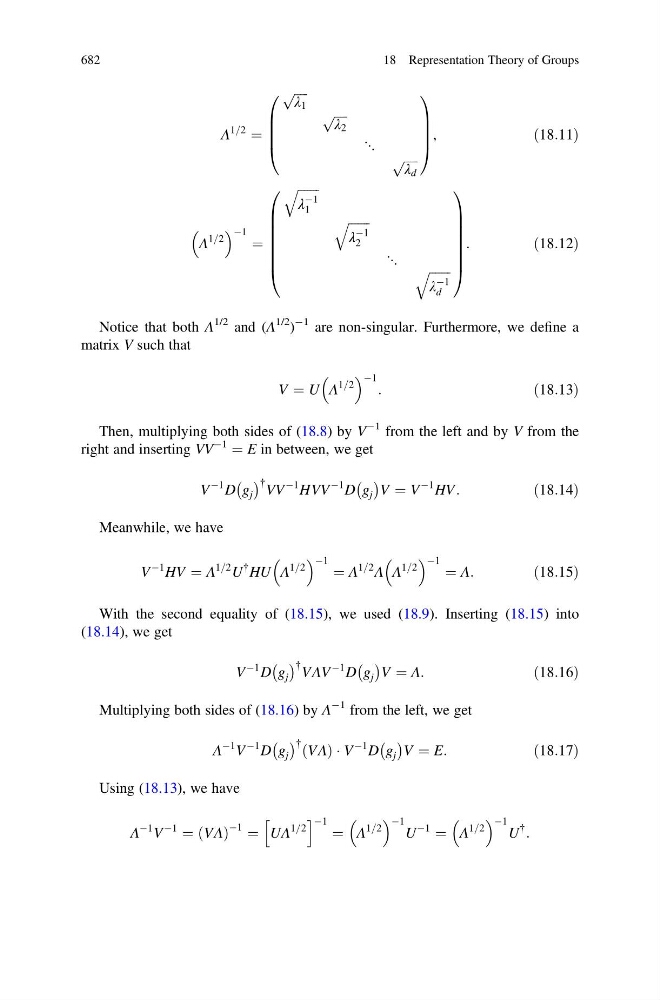
Notice that both Λ
1/2 and (Λ
1/2
)
À1 are non-singular. Furthermore, we define a
matrix V such that
V ¼ U Λ
1=2
À1 :
ð18:13Þ
Then, multiplying both sides of (18.8) by V
À1 from the left and by V from the
right and inserting VV
À1
¼ E in between, we get
V
À1 D g j
À Á { VV
À1 HVV
À1 D g j
À Á
V ¼ V
À1 HV :
ð18:14Þ
Meanwhile, we have
V
À1 HV ¼ Λ
1=2 U
{ HU Λ
1=2
À1 ¼ Λ
1=2
Λ Λ
1=2
À1 ¼ Λ:
ð18:15Þ
With the second equality of (18.15), we used (18.9). Inserting (18.15) into
(18.14), we get
V
À1 D g j
À Á { VΛV
À1 D g j
À Á
V ¼ Λ:
ð18:16Þ
Multiplying both sides of (18.16) by Λ
À1 from the left, we get
Λ
À1 V
À1 D g j
À Á { VΛ
ð ÞÁV
À1 D g j
À Á
V ¼ E:
ð18:17Þ
Using (18.13), we have
Λ
À1 V
À1
¼ VΛ
ð Þ
À1 ¼ UΛ
1=2
h
i À1 ¼ Λ
1=2
À1
U
À1
¼ Λ
1=2
À1
U
{
:
682
18 Representation Theory of Groups
1=2
¼
ffiffiffiffi ffi
λ 1
p
ffiffiffiffi ffi
λ 2
p
⋱
ffiffiffiffi ffi
λ d
p
0
B
B
B
@
1
C
C
C
A
,
ð18:11Þ
Λ
1=2
À1 ¼
ffiffiffiffiffiffiffi
λ
À1
1
q
ffiffiffiffiffiffiffi
λ
À1
2
q
⋱
ffiffiffiffiffiffiffi
λ
À1
d
q
0
B
B
B
B
B
B
@
1
C
C
C
C
C
C
A
:
ð18:12Þ
Notice that both Λ
1/2 and (Λ
1/2
)
À1 are non-singular. Furthermore, we define a
matrix V such that
V ¼ U Λ
1=2
À1 :
ð18:13Þ
Then, multiplying both sides of (18.8) by V
À1 from the left and by V from the
right and inserting VV
À1
¼ E in between, we get
V
À1 D g j
À Á { VV
À1 HVV
À1 D g j
À Á
V ¼ V
À1 HV :
ð18:14Þ
Meanwhile, we have
V
À1 HV ¼ Λ
1=2 U
{ HU Λ
1=2
À1 ¼ Λ
1=2
Λ Λ
1=2
À1 ¼ Λ:
ð18:15Þ
With the second equality of (18.15), we used (18.9). Inserting (18.15) into
(18.14), we get
V
À1 D g j
À Á { VΛV
À1 D g j
À Á
V ¼ Λ:
ð18:16Þ
Multiplying both sides of (18.16) by Λ
À1 from the left, we get
Λ
À1 V
À1 D g j
À Á { VΛ
ð ÞÁV
À1 D g j
À Á
V ¼ E:
ð18:17Þ
Using (18.13), we have
Λ
À1 V
À1
¼ VΛ
ð Þ
À1 ¼ UΛ
1=2
h
i À1 ¼ Λ
1=2
À1
U
À1
¼ Λ
1=2
À1
U
{
:
682
18 Representation Theory of Groups