

R 3 ¼
0 0 1
1 0 0
0 1 0
0
B
@
1
C
A:
ð17:116Þ
If we write a linear transformation R 3 following (11.37), we get
R 3 jxi
ð Þ ¼ e 1 i
j je 2
ð
i j e 3 iÞ
0 0 1
1 0 0
0 1 0
0
B
@
1
C
A
x 1
x 2
x 3
0
B
@
1
C
A,
ð17:117Þ
where je 1 i, j e 2 i, and j e 3 i represent unit basis vectors in the direction of x-, y-, and zaxes, respectively. We have jxi ¼ x 1 j e 1 i + x 2 j e 2 i + x 3 j e 3 i. Thus, we get
R 3 jxi
ð Þ ¼ je 2 i je 3 i je 1 i
ð
Þ
x 1
x 2
x 3
0
B
@
1
C
A:
ð17:118Þ
This implies a cyclic permutation of the basis vectors. This is well expressed in terms
of the column vectors (i.e., coordinate) transformation as
x
y
z
O
(a)
(b)
x
y
z
O
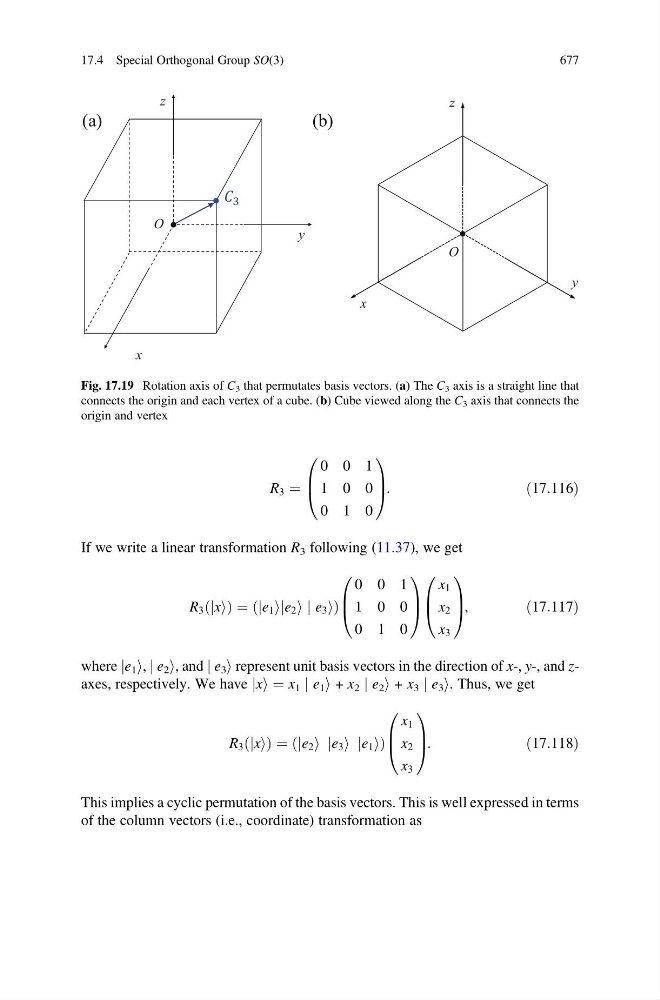
Fig. 17.19 Rotation axis of C 3 that permutates basis vectors. (a) The C 3 axis is a straight line that
connects the origin and each vertex of a cube. (b) Cube viewed along the C 3 axis that connects the
origin and vertex
17.4 Special Orthogonal Group SO(3)
677
0 0 1
1 0 0
0 1 0
0
B
@
1
C
A:
ð17:116Þ
If we write a linear transformation R 3 following (11.37), we get
R 3 jxi
ð Þ ¼ e 1 i
j je 2
ð
i j e 3 iÞ
0 0 1
1 0 0
0 1 0
0
B
@
1
C
A
x 1
x 2
x 3
0
B
@
1
C
A,
ð17:117Þ
where je 1 i, j e 2 i, and j e 3 i represent unit basis vectors in the direction of x-, y-, and zaxes, respectively. We have jxi ¼ x 1 j e 1 i + x 2 j e 2 i + x 3 j e 3 i. Thus, we get
R 3 jxi
ð Þ ¼ je 2 i je 3 i je 1 i
ð
Þ
x 1
x 2
x 3
0
B
@
1
C
A:
ð17:118Þ
This implies a cyclic permutation of the basis vectors. This is well expressed in terms
of the column vectors (i.e., coordinate) transformation as
x
y
z
O
(a)
(b)
x
y
z
O
Fig. 17.19 Rotation axis of C 3 that permutates basis vectors. (a) The C 3 axis is a straight line that
connects the origin and each vertex of a cube. (b) Cube viewed along the C 3 axis that connects the
origin and vertex
17.4 Special Orthogonal Group SO(3)
677