

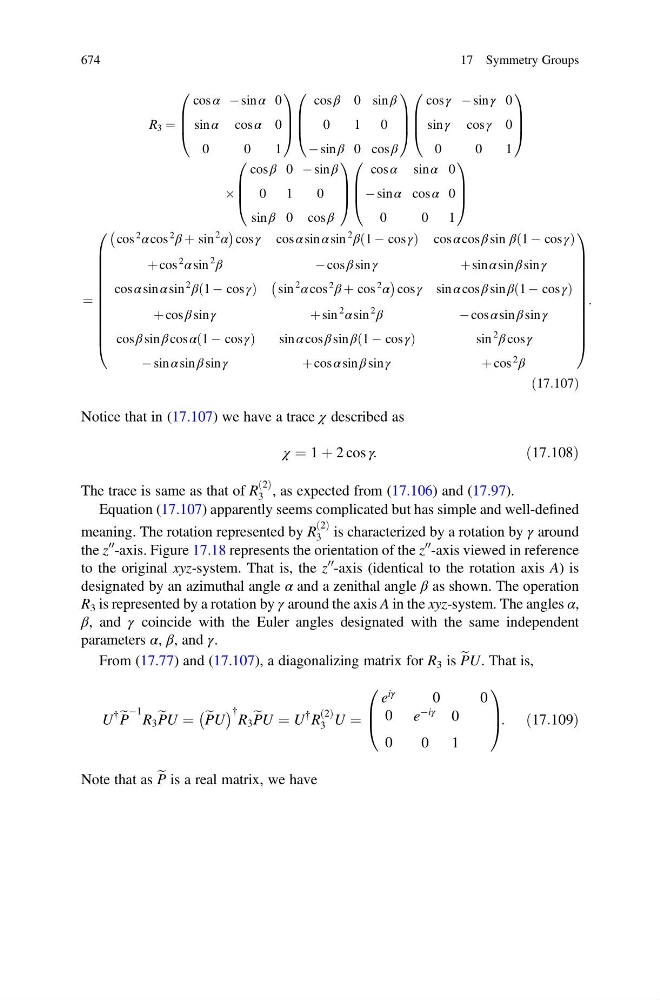
R 3 ¼
cos α À sin α 0
sin α cos α 0
0
0
1
0
B
B
@
1
C
C
A
cos β 0 sin β
0
1 0
À sin β 0 cos β
0
B
B
@
1
C
C
A
cos γ À sin γ 0
sin γ cos γ 0
0
0
1
0
B
B
@
1
C
C
A
Â
cos β 0 À sin β
0 1
0
sin β 0 cos β
0
B
B
@
1
C
C
A
cos α sin α 0
À sin α cos α 0
0
0 1
0
B
B
@
1
C
C
A
¼
cos
2
α cos
2
β þ sin
2 α
À
Á
cos γ cos α sin α sin
2 β 1 À cos γ
ð
Þ cos α cos β sin β 1 À cos γ
ð
Þ
þ cos
2
α sin
2 β
À cos β sin γ
þ sin α sin β sin γ
cos α sin α sin
2 β 1 À cos γ
ð
Þ
sin
2 α cos
2
β þ cos
2
α
À
Á
cos γ sin α cos β sin β 1 À cos γ
ð
Þ
þ cos β sin γ
þ sin
2 α sin
2 β
À cos α sin β sin γ
cos β sin β cos α 1 À cos γ
ð
Þ
sin α cos β sin β 1 À cos γ
ð
Þ
sin
2 β cos γ
À sin α sin β sin γ
þ cos α sin β sin γ
þ cos
2
β
0
B
B
B
B
B
B
B
B
B
B
B
@
1
C
C
C
C
C
C
C
C
C
C
C
A
:
ð17:107Þ
Notice that in (17.107) we have a trace χ described as
χ ¼ 1 þ 2 cos γ:
ð17:108Þ
The trace is same as that of R
2
ð Þ
3 , as expected from (17.106) and (17.97).
Equation (17.107) apparently seems complicated but has simple and well-defined
meaning. The rotation represented by R
2
ð Þ
3 is characterized by a rotation by γ around
the z
00 -axis. Figure 17.18 represents the orientation of the z
00 -axis viewed in reference
to the original xyz-system. That is, the z
00
-axis (identical to the rotation axis A) is
designated by an azimuthal angle α and a zenithal angle β as shown. The operation
R 3 is represented by a rotation by γ around the axis A in the xyz-system. The angles α,
β, and γ coincide with the Euler angles designated with the same independent
parameters α, β, and γ.
From (17.77) and (17.107), a diagonalizing matrix for R 3 is e
PU. That is,
U
{ e
P
À1 R 3 e
PU ¼ e
PU
À Á { R 3 e
PU ¼ U
{ R
2
ð Þ
3 U ¼
e
iγ
0
0
0
0
e
Àiγ
0
0
1
0
B
@
1
C
A: ð17:109Þ
Note that as e
P is a real matrix, we have
674
17 Symmetry Groups