

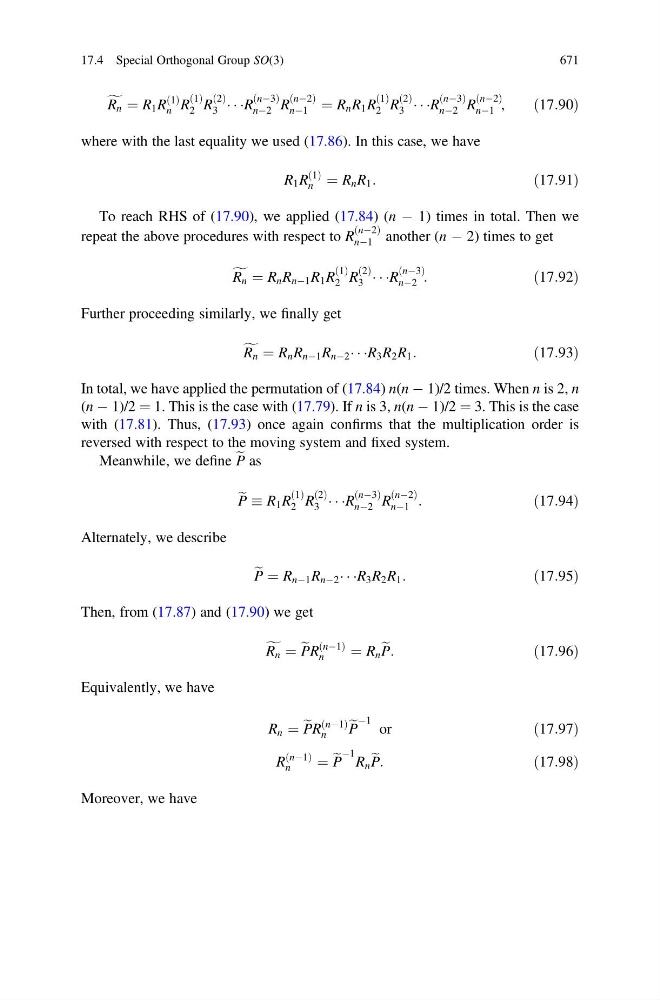
f R n ¼ R 1 R
1
ð Þ
n R
1
ð Þ
2 R
2
ð Þ
3 Á Á ÁR
nÀ3
ð
Þ
nÀ2 R
nÀ2
ð
Þ
nÀ1 ¼ R n R 1 R
1
ð Þ
2 R
2
ð Þ
3 Á Á ÁR
nÀ3
ð
Þ
nÀ2 R
nÀ2
ð
Þ
nÀ1 ,
ð17:90Þ
where with the last equality we used (17.86). In this case, we have
R 1 R
1
ð Þ
n ¼ R n R 1 :
ð17:91Þ
To reach RHS of (17.90), we applied (17.84) (n À 1) times in total. Then we
repeat the above procedures with respect to R
nÀ2
ð
Þ
nÀ1 another (n À 2) times to get
f R n ¼ R n R nÀ1 R 1 R
1
ð Þ
2 R
2
ð Þ
3 Á Á ÁR
nÀ3
ð
Þ
nÀ2 :
ð17:92Þ
Further proceeding similarly, we finally get
f
R n ¼ R n R nÀ1 R nÀ2 Á Á ÁR 3 R 2 R 1 :
ð17:93Þ
In total, we have applied the permutation of (17.84) n(n À 1)/2 times. When n is 2, n
(n À 1)/2 ¼ 1. This is the case with (17.79). If n is 3, n(n À 1)/2 ¼ 3. This is the case
with (17.81). Thus, (17.93) once again confirms that the multiplication order is
reversed with respect to the moving system and fixed system.
Meanwhile, we define e
P as
e
P R 1 R
1
ð Þ
2 R
2
ð Þ
3 Á Á ÁR
nÀ3
ð
Þ
nÀ2 R
nÀ2
ð
Þ
nÀ1 :
ð17:94Þ
Alternately, we describe
e
P ¼ R nÀ1 R nÀ2 Á Á ÁR 3 R 2 R 1 :
ð17:95Þ
Then, from (17.87) and (17.90) we get
f
R n ¼ e
PR
nÀ1
ð
Þ
n
¼ R n e
P:
ð17:96Þ
Equivalently, we have
R n ¼ e
PR
nÀ1
ð
Þ
n
e
P
À1 or
ð17:97Þ
R
nÀ1
ð
Þ
n
¼ e
P
À1 R n e
P:
ð17:98Þ
Moreover, we have
17.4 Special Orthogonal Group SO(3)
671
1
ð Þ
n R
1
ð Þ
2 R
2
ð Þ
3 Á Á ÁR
nÀ3
ð
Þ
nÀ2 R
nÀ2
ð
Þ
nÀ1 ¼ R n R 1 R
1
ð Þ
2 R
2
ð Þ
3 Á Á ÁR
nÀ3
ð
Þ
nÀ2 R
nÀ2
ð
Þ
nÀ1 ,
ð17:90Þ
where with the last equality we used (17.86). In this case, we have
R 1 R
1
ð Þ
n ¼ R n R 1 :
ð17:91Þ
To reach RHS of (17.90), we applied (17.84) (n À 1) times in total. Then we
repeat the above procedures with respect to R
nÀ2
ð
Þ
nÀ1 another (n À 2) times to get
f R n ¼ R n R nÀ1 R 1 R
1
ð Þ
2 R
2
ð Þ
3 Á Á ÁR
nÀ3
ð
Þ
nÀ2 :
ð17:92Þ
Further proceeding similarly, we finally get
f
R n ¼ R n R nÀ1 R nÀ2 Á Á ÁR 3 R 2 R 1 :
ð17:93Þ
In total, we have applied the permutation of (17.84) n(n À 1)/2 times. When n is 2, n
(n À 1)/2 ¼ 1. This is the case with (17.79). If n is 3, n(n À 1)/2 ¼ 3. This is the case
with (17.81). Thus, (17.93) once again confirms that the multiplication order is
reversed with respect to the moving system and fixed system.
Meanwhile, we define e
P as
e
P R 1 R
1
ð Þ
2 R
2
ð Þ
3 Á Á ÁR
nÀ3
ð
Þ
nÀ2 R
nÀ2
ð
Þ
nÀ1 :
ð17:94Þ
Alternately, we describe
e
P ¼ R nÀ1 R nÀ2 Á Á ÁR 3 R 2 R 1 :
ð17:95Þ
Then, from (17.87) and (17.90) we get
f
R n ¼ e
PR
nÀ1
ð
Þ
n
¼ R n e
P:
ð17:96Þ
Equivalently, we have
R n ¼ e
PR
nÀ1
ð
Þ
n
e
P
À1 or
ð17:97Þ
R
nÀ1
ð
Þ
n
¼ e
P
À1 R n e
P:
ð17:98Þ
Moreover, we have
17.4 Special Orthogonal Group SO(3)
671