

À
d
2 u ξ
ð Þ
dξ
2
þ ξ
2 u ξ
ð Þ ¼
2E
ħω
u ξ
ð Þ:
ð2:109Þ
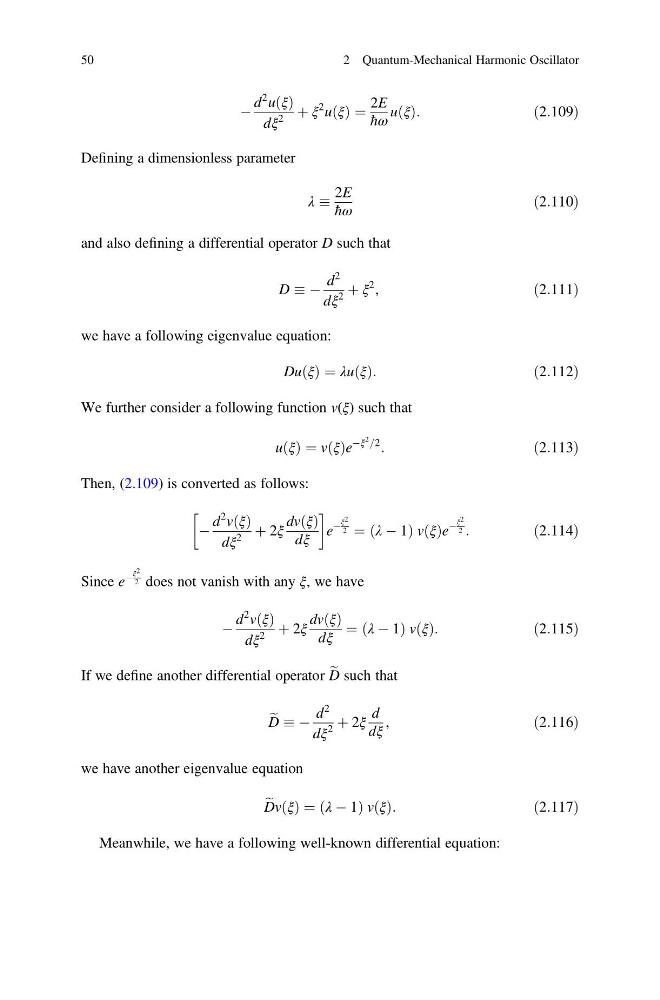
Defining a dimensionless parameter
λ
2E
ħω
ð2:110Þ
and also defining a differential operator D such that
D À
d
2
dξ
2
þ ξ
2 ,
ð2:111Þ
we have a following eigenvalue equation:
Du ξ
ð Þ ¼ λu ξ
ð Þ:
ð2:112Þ
We further consider a following function v(ξ) such that
u ξ
ð Þ ¼ v ξ
ð Þe
Àξ
2 =2
:
ð2:113Þ
Then, (2.109) is converted as follows:
À
d
2 v ξ
ð Þ
dξ
2
þ 2ξ
dv ξ
ð Þ
dξ
!
e
À
ξ 2
2 ¼ λ À 1
ð
Þv ξ
ð Þe
À
ξ 2
2 :
ð2:114Þ
Since e
À
ξ 2
2 does not vanish with any ξ, we have
À
d
2 v ξ
ð Þ
dξ
2
þ 2ξ
dv ξ
ð Þ
dξ
¼ λ À 1
ð
Þv ξ
ð Þ:
ð2:115Þ
If we define another differential operator e
D such that
e
D À
d
2
dξ
2
þ 2ξ
d
dξ
,
ð2:116Þ
we have another eigenvalue equation
e
Dv ξ
ð Þ ¼ λ À 1
ð
Þv ξ
ð Þ:
ð2:117Þ
Meanwhile, we have a following well-known differential equation:
50
2 Quantum-Mechanical Harmonic Oscillator
d
2 u ξ
ð Þ
dξ
2
þ ξ
2 u ξ
ð Þ ¼
2E
ħω
u ξ
ð Þ:
ð2:109Þ
Defining a dimensionless parameter
λ
2E
ħω
ð2:110Þ
and also defining a differential operator D such that
D À
d
2
dξ
2
þ ξ
2 ,
ð2:111Þ
we have a following eigenvalue equation:
Du ξ
ð Þ ¼ λu ξ
ð Þ:
ð2:112Þ
We further consider a following function v(ξ) such that
u ξ
ð Þ ¼ v ξ
ð Þe
Àξ
2 =2
:
ð2:113Þ
Then, (2.109) is converted as follows:
À
d
2 v ξ
ð Þ
dξ
2
þ 2ξ
dv ξ
ð Þ
dξ
!
e
À
ξ 2
2 ¼ λ À 1
ð
Þv ξ
ð Þe
À
ξ 2
2 :
ð2:114Þ
Since e
À
ξ 2
2 does not vanish with any ξ, we have
À
d
2 v ξ
ð Þ
dξ
2
þ 2ξ
dv ξ
ð Þ
dξ
¼ λ À 1
ð
Þv ξ
ð Þ:
ð2:115Þ
If we define another differential operator e
D such that
e
D À
d
2
dξ
2
þ 2ξ
d
dξ
,
ð2:116Þ
we have another eigenvalue equation
e
Dv ξ
ð Þ ¼ λ À 1
ð
Þv ξ
ð Þ:
ð2:117Þ
Meanwhile, we have a following well-known differential equation:
50
2 Quantum-Mechanical Harmonic Oscillator