

Theorem 17.1: Cayley’s Theorem [1] Every finite group ℊ of order n is isomorphic to a subgroup (containing a whole group) of the symmetric group S n .
17.4 Special Orthogonal Group SO(3)
In Part III and Part IV thus far, we have dealt with a broad class of linear transformations. Related groups are finite groups. Here we will describe characteristics of
special orthogonal group SO(3), a kind of infinite groups. The SO(3) represents
rotations in three-dimensional Euclidean space ℝ
3 . Rotations are made around an
axis (a line through the origin) with the origin fixed. The rotation is defined by an
azimuth of direction and a magnitude (angle) of rotation. The azimuth of direction is
defined by two parameters and the magnitude is defined by one parameter, a rotation
angle. Hence, the rotation is defined by three independent parameters. Since those
parameters are continuously variable, SO(3) is one of continuous groups.
Two rotations result in another rotation with the origin again fixed. A reverse
rotation is unambiguously defined. An identity transformation is naturally defined.
An associative law holds as well. Thus, the relevant rotations form a group, i.e., SO
(3). The rotation is represented by a real (3, 3) matrix whose determinant is 1. A
matrix representation is uniquely determined once an orthonormal basis is set in ℝ
3 .
Any rotation is represented by a rotation matrix accordingly. The rotation matrix R is
defined by
R
T R ¼ RR
T
¼ E,
ð17:54Þ
where R is a real matrix with det R ¼ 1. Notice that we exclude the case where det
R ¼ À 1. Matrices that satisfy (17.54) with det R ¼ Æ 1 are referred to as orthogonal
matrices that cause orthogonal transformation. Correspondingly, orthogonal groups
(represented by orthogonal matrices) contain rotation groups as a special case. In
other words, the orthogonal groups contain the rotation groups as a subgroup. An
orthogonal group in ℝ
3 denoted O(3) contains SO(3) as a subgroup. By the same
token, orthogonal matrices contain rotation matrices as a special case.
In Sect. 17.2 we treated reflection and improper rotation with a determinant of
their matrices being À1. In this section these transformations are excluded and only
rotations are dealt with. We focus on geometric characteristics of the rotation groups.
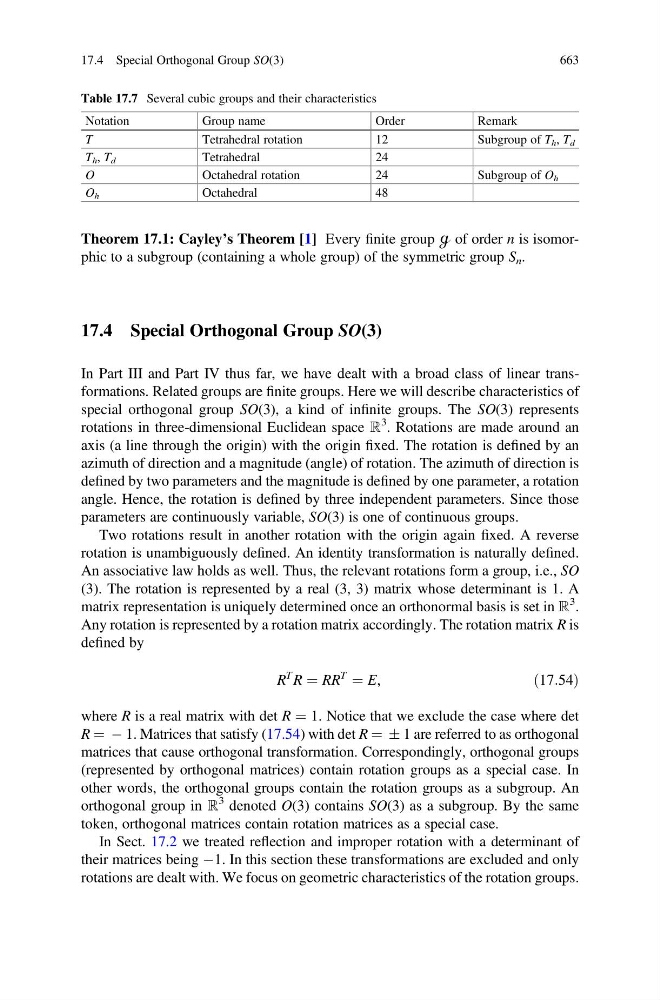
Table 17.7 Several cubic groups and their characteristics
Notation
Group name
Order
Remark
T
Tetrahedral rotation
12
Subgroup of T h , T d
T h , T d
Tetrahedral
24
O
Octahedral rotation
24
Subgroup of O h
O h
Octahedral
48
17.4 Special Orthogonal Group SO(3)
663
17.4 Special Orthogonal Group SO(3)
In Part III and Part IV thus far, we have dealt with a broad class of linear transformations. Related groups are finite groups. Here we will describe characteristics of
special orthogonal group SO(3), a kind of infinite groups. The SO(3) represents
rotations in three-dimensional Euclidean space ℝ
3 . Rotations are made around an
axis (a line through the origin) with the origin fixed. The rotation is defined by an
azimuth of direction and a magnitude (angle) of rotation. The azimuth of direction is
defined by two parameters and the magnitude is defined by one parameter, a rotation
angle. Hence, the rotation is defined by three independent parameters. Since those
parameters are continuously variable, SO(3) is one of continuous groups.
Two rotations result in another rotation with the origin again fixed. A reverse
rotation is unambiguously defined. An identity transformation is naturally defined.
An associative law holds as well. Thus, the relevant rotations form a group, i.e., SO
(3). The rotation is represented by a real (3, 3) matrix whose determinant is 1. A
matrix representation is uniquely determined once an orthonormal basis is set in ℝ
3 .
Any rotation is represented by a rotation matrix accordingly. The rotation matrix R is
defined by
R
T R ¼ RR
T
¼ E,
ð17:54Þ
where R is a real matrix with det R ¼ 1. Notice that we exclude the case where det
R ¼ À 1. Matrices that satisfy (17.54) with det R ¼ Æ 1 are referred to as orthogonal
matrices that cause orthogonal transformation. Correspondingly, orthogonal groups
(represented by orthogonal matrices) contain rotation groups as a special case. In
other words, the orthogonal groups contain the rotation groups as a subgroup. An
orthogonal group in ℝ
3 denoted O(3) contains SO(3) as a subgroup. By the same
token, orthogonal matrices contain rotation matrices as a special case.
In Sect. 17.2 we treated reflection and improper rotation with a determinant of
their matrices being À1. In this section these transformations are excluded and only
rotations are dealt with. We focus on geometric characteristics of the rotation groups.
Table 17.7 Several cubic groups and their characteristics
Notation
Group name
Order
Remark
T
Tetrahedral rotation
12
Subgroup of T h , T d
T h , T d
Tetrahedral
24
O
Octahedral rotation
24
Subgroup of O h
O h
Octahedral
48
17.4 Special Orthogonal Group SO(3)
663