

À
À1 0 0
0 0 À1
0 1 0
0
B
@
1
C
A
À1
¼ À
À1 0 0
0
0 1
0 À1 0
0
B
@
1
C
A ¼
1
0 0
0
0
0 À1
1 0
0
B
@
1
C
A:
The resulting matrix is identical to the first matrix of C 4 of O. Thus, we find T d and
O are isomorphic to each other.
Both O and T d consist of 24 group elements and isomorphic to a symmetric group
S 4 ; do not confuse it with the same symbol S 4 as a group element of T d . The subgroup
T consists of three conjugacy classes E, 8C 3 , and 3C 2 . Since T is constructed only by
entire classes, it is an invariant subgroup; in this respect see the discussion of Sect.
16.3. The groups O, T d , and T along with T h and O h form cubic groups [2]. In
Table 17.7, we list these cubic groups together with their name and order. Of these,
O is a pure rotation subgroup of O h and T is a pure rotation subgroup of T d and T h .
Symmetry groups are related to permutations of n elements (or objects or
numbers). The permutation has already appeared in (11.56) when we defined a
determinant of a matrix. That was defined as
σ ¼
1 2 Á Á Á n
i 1 i 2 Á Á Á i n
,
where σ means the permutation of the numbers 1, 2, Á Á Á, n. Therefore, the above
symmetry group has n! group elements (i.e., different ways of rearrangements).
Although we do not dwell on symmetric groups much, we describe a following
important theorem related to finite groups without proof. Interested readers are
referred to literature [1].
y
x
z
O
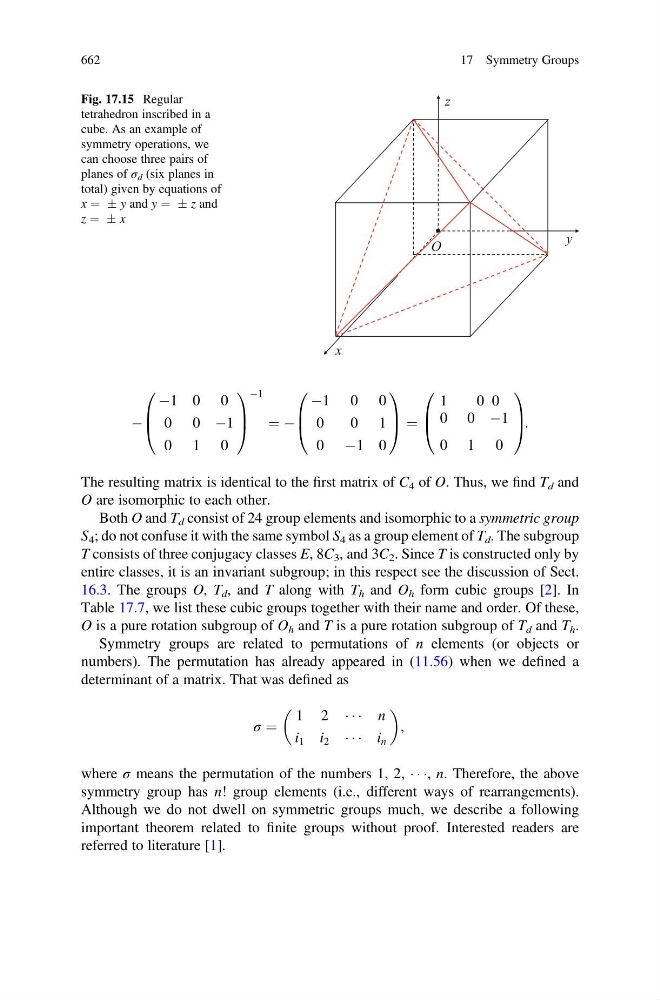
Fig. 17.15 Regular
tetrahedron inscribed in a
cube. As an example of
symmetry operations, we
can choose three pairs of
planes of σ d (six planes in
total) given by equations of
x ¼ Æ y and y ¼ Æ z and
z ¼ Æ x
662
17 Symmetry Groups
À1 0 0
0 0 À1
0 1 0
0
B
@
1
C
A
À1
¼ À
À1 0 0
0
0 1
0 À1 0
0
B
@
1
C
A ¼
1
0 0
0
0
0 À1
1 0
0
B
@
1
C
A:
The resulting matrix is identical to the first matrix of C 4 of O. Thus, we find T d and
O are isomorphic to each other.
Both O and T d consist of 24 group elements and isomorphic to a symmetric group
S 4 ; do not confuse it with the same symbol S 4 as a group element of T d . The subgroup
T consists of three conjugacy classes E, 8C 3 , and 3C 2 . Since T is constructed only by
entire classes, it is an invariant subgroup; in this respect see the discussion of Sect.
16.3. The groups O, T d , and T along with T h and O h form cubic groups [2]. In
Table 17.7, we list these cubic groups together with their name and order. Of these,
O is a pure rotation subgroup of O h and T is a pure rotation subgroup of T d and T h .
Symmetry groups are related to permutations of n elements (or objects or
numbers). The permutation has already appeared in (11.56) when we defined a
determinant of a matrix. That was defined as
σ ¼
1 2 Á Á Á n
i 1 i 2 Á Á Á i n
,
where σ means the permutation of the numbers 1, 2, Á Á Á, n. Therefore, the above
symmetry group has n! group elements (i.e., different ways of rearrangements).
Although we do not dwell on symmetric groups much, we describe a following
important theorem related to finite groups without proof. Interested readers are
referred to literature [1].
y
x
z
O
Fig. 17.15 Regular
tetrahedron inscribed in a
cube. As an example of
symmetry operations, we
can choose three pairs of
planes of σ d (six planes in
total) given by equations of
x ¼ Æ y and y ¼ Æ z and
z ¼ Æ x
662
17 Symmetry Groups