

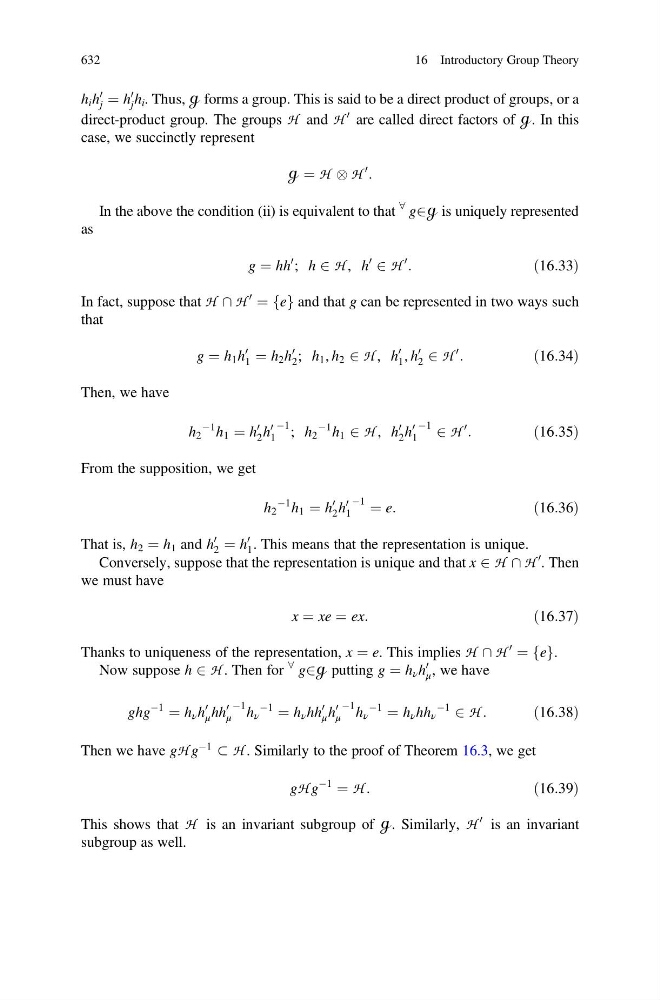
h i h
0
j ¼ h
0
j h i . Thus, ℊ forms a group. This is said to be a direct product of groups, or a
direct-product group. The groups H and H
0 are called direct factors of ℊ. In this
case, we succinctly represent
ℊ ¼ H H
0
:
In the above the condition (ii) is equivalent to that
8
g2ℊ is uniquely represented
as
g ¼ hh
0 ; h 2 H , h
0
2 H
0
:
ð16:33Þ
In fact, suppose that H \ H
0
¼ e
f g and that g can be represented in two ways such
that
g ¼ h 1 h
0
1 ¼ h 2 h
0
2 ; h 1 , h 2 2 H , h
0
1 , h
0
2 2 H
0
:
ð16:34Þ
Then, we have
h 2
À1
h 1 ¼ h
0
2 h
0
1
À1 ; h 2
À1
h 1 2 H , h
0
2 h
0
1
À1 2 H
0
:
ð16:35Þ
From the supposition, we get
h 2
À1
h 1 ¼ h
0
2 h
0
1
À1 ¼ e:
ð16:36Þ
That is, h 2 ¼ h 1 and h
0
2 ¼ h
0
1 . This means that the representation is unique.
Conversely, suppose that the representation is unique and that x 2 H \ H
0 . Then
we must have
x ¼ xe ¼ ex:
ð16:37Þ
Thanks to uniqueness of the representation, x ¼ e. This implies H \ H
0
¼ e
f g.
Now suppose h 2 H . Then for
8
g2ℊ putting g ¼ h ν h
0
μ , we have
ghg
À1
¼ h ν h
0
μ hh
0
μ
À1 h ν
À1
¼ h ν hh
0
μ h
0
μ
À1 h ν
À1
¼ h ν hh ν
À1
2 H :
ð16:38Þ
Then we have gH g
À1
⊂ H . Similarly to the proof of Theorem 16.3, we get
gH g
À1
¼ H :
ð16:39Þ
This shows that H is an invariant subgroup of ℊ. Similarly, H
0 is an invariant
subgroup as well.
632
16 Introductory Group Theory
0
j ¼ h
0
j h i . Thus, ℊ forms a group. This is said to be a direct product of groups, or a
direct-product group. The groups H and H
0 are called direct factors of ℊ. In this
case, we succinctly represent
ℊ ¼ H H
0
:
In the above the condition (ii) is equivalent to that
8
g2ℊ is uniquely represented
as
g ¼ hh
0 ; h 2 H , h
0
2 H
0
:
ð16:33Þ
In fact, suppose that H \ H
0
¼ e
f g and that g can be represented in two ways such
that
g ¼ h 1 h
0
1 ¼ h 2 h
0
2 ; h 1 , h 2 2 H , h
0
1 , h
0
2 2 H
0
:
ð16:34Þ
Then, we have
h 2
À1
h 1 ¼ h
0
2 h
0
1
À1 ; h 2
À1
h 1 2 H , h
0
2 h
0
1
À1 2 H
0
:
ð16:35Þ
From the supposition, we get
h 2
À1
h 1 ¼ h
0
2 h
0
1
À1 ¼ e:
ð16:36Þ
That is, h 2 ¼ h 1 and h
0
2 ¼ h
0
1 . This means that the representation is unique.
Conversely, suppose that the representation is unique and that x 2 H \ H
0 . Then
we must have
x ¼ xe ¼ ex:
ð16:37Þ
Thanks to uniqueness of the representation, x ¼ e. This implies H \ H
0
¼ e
f g.
Now suppose h 2 H . Then for
8
g2ℊ putting g ¼ h ν h
0
μ , we have
ghg
À1
¼ h ν h
0
μ hh
0
μ
À1 h ν
À1
¼ h ν hh
0
μ h
0
μ
À1 h ν
À1
¼ h ν hh ν
À1
2 H :
ð16:38Þ
Then we have gH g
À1
⊂ H . Similarly to the proof of Theorem 16.3, we get
gH g
À1
¼ H :
ð16:39Þ
This shows that H is an invariant subgroup of ℊ. Similarly, H
0 is an invariant
subgroup as well.
632
16 Introductory Group Theory