

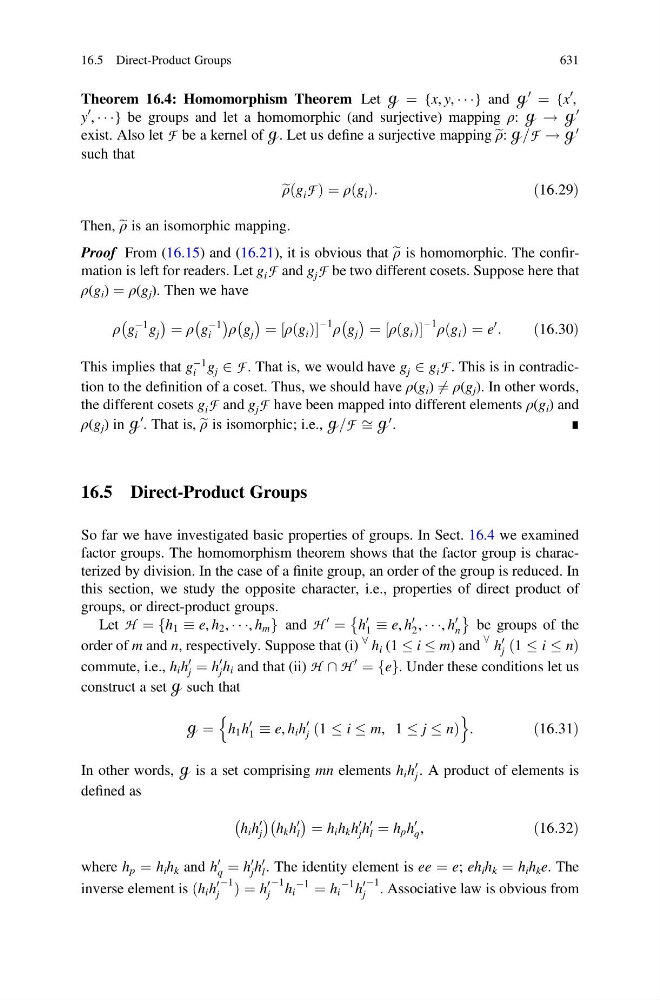
Theorem 16.4: Homomorphism Theorem Let ℊ ¼ {x, y, Á Á Á} and ℊ
0
¼ {x
0
,
y
0 , Á Á Á} be groups and let a homomorphic (and surjective) mapping ρ: ℊ ! ℊ
0
exist. Also let F be a kernel of ℊ. Let us define a surjective mapping e ρ: ℊ=F ! ℊ
0
such that
e ρ g i F
ð Þ ¼ ρ g i
ð Þ:
ð16:29Þ
Then, e ρ is an isomorphic mapping.
Proof From (16.15) and (16.21), it is obvious that e ρ is homomorphic. The confirmation is left for readers. Let g i F and g j F be two different cosets. Suppose here that
ρ(g i ) ¼ ρ(g j ). Then we have
ρ g
À1
i g j
À
Á ¼ ρ g
À1
i
À Á ρ g j
À Á ¼ ρ g i
ð Þ
½
À1 ρ g j
À Á ¼ ρ g i
ð Þ
½
À1 ρ g i
ð Þ ¼ e
0
:
ð16:30Þ
This implies that g
À1
i g j 2 F . That is, we would have g j 2 g i F . This is in contradiction to the definition of a coset. Thus, we should have ρ(g i ) 6 ¼ ρ(g j ). In other words,
the different cosets g i F and g j F have been mapped into different elements ρ(g i ) and
ρ(g j ) in ℊ
0 . That is, e ρ is isomorphic; i.e., ℊ=F ffi ℊ
0 .
∎
16.5 Direct-Product Groups
So far we have investigated basic properties of groups. In Sect. 16.4 we examined
factor groups. The homomorphism theorem shows that the factor group is characterized by division. In the case of a finite group, an order of the group is reduced. In
this section, we study the opposite character, i.e., properties of direct product of
groups, or direct-product groups.
Let H ¼ h 1 e, h 2 , Á Á Á, h m
f
gand H
0
¼ h
0
1 e, h
0
2 , Á Á Á, h
0
n
È
É
be groups of the
order of m and n, respectively. Suppose that (i)
8
h i (1 i m) and
8 h
0
j 1 i n
ð
Þ
commute, i.e., h i h
0
j ¼ h
0
j h i and that (ii) H \ H
0
¼ e
f g. Under these conditions let us
construct a set ℊ such that
ℊ ¼ h 1 h
0
1 e, h i h
0
j 1 i m, 1 j n
ð
Þ
n
o
:
ð16:31Þ
In other words, ℊ is a set comprising mn elements h i h
0
j . A product of elements is
defined as
À h i h
0
j
Á h k h
0
l
À
Á ¼ h i h k h
0
j h
0
l ¼ h p h
0
q ,
ð16:32Þ
where h p ¼ h i h k and h
0
q ¼ h
0
j h
0
l . The identity element is ee ¼ e; eh i h k ¼ h i h k e. The
inverse element is ðh i h
0
j
À1 Þ ¼ h
0
j
À1 h i
À1
¼ h i
À1
h
0
j
À1 . Associative law is obvious from
16.5 Direct-Product Groups
631
0
¼ {x
0
,
y
0 , Á Á Á} be groups and let a homomorphic (and surjective) mapping ρ: ℊ ! ℊ
0
exist. Also let F be a kernel of ℊ. Let us define a surjective mapping e ρ: ℊ=F ! ℊ
0
such that
e ρ g i F
ð Þ ¼ ρ g i
ð Þ:
ð16:29Þ
Then, e ρ is an isomorphic mapping.
Proof From (16.15) and (16.21), it is obvious that e ρ is homomorphic. The confirmation is left for readers. Let g i F and g j F be two different cosets. Suppose here that
ρ(g i ) ¼ ρ(g j ). Then we have
ρ g
À1
i g j
À
Á ¼ ρ g
À1
i
À Á ρ g j
À Á ¼ ρ g i
ð Þ
½
À1 ρ g j
À Á ¼ ρ g i
ð Þ
½
À1 ρ g i
ð Þ ¼ e
0
:
ð16:30Þ
This implies that g
À1
i g j 2 F . That is, we would have g j 2 g i F . This is in contradiction to the definition of a coset. Thus, we should have ρ(g i ) 6 ¼ ρ(g j ). In other words,
the different cosets g i F and g j F have been mapped into different elements ρ(g i ) and
ρ(g j ) in ℊ
0 . That is, e ρ is isomorphic; i.e., ℊ=F ffi ℊ
0 .
∎
16.5 Direct-Product Groups
So far we have investigated basic properties of groups. In Sect. 16.4 we examined
factor groups. The homomorphism theorem shows that the factor group is characterized by division. In the case of a finite group, an order of the group is reduced. In
this section, we study the opposite character, i.e., properties of direct product of
groups, or direct-product groups.
Let H ¼ h 1 e, h 2 , Á Á Á, h m
f
gand H
0
¼ h
0
1 e, h
0
2 , Á Á Á, h
0
n
È
É
be groups of the
order of m and n, respectively. Suppose that (i)
8
h i (1 i m) and
8 h
0
j 1 i n
ð
Þ
commute, i.e., h i h
0
j ¼ h
0
j h i and that (ii) H \ H
0
¼ e
f g. Under these conditions let us
construct a set ℊ such that
ℊ ¼ h 1 h
0
1 e, h i h
0
j 1 i m, 1 j n
ð
Þ
n
o
:
ð16:31Þ
In other words, ℊ is a set comprising mn elements h i h
0
j . A product of elements is
defined as
À h i h
0
j
Á h k h
0
l
À
Á ¼ h i h k h
0
j h
0
l ¼ h p h
0
q ,
ð16:32Þ
where h p ¼ h i h k and h
0
q ¼ h
0
j h
0
l . The identity element is ee ¼ e; eh i h k ¼ h i h k e. The
inverse element is ðh i h
0
j
À1 Þ ¼ h
0
j
À1 h i
À1
¼ h i
À1
h
0
j
À1 . Associative law is obvious from
16.5 Direct-Product Groups
631