

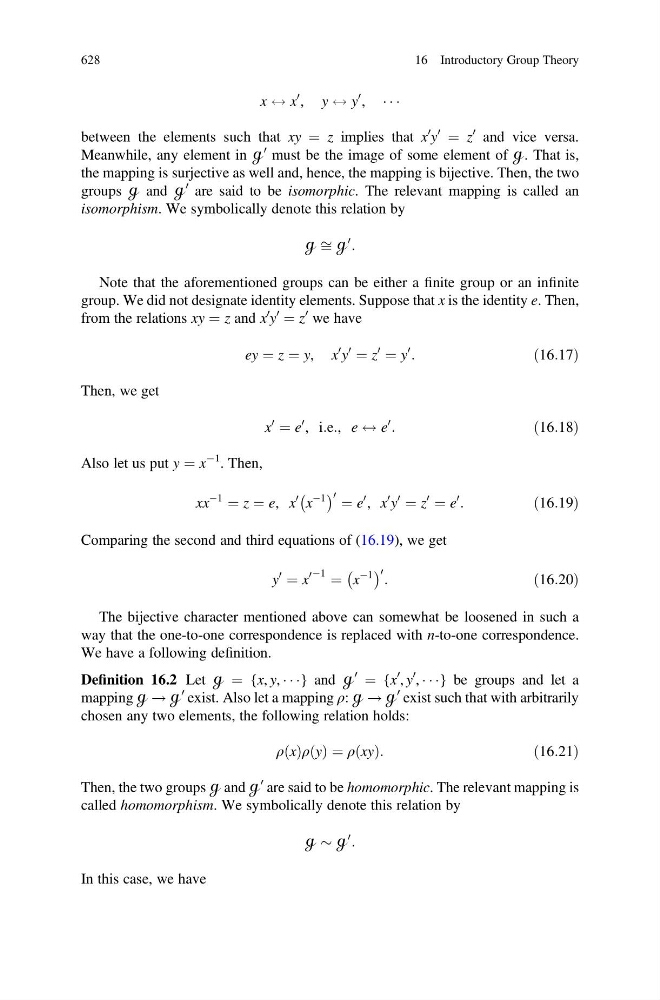
x $ x
0 , y $ y
0 , Á Á Á
between the elements such that xy ¼ z implies that x
0
y
0
¼ z
0 and vice versa.
Meanwhile, any element in ℊ
0 must be the image of some element of ℊ. That is,
the mapping is surjective as well and, hence, the mapping is bijective. Then, the two
groups ℊ and ℊ
0 are said to be isomorphic. The relevant mapping is called an
isomorphism. We symbolically denote this relation by
ℊ ffi ℊ
0
:
Note that the aforementioned groups can be either a finite group or an infinite
group. We did not designate identity elements. Suppose that x is the identity e. Then,
from the relations xy ¼ z and x
0
y
0
¼ z
0 we have
ey ¼ z ¼ y, x
0
y
0
¼ z
0
¼ y
0
:
ð16:17Þ
Then, we get
x
0
¼ e
0 , i:e:, e $ e
0
:
ð16:18Þ
Also let us put y ¼ x
À1 . Then,
xx
À1
¼ z ¼ e, x
0
x
À1
À Á 0 ¼ e
0 , x
0
y
0
¼ z
0
¼ e
0
:
ð16:19Þ
Comparing the second and third equations of (16.19), we get
y
0
¼ x
0 À1 ¼ x
À1
À Á 0 :
ð16:20Þ
The bijective character mentioned above can somewhat be loosened in such a
way that the one-to-one correspondence is replaced with n-to-one correspondence.
We have a following definition.
Definition 16.2 Let ℊ ¼ {x, y, Á Á Á} and ℊ
0
¼ {x
0 , y
0 , Á Á Á} be groups and let a
mapping ℊ ! ℊ
0 exist. Also let a mapping ρ: ℊ ! ℊ
0 exist such that with arbitrarily
chosen any two elements, the following relation holds:
ρ x
ð Þρ y
ð Þ ¼ ρ xy
ð Þ:
ð16:21Þ
Then, the two groups ℊ and ℊ
0 are said to be homomorphic. The relevant mapping is
called homomorphism. We symbolically denote this relation by
ℊ $ ℊ
0
:
In this case, we have
628
16 Introductory Group Theory