

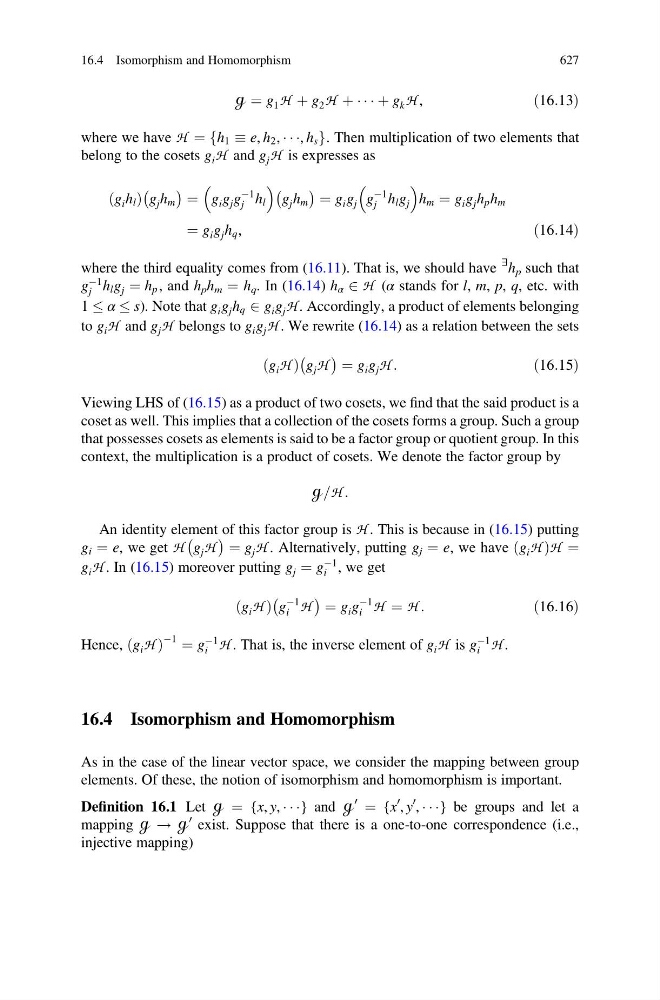
ℊ ¼ g 1 H þ g 2 H þ Á Á Á þ g k H ,
ð16:13Þ
where we have H ¼ h 1 e, h 2 , Á Á Á, h s
f
g . Then multiplication of two elements that
belong to the cosets g i H and g j H is expresses as
g i h l
ð Þ g j h m
À
Á ¼ g i g j g
À1
j h l
g j h m
À
Á ¼ g i g j g
À1
j h l g j
h m ¼ g i g j h p h m
¼ g i g j h q ,
ð16:14Þ
where the third equality comes from (16.11). That is, we should have
∃
h p such that
g
À1
j h l g j ¼ h p , and h p h m ¼ h q . In (16.14) h α 2 H (α stands for l, m, p, q, etc. with
1 α s). Note that g i g j h q 2 g i g j H . Accordingly, a product of elements belonging
to g i H and g j H belongs to g i g j H . We rewrite (16.14) as a relation between the sets
g i H
ð
Þ g j H
À
Á ¼ g i g j H :
ð16:15Þ
Viewing LHS of (16.15) as a product of two cosets, we find that the said product is a
coset as well. This implies that a collection of the cosets forms a group. Such a group
that possesses cosets as elements is said to be a factor group or quotient group. In this
context, the multiplication is a product of cosets. We denote the factor group by
ℊ=H :
An identity element of this factor group is H . This is because in (16.15) putting
g i ¼ e, we get H g j H
À
Á ¼ g j H . Alternatively, putting g j ¼ e, we have g i H
ð
ÞH ¼
g i H . In (16.15) moreover putting g j ¼ g
À1
i , we get
g i H
ð
Þ g
À1
i H
À
Á ¼ g i g
À1
i H ¼ H :
ð16:16Þ
Hence, g i H
ð
Þ
À1 ¼ g
À1
i H . That is, the inverse element of g i H is g
À1
i H .
16.4 Isomorphism and Homomorphism
As in the case of the linear vector space, we consider the mapping between group
elements. Of these, the notion of isomorphism and homomorphism is important.
Definition 16.1 Let ℊ ¼ {x, y, Á Á Á} and ℊ
0
¼ {x
0 , y
0 , Á Á Á} be groups and let a
mapping ℊ ! ℊ
0 exist. Suppose that there is a one-to-one correspondence (i.e.,
injective mapping)
16.4 Isomorphism and Homomorphism
627